
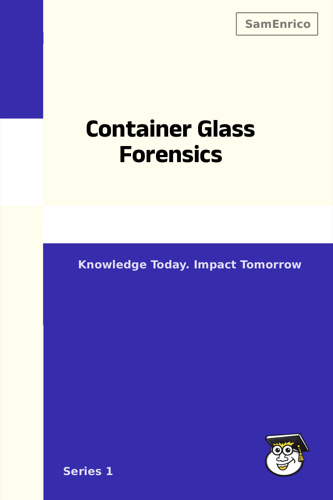
Non-FictionTrue CrimeContainer
Container Glass Forensics Audiobook
Bottle, jar, and drinking glass fragment evidence.
by Franz Kizzie
Bottle, jar, and drinking glass fragment evidence.
Formats
Free sample
Chapter 1: The Hidden Fragment--The detective held the manila evidence envelope like it contained a live grenade. Inside, suspended between two sheets of acetate, was a single shard of brown glass no larger than a grain of rice. It had been vacuumed from the cuff of a suspect's jacket three days after a brutal pub assault. The victim, a thirty-four-year-old warehouse worker, had sustained forty-seven lacerations to his face and scalp. He would require 112 stitches and would never regain full sensation in his left cheek.
The suspect, a forty-one-year-old regular at the same pub, claimed he had been standing ten feet away when the bottle was thrown. He said he had not touched anyone. He said he had no idea how the glass got on his jacket.The fragment would prove him wrong.This is the story of how a piece of glass smaller than a fingernail can send a person to prison for a decade. It is also the story of how the same type of evidence, mishandled or misinterpreted, can send an innocent person there instead. Container glass forensics sits at the intersection of materials science, crime scene investigation, statistical reasoning, and courtroom advocacy.
It is a discipline that has matured dramatically over the past thirty years, moving from simple visual comparisons ("the fragment looks like it came from a beer bottle") to laser ablation mass spectrometry that measures elemental concentrations down to parts per billion. Yet for all its technological sophistication, the core principle remains elegantly simple: glass that is physically, optically, and chemically indistinguishable from a broken container at a crime scene almost certainly came from that container.But "almost certainly" is not the same as "certainly." And understanding that difference is what this entire book is about.The Unique Forensic Value of Hollow Glassware Glass is one of the most common types of trace evidence recovered in serious crimes. According to data from the United Kingdom's Forensic Science Service (prior to its closure in 2012), glass appeared in approximately fifteen to twenty percent of all trace evidence casework involving burglary, assault, and homicide. The Federal Bureau of Investigation's National Integrated Ballistic Information Network does not track glass specifically, but internal studies from major metropolitan crime laboratories suggest similar prevalence rates in the United States. Why is glass so common?
Because it is everywhere, it breaks easily, and when it breaks, it produces fragments that transfer readily to clothing, skin…
This is the end of the free sample. Get the Audiobook to keep going. Buy now
About this book
Details
- Author
- Franz Kizzie
- Publisher
- SamEnrico
- Language
- English
- Genre
- Non-Fiction, True Crime, Container
- Released
- 2026-06-10
- Pages (approx.)
- 137
- Available as
- eBook, Audiobook

Listen in the VoxFlicks app
Audiobooks and audio dramas wherever you go. Sign in with your SamEnrico account and press play.
More by Franz Kizzie
 Social Media And Self ImageFranz Kizzie$11.99
 Grieving While Parenting OthersFranz Kizzie$11.99
 Performance Anxiety HypnosisFranz Kizzie$11.99
 The Mood and Micronutrient LinkFranz Kizzie$11.99
 EQ Success StoriesFranz Kizzie$11.99
 Religious Faith After Infant LossFranz Kizzie$11.99
 Anki Stats InterpretationFranz Kizzie$11.99
 The Accidental Insider: How a Kenyan University Student Uncovered a $100 Million FraudFranz Kizzie$11.99
 The Bloodied Silk Road: The Battle of Talas and the Birth of a SuperpowerFranz Kizzie$11.99
 How to Produce Scented OilFranz Kizzie$11.99
 Jack Russell Terrier: Tenacious & TirelessFranz Kizzie$11.99
 How to Produce Flea and Tick Control ProductsFranz Kizzie$11.99
You may also like
 Hong Kong Handover 1997Dunn Johnnie$11.99
 Zumba For Postnatal Recovery CourseNeal Christian$11.99
 Zumba for BeginnersLadner Nikia$11.99
 YouTube Comment Mining GuideHumes Pandora$12.99
 Worry Box MeditationCarlin Rudy$11.99
 Workplace Stress MeditationNguyen Lynn$11.99
 Workplace Stress and Sleep RepairHawley Ivory$11.99
 Workplace Perfectionism CureDelaney Jeffry$11.99
 Workplace Injustice Anger GuideWallen Isabelle$11.99
 Work Addiction and Burnout LinkGreenwood Ester$11.99
 Women in Yoga and WellnessBeattie Galina$11.99
 Women in Stand Up ComedyChun Evangeline$11.99