
Non-FictionBusiness BriefConsumer
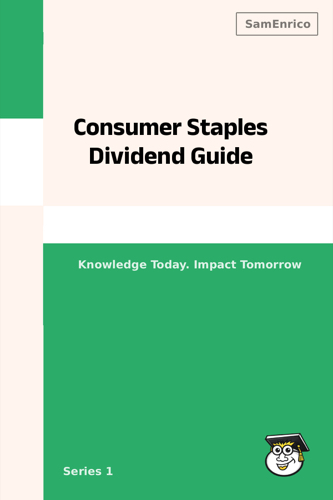
Consumer Staples Dividend Guide eBook
Focuses on defensive food, beverage, and household
by Parks Angie
Focuses on defensive food, beverage, and household product stocks.
Formats
Free sample
Chapter 1: The Boring Fortune--The most dangerous words in investing are not “market crash” or “bear market.” They are “this time is different.”Every decade, a new asset class promises to rewrite the rules of wealth. In the 1990s, it was dot-com startups with no earnings. In the 2000s, it was housing derivatives that supposedly eliminated risk. In the 2010s, it was cryptocurrencies and growth stocks trading at hundreds of times revenue. In the 2020s, it has been artificial intelligence and the Magnificent Seven.
And each time, investors abandoned boring, predictable businesses to chase the shiny new thing. Each time, many of them lost everything or spent years recovering.Meanwhile, a quiet fortune has been built by people who did something profoundly unexciting. They bought shares in companies that sell toothpaste, laundry detergent, ketchup, and toilet paper. They held those shares through booms and busts, wars and pandemics, inflation and deflation. They reinvested their dividends.
And they rarely, if ever, checked their portfolio with sweaty palms at 2 a.m.This book is about becoming that investor.The consumer staples sector—food, beverages, household products, personal care, and tobacco—is not glamorous. No one brags at a cocktail party about owning Procter & Gamble. No one gets interviewed on CNBC for holding Coca-Cola for twenty years. But that is precisely the point. The absence of excitement is the presence of reliability.
And in the world of dividend investing, reliability is the single most valuable currency.This chapter will explain why consumer staples are the foundation of any serious dividend portfolio, how their unique economic characteristics create durable wealth, and why the investor who embraces boring is often the one who sleeps best at night.The Great Misconception: Boring Does Not Mean Low Return Let us begin by destroying a myth. Many investors believe that avoiding risk means accepting low returns. They think that safe investments—government bonds, savings accounts, blue-chip dividend stocks—are for widows and orphans, not for serious wealth builders. This belief is not just wrong. It is dangerously wrong.Consider the following comparison.
From January 2000 through December 2024, the S&P 500 delivered an average annual total return of approximately 7.5 percent. During that same period, the consumer staples sector delivered approximately 8.2 percent. The so-called boring stocks actually outperformed the broader market over nearly a quarter of a century. And they did so with dramatically less volatility.But the real story is not about average returns. It is about what happened during the bad years.In 2008, when the financial system nearly collapsed, the S&P 500 fell 37 percent.
The consumer staples sector fell 18 percent. In 2020, when the pandemic shut down the global economy, the S&P 500 fell 34 percent from peak to trough in March. Staples fell 24 percent. In 2022, when inflation spooked the market and technology stocks were crushed, the S&P 500 fell 19 percent. The NASDAQ, heavy with growth stocks, fell 33 percent.
Consumer staples fell less than 3 percent and actually produced positive total returns when including dividends.This is not luck. This is structure.The Inelastic Demand Curve: Why You Keep Buying Every investor should understand the concept of elasticity. In economics, elasticity measures how much demand for a product changes when the price changes. For luxury goods—yachts, designer handbags, exotic vacations—demand is highly elastic. Raise the price by 10 percent, and demand might fall by 20 percent.
People delay purchases, buy used, or do without.For consumer staples, demand is inelastic. Highly inelastic.If the price of toothpaste rises by 10 percent, do you stop brushing your teeth? Of course not. You might grumble, you might clip a coupon, but you buy the toothpaste. If the price of laundry detergent rises, you still wash your clothes.
If the price of bread rises, you still eat. These are not optional purchases. They are biological and social necessities.This inelasticity has profound implications for investors. When a company sells products that people must buy regardless of price or economic conditions, that company has what Warren Buffett calls a protective moat. Competitors cannot easily steal customers by lowering prices because customers are not primarily price-sensitive.
The brand matters. The habit matters. The convenience matters.Consider your own behavior. When you walk down the grocery aisle for ketchup, do you carefully compare the price of Heinz to the store brand? Maybe sometimes.
But most people grab Heinz without thinking. That is brand loyalty. That is an economic moat. That is why Heinz has sold ketchup for over 150 years and why Kraft Heinz can raise prices without losing half its customers.The Pricing Power Premium Inelastic demand creates something even more valuable than stable revenue. It creates pricing power.Pricing power is the ability to raise prices faster than costs rise, thereby expanding profit margins over time.
In most industries, companies compete primarily on price. If your competitor lowers prices, you must follow or lose market share. This dynamic crushes profitability. It is why airlines, hotels, and commodity producers struggle to generate consistent returns.Consumer staples companies operate differently. They compete on brand, quality, habit, and distribution.
Price is secondary. This allows them to raise prices annually by 2 to 3 percent, slightly ahead of inflation, without losing meaningful market share. Over a decade, that 2 to 3 percent annual price increase compounds into significantly higher revenues and profits.Let us put numbers on this. A company with 30 percent profit margins that raises prices 2 percent per year while keeping costs flat increases its profit margin to 31.4 percent after one year, 34.5 percent after five years, and nearly 40 percent after a decade. That expansion flows directly to shareholders through higher dividends and stock prices.Pepsi Co provides a real-world example.
Between 2015 and 2024, the company increased its average selling price on beverages and snacks by roughly 25 percent cumulatively. Volume during that period remained essentially flat. Yet revenues grew by over 30 percent, and earnings per share grew by over 50 percent. The difference was pricing power combined with share buybacks. Customers paid more for the same Mountain Dew and Lay’s potato chips, and Pepsi turned that extra revenue into shareholder returns.This is not exploitation.
It is the natural result of building brands that consumers trust and prefer. And it is the reason consumer staples have outperformed the broader market over long periods despite growing more slowly than technology companies.Defensive vs. Aggressive: Understanding Beta Professional investors use a metric called beta to measure a stock’s volatility relative to the overall market. A beta of 1.0 means the stock moves exactly with the market. A beta above 1.0 means the stock is more volatile—it rises more in good times and falls more in bad times.
A beta below 1.0 means the stock is less volatile—it rises less in good times but falls much less in bad times.Technology stocks typically have betas between 1.2 and 1.8. They are aggressive. Consumer staples stocks typically have betas between 0.4 and 0.8. They are defensive.This has a mathematical consequence that many investors misunderstand. A stock with a beta of 0.5 that falls half as much as the market in a crash also rises half as much in a recovery.
Over a full market cycle, a portfolio of defensive stocks might produce slightly lower average returns than an aggressive portfolio. But the difference in volatility is…
This is the end of the free sample. Get the eBook to keep going. Buy now
About this book
Details
- Author
- Parks Angie
- Publisher
- SamEnrico
- Language
- English
- Genre
- Non-Fiction, Business Brief, Consumer
- Released
- 2026-06-09
- Pages (approx.)
- 139
- Available as
- eBook, Audiobook

Read better in the ZLOADR app
Your eBooks on your phone or tablet. Sign in with your SamEnrico account and start reading.
More by Parks Angie
 Grief and Pets After Child DeathParks Angie$11.99
 Distraction Proof Reading SystemParks Angie$11.99
 Backward Goal PlanningParks Angie$11.99
 Career Success Affirmations ManualParks Angie$11.99
 Norwegian Defense of King HaakonParks Angie$11.99
 Health Goal SettingParks Angie$11.99
 Burnout Recovery Massage TherapyParks Angie$11.99
 The Pen and the Podium: How Japanese Journalists Shaped Olympic History (1984-1996)Parks Angie$11.99
 Blood on the Olive Groves: The Siege of the AlcázarParks Angie$11.99
 How to Produce Wire and Cable Hand ToolsParks Angie$11.99
 Scholarship Application Tracking HandbookParks Angie$12.99
 I 9 Verification Trap GuideParks Angie$12.99
You may also like
 Hong Kong Handover 1997Dunn Johnnie$11.99
 Zumba For Postnatal Recovery CourseNeal Christian$11.99
 Zumba for BeginnersLadner Nikia$11.99
 YouTube Comment Mining GuideHumes Pandora$12.99
 Worry Box MeditationCarlin Rudy$11.99
 Workplace Stress MeditationNguyen Lynn$11.99
 Workplace Stress and Sleep RepairHawley Ivory$11.99
 Workplace Perfectionism CureDelaney Jeffry$11.99
 Workplace Injustice Anger GuideWallen Isabelle$11.99
 Work Addiction and Burnout LinkGreenwood Ester$11.99
 Women in Yoga and WellnessBeattie Galina$11.99
 Women in Stand Up ComedyChun Evangeline$11.99