
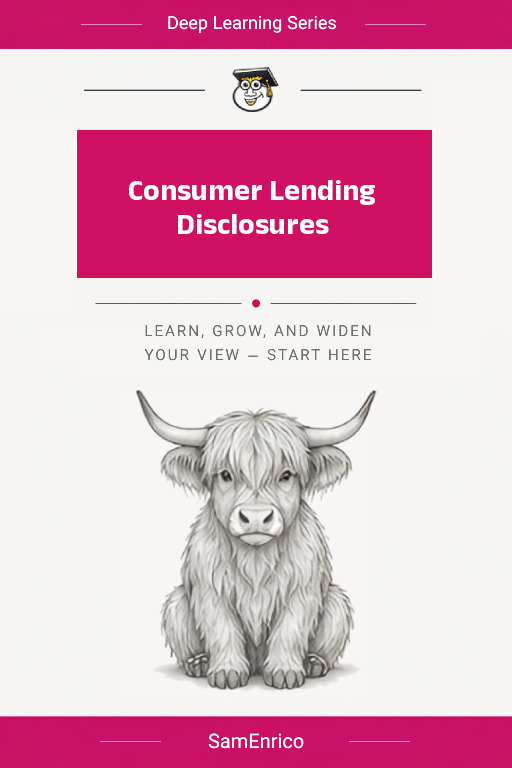
Non-FictionAnnual CheckupFintechTILA
Consumer Lending Disclosures eBook
Comply with TILA and Regulation Z disclosure requi
Comply with TILA and Regulation Z disclosure requirements for fintech consumer lending products.
Formats
Free sample
Chapter 1: The Billion-Dollar Typo--The year was 2019, and a promising fintech lender we will call “Fast Fund” had done everything right. They had raised 120millionin Series Cfunding,hiredageneralcounselfromatop−tierbank,andbuiltasleekmobileappthatcouldapprovea120 million in Series C funding, hired a general counsel from a top-tier bank, and built a sleek mobile app that could approve a 120millionin Series Cfunding,hiredageneralcounselfromatop−tierbank,andbuiltasleekmobileappthatcouldapprovea5,000 personal loan in under ninety seconds. Their engineering team was proud of the credit decisioning algorithm. Their product team celebrated a user experience that required only seven taps from launch to funding. Their compliance team had reviewed every disclosure template against Regulation Z.
The APR calculation was correct—or so they believed. Eighteen months later, a plaintiffs’ lawyer in the Southern District of New York filed a class action complaint alleging that Fast Fund had mis-disclosed the finance charge on every single loan they had ever originated. The alleged error? Two cents. Two cents per loan, on a portfolio of 1.2 million loans, resulting in statutory damages that could exceed 48millionbeforeaccountingforattorney’sfees.Thecasedidnotgototrial.Fast Fundsettledfor48 million before accounting for attorney’s fees.
The case did not go to trial. Fast Fund settled for 48millionbeforeaccountingforattorney’sfees.Thecasedidnotgototrial.Fast Fundsettledfor31 million and laid off 40 percent of its staff. The APR had been calculated correctly in absolute terms. The problem was not the math. The problem was what the math failed to include.This is the reality of consumer lending disclosures in the fintech era.
The Truth in Lending Act, known universally as TILA, was signed into law by President Lyndon B. Johnson on May 29, 1968, as part of the broader Consumer Credit Protection Act. It was a response to an era when lenders routinely buried interest rates in fine print, advertised “only $10 per month” without revealing that the loan would last seven years, and relied on consumers’ inability to compare costs across different credit products. TILA’s core innovation was radical for its time: before a consumer became obligated on a loan, the lender had to provide a standardized set of disclosures—the finance charge, the annual percentage rate, the payment schedule—in a format that allowed comparison shopping. The law was never meant to be easy for lenders.
It was meant to be clear for borrowers.But TILA was designed for paper. It assumed that disclosures would be printed on letter-sized paper, mailed to the consumer’s home, and signed with a pen. It assumed that “delivery” meant physical possession. It assumed that “clear and conspicuous” meant font size no smaller than ten points and placement on the front of a single page. It assumed that the consumer would have time—days, not seconds—to review the terms before deciding whether to borrow.
Fast-forward to the present. A consumer opens a fintech app, taps a button that says “Check my offer,” sees an approval screen with a large green “Accept Loan” button, and completes the transaction before finishing a cup of coffee. The entire customer journey from application to funding takes less than two minutes. The disclosure that TILA requires—the same disclosure that took pages of paper in 1968—must now fit on a smartphone screen, render correctly across fourteen different operating system versions, survive variable network latency, and still be “clear and conspicuous” under a standard written before the invention of the i Phone.This is the digital irony of TILA. The law’s purpose—ensuring that consumers understand the true cost of credit—is more urgent than ever.
The tools available to fulfill that purpose—interactive screens, real-time calculations, session replay logs, and personalized formatting—are more powerful than ever. Yet the gap between what the law requires and what fintechs actually deliver has never been wider. Enforcement actions are rising. Class action filings under TILA increased by 37 percent in 2024 compared to the prior year, according to a review of federal dockets. The Consumer Financial Protection Bureau (CFPB) has made disclosure formatting a formal examination priority for 2025 and 2026, with particular attention to mobile viewports and what regulators call “dark patterns”—design choices that technically display the required information but make it functionally invisible to a reasonable consumer.
The cost of getting disclosures wrong is no longer measured in compliance fines alone. It is measured in destroyed valuations, abandoned funding rounds, and entire companies that cease to exist.This book exists to ensure that your fintech is not the next Fast Fund. It is not a dry recitation of regulatory text. It is not a reference manual to be shelved next to the Code of Federal Regulations. It is an engineering and product management playbook for building disclosure systems that actually comply with TILA and Regulation Z in a mobile-first, real-time lending environment.
Every chapter answers two questions: What does the law require? And how must our code, user experience, APIs, and audit logs behave to prove compliance? The audience for this book is the integrated fintech team—legal, compliance, product management, engineering, and marketing—working together to build disclosures that protect consumers and survive regulatory scrutiny.Before we dive into the technical details of finance charge calculations, trigger terms, and rescission timelines, we must establish the foundational concepts that will appear in every subsequent chapter. This first chapter defines the core terminology of TILA, introduces the single most important standard in all of consumer lending disclosure law—the “clear and conspicuous” requirement—and explains why the shift from paper to pixels has fundamentally changed what compliance means. By the end of this chapter, you will understand why a disclosure that is technically correct can still be legally deficient, and why the difference between the two has already cost the fintech industry hundreds of millions of dollars.The Architecture of Truth in Lending The Truth in Lending Act is codified at 15 U.S.C.
§§1601 et seq., but the operative rules that most fintechs need to follow live in Regulation Z, which is Title 12, Part 1026 of the Code of Federal Regulations. This structure matters because Congress writes the broad statute, but the Consumer Financial Protection Bureau—which inherited TILA rulemaking authority from the Federal Reserve Board after the Dodd-Frank Act of 2010—writes the detailed implementing regulations. When a fintech violates Regulation Z, it has violated TILA. The two are functionally inseparable for compliance purposes.The threshold question for any lending product is whether TILA applies at all. The answer, for almost all consumer-facing fintech lending products, is yes.
TILA applies to any person who regularly extends consumer credit—defined as credit offered or extended to a natural person primarily for personal, family, or household purposes—and who does so subject to a finance charge or by written agreement in more than four installments. This captures virtually every fintech making personal loans, credit cards, buy now pay later products with fees, earned wage access products with membership charges, and even certain overdraft programs. The only significant exemptions are for business loans, loans above $69,500 that are not secured by real estate (a threshold that is adjusted annually and rarely relevant to mainstream fintech products), and certain very small or infrequent lending arrangements. If your fintech moves money to consumers and charges a fee or interest, you should assume TILA applies until proven otherwise.Once TILA applies, the lender must…
This is the end of the free sample. Get the eBook to keep going. Buy now
About this book
Details
- Author
- Galarza Lovie
- Publisher
- SamEnrico
- Language
- English
- Genre
- Non-Fiction, Annual Checkup, Fintech, TILA
- Released
- 2026-06-01
- Pages (approx.)
- 158
- Available as
- eBook, Audiobook

Read better in the ZLOADR app
Your eBooks on your phone or tablet. Sign in with your SamEnrico account and start reading.
More by Galarza Lovie
 Dental Health Longevity GuideGalarza Lovie$11.99
 Paraphilia Recovery PrimerGalarza Lovie$11.99
 Construction Insurance Agency ListGalarza Lovie$11.99
 Loving Kindness for Financial Stress WorkbookGalarza Lovie$11.99
 Breath Awareness for Arthritis PainGalarza Lovie$11.99
 The Gobi's Whisper: Unearthing Dinosaurs in the Desert SeaGalarza Lovie$11.99
 The Last Broadcast: The Mysterious Case of Orson Welles' War of the WorldsGalarza Lovie$11.99
 How to Become a Spike-machine HeaterGalarza Lovie$11.99
 Understanding Dental CariesGalarza Lovie$17.99
 Turkish Student Visa RenewalGalarza Lovie$12.99
 Principal Software DeveloperGalarza Lovie$11.99
You may also like
 Hong Kong Handover 1997Dunn Johnnie$11.99
 Zumba For Postnatal Recovery CourseNeal Christian$11.99
 Zumba for BeginnersLadner Nikia$11.99
 YouTube Comment Mining GuideHumes Pandora$12.99
 Worry Box MeditationCarlin Rudy$11.99
 Workplace Stress MeditationNguyen Lynn$11.99
 Workplace Stress and Sleep RepairHawley Ivory$11.99
 Workplace Perfectionism CureDelaney Jeffry$11.99
 Workplace Injustice Anger GuideWallen Isabelle$11.99
 Work Addiction and Burnout LinkGreenwood Ester$11.99
 Women in Yoga and WellnessBeattie Galina$11.99
 Women in Stand Up ComedyChun Evangeline$11.99