
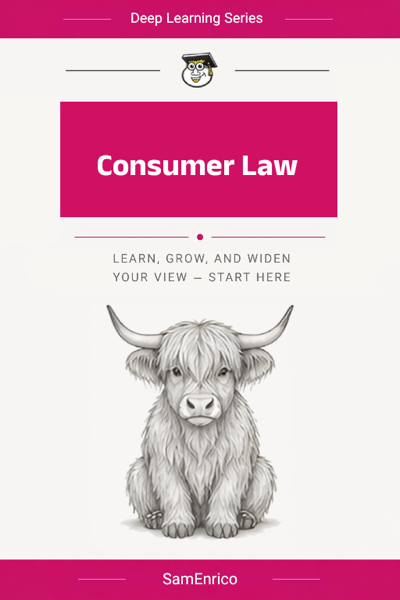
Consumer Law eBook
A Coursebook on Consumer Law
by Kern Lyman
A Coursebook on Consumer Law
Formats
Free sample
Chapter 1: The Fine Print Trap--–- You are about to sign something. Maybe it is a new credit card agreement, a subscription for a streaming service, a rental lease, or a thirty-page terms-of-service page that you will scroll through without reading a single word. In the next sixty seconds, a company will almost certainly ask you to bind yourself to a contract. You will click “I agree,” or sign your name, or simply open a shrink-wrapped box. And in that moment, you will surrender rights you did not know you had, agree to terms you cannot understand, and waive remedies that took centuries of law to create.This is not an accident.
It is a system. And this book is the antidote.Consumer law is not a dusty corner of legal academia reserved for lawyers and compliance officers. It is the set of rules that determines whether you can be sued for a debt you do not owe, whether your new car must actually run, whether a debt collector can call your employer and threaten arrest, and whether the fine print on a website can strip away your right to a jury trial. Every day, ordinary people lose thousands of dollars because they do not know the three or four fundamental principles that would flip the power balance entirely. This chapter, and the eleven that follow, will teach you those principles.But before we dive into statutes, cases, and remedies, we must understand the problem at its most basic level.
Why does consumer law exist as a separate field? Why is it not simply contract law with a different label? And why do the most powerful corporations in the world spend millions of dollars on compliance if consumers have so few rights?The answers lie in three concepts that every consumer should tattoo on the inside of their forearm: information asymmetry, unequal bargaining power, and market failure. These are not abstract economic terms. They are the rationales that justify every consumer protection statute from the FTC Act to the Fair Debt Collection Practices Act to the Dodd-Frank Wall Street Reform Act.
Understand these three ideas, and you will understand the architecture of every rule in this book.The Three Pillars of Consumer Protection Information Asymmetry: Why Sellers Know More Than You Imagine walking onto a used car lot. The seller has been selling cars for fifteen years. They have access to vehicle history databases, wholesale price guides, and mechanical inspection reports. They know which cars have hidden flood damage, which odometers have been rolled back, and which models are notorious for transmission failure. You, the buyer, have a smartphone and a gut feeling.
This imbalance of information is not accidental; it is structural to almost every consumer transaction.Information asymmetry means that the seller almost always knows more about the product or service than the buyer does. The seller knows the true cost of manufacturing, the likelihood of defects, the hidden fees buried in the fine print, and the probability that a warranty claim will be denied. The consumer knows only what the seller chooses to disclose. This creates an obvious opportunity for exploitation: sellers can withhold negative information, exaggerate positive attributes, or design contracts that appear fair on the surface but contain devastating surprises on page seventeen.Consumer law responds to information asymmetry primarily through disclosure requirements. The Truth in Lending Act (TILA) forces lenders to disclose the Annual Percentage Rate (APR) in a standardized format so that consumers can compare credit offers.
The Fair Credit Reporting Act (FCRA) requires credit bureaus to give consumers access to their credit files and dispute inaccurate information. The Consumer Leasing Act mandates clear disclosures for lease terms that would otherwise be buried in fine print. But disclosure has limits. A mountain of paperwork can be just as obscuring as a blank page. As one federal judge famously observed, the average consumer would need a law degree and a week of study to understand the disclosures that accompany a mortgage closing.
Thus, consumer law also uses substantive protections that go beyond mere disclosure: prohibitions on deceptive acts, unconscionable terms, and unfair practices that no amount of fine print can legitimate.Unequal Bargaining Power: Why You Cannot Say No The second pillar is unequal bargaining power. In theory, contracts are voluntary agreements between equals. In reality, most consumer contracts are contracts of adhesion – take-it-or-leave-it forms presented by a party with vastly greater power. Have you ever tried to negotiate the terms of your cell phone contract? Your credit card agreement?
The terms of service for a banking app? Of course not. You cannot. The company presents a pre-printed, non-negotiable document, and your only choice is to sign or walk away. And often, walking away is not a real option.
You need a phone. You need a bank account. You need a car to get to work.Unequal bargaining power matters because it undermines the moral foundation of contract law: the idea that both parties voluntarily consented to mutually beneficial terms. When one party has no realistic alternative, consent becomes a fiction. Consumer law responds by policing the substance of contracts, not just the process of formation.
The doctrine of unconscionability, codified in UCC 2-302, allows courts to refuse to enforce contract terms that are so one-sided that they “shock the conscience.” A furniture store that retains a security interest in every item a consumer has ever purchased until the last item is paid off – the infamous Williams v. Walker-Thomas Furniture case – is not engaging in fair dealing, even if the consumer signed on the dotted line. Similarly, class action waivers buried in arbitration clauses are scrutinized not because the consumer could have negotiated, but because no real negotiation ever occurred.Market Failure: When Competition Does Not Protect You The third pillar is market failure. Classical economics assumes that competitive markets protect consumers: if one seller charges too much or sells shoddy goods, another seller will undercut them, and consumers will vote with their wallets. This works reasonably well for simple, repeat purchases where quality is easily observable.
It fails dramatically for complex products, essential services, and transactions where harm is delayed or diffuse.Think about a mortgage. By the time you discover that the loan was predatory – hidden fees, exploding interest rates, negative amortization – you have already signed, already bought the house, and already lost your ability to shop elsewhere. The market cannot correct this failure because the consumer cannot learn from experience without suffering catastrophic harm. Similarly, credit reporting errors affect millions of people, but no single consumer has the leverage to force Equifax or Trans Union to correct systemic problems. The market will not spontaneously generate accurate credit reports because the credit bureaus profit from selling information, not from ensuring its accuracy.Consumer law addresses market failures through regulation and enforcement.
The FTC and CFPB have authority to investigate industry-wide practices, issue rules, and impose civil penalties. State Attorneys General can bring parens patriae actions on behalf of all citizens. And class actions allow thousands of consumers with small individual claims to aggregate their damages and sue collectively. Without these mechanisms, many consumer injuries would never be redressed because no single person…
This is the end of the free sample. Get the eBook to keep going. Buy now
About this book
Details
- Author
- Kern Lyman
- Publisher
- SamEnrico
- Language
- English
- Genre
- Non-Fiction, Informative, Educational
- Released
- 2026-05-06
- Pages (approx.)
- 152
- Available as
- eBook, Audiobook

Read better in the ZLOADR app
Your eBooks on your phone or tablet. Sign in with your SamEnrico account and start reading.
More by Kern Lyman
 The Learning Disability AccommodationKern Lyman$11.99
 Medical Relapse Prevention Laboratory MonitoringKern Lyman$11.99
 Curie Paris Institute FoundingKern Lyman$11.99
 Breaking Sugar Addiction Recovery GuideKern Lyman$11.99
 Writing Effective Remote EmailsKern Lyman$11.99
 Chronic Illness Parent ChildhoodKern Lyman$11.99
 Fast Food Drive Through UrgeKern Lyman$11.99
 Anticipatory Grief JournalKern Lyman$11.99
 Autophagy Growth Hormone BalanceKern Lyman$11.99
 The Forgotten Navigator: Abel Tasman and the First European Sightings of Australia and New ZealandKern Lyman$11.99
 Pets.com: The Balloon That BurstKern Lyman$11.99
 The Bloodhound and the Billionaire: How a Dog Solved the Case of the Missing Mona LisaKern Lyman$11.99