
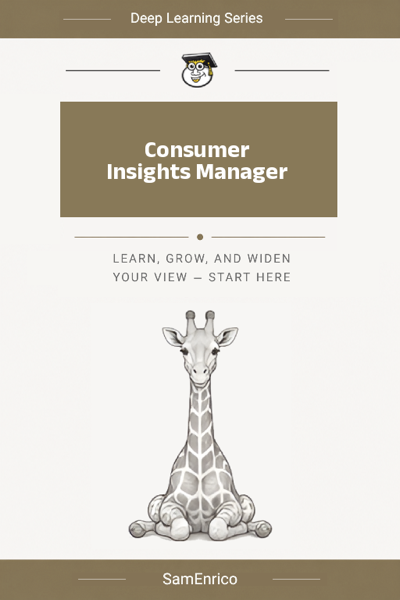
Non-FictionInformativeEducational
Consumer Insights Manager eBook
A Coursebook on Consumer Insights Manager
by Guinn Tonda
A Coursebook on Consumer Insights Manager
Formats
Free sample
Chapter 1: The $3 Billion Mistake--–- In 2004, Blockbuster had 60,000 employees, 9,000 stores, and $6 billion in annual revenue. Netflix had 500 employees, no stores, and was bleeding cash so heavily that its own shareholders doubted it would survive another year. By every conventional measure, Blockbuster was the undisputed king of home entertainment, and Netflix was a niche experiment that would soon be crushed or acquired.Yet within six years, Blockbuster was bankrupt. Netflix was worth over $30 billion.What happened? The answer is not what you think.
It was not about technology alone. Blockbuster could have built a streaming service. It was not about price. Blockbuster could have matched Netflix’s subscription model. It was not about selection.
Blockbuster’s physical inventory dwarfed Netflix’s early DVD catalog.The difference was something far more fundamental, and far more invisible.Blockbuster had data. Netflix had insight.This distinction is the entire premise of this book, and if you remember nothing else from these pages, remember this: data tells you what happened. Analytics tells you where patterns exist. But insight—true, actionable, non-obvious insight—tells you why consumers behave the way they do. And the why is where fortunes are made and lost.The Data Trap: How Blockbuster Saw Everything and Understood Nothing Let us step inside Blockbuster’s corporate headquarters in 2004.
The data team produces four hundred page reports on rental trends. They know exactly how many copies of There’s Something About Mary were rented in Des Moines on any given Tuesday. They know which genres perform best in which seasons. They know that late fees generate nearly $800 million annually in pure profit. They know that customers complain about late fees constantly, but they also know that customers pay them.The data is clean, comprehensive, and completely misleading.Because here is what the data never told Blockbuster’s executives: customers were not renting movies.
They were renting control over their Saturday night. When a family drove fifteen minutes to Blockbuster, spent twenty minutes searching the aisles, and discovered that the one movie everyone agreed on was already checked out, they felt something. That something was not mild inconvenience. It was a small, quiet humiliation. They had failed at the simple task of securing entertainment for their family.Then, when they returned the movie they settled for—the one nobody really wanted to watch—and were charged a late fee because life got in the way, that humiliation turned into resentment.Netflix understood none of this from data.
They understood it from insight. Reed Hastings, Netflix’s co-founder, has famously recounted that the idea came after he was charged $40 in late fees for Apollo 13. But the deeper insight was not about late fees. It was about what late fees represented. They represented a power imbalance: the store controlled your money, your time, and your choices.
Netflix offered the opposite: no due dates, no late fees, no trips to the store, and a recommendation engine that got better the more you used it.Control. Autonomy. Respect for the customer’s time and intelligence.Those were the insights that data alone could never reveal.The Three Layers of Knowing Your Customer Most organizations believe they are customer-centric. Most are wrong. They mistake customer data for customer understanding, and they mistake customer understanding for customer insight.
These are three distinct layers, and moving from one to the next is the entire job of a Consumer Insights Manager.Let me define them clearly, because these definitions will anchor every chapter that follows.Layer One: Market Research answers the question what happened?Market research is retrospective. It counts, measures, and reports. Sales dropped five percent last quarter. Customer satisfaction scores are flat. Brand awareness is up among women aged twenty-five to thirty-four.
This information is necessary but not sufficient. It tells you where you have been, not where you are going. It describes symptoms, not causes. A doctor who only takes your temperature but never asks how you feel is practicing market research.Layer Two: Data Analytics answers the question what patterns exist?Data analytics identifies correlations, clusters, and trends. Users aged eighteen to twenty-four churn at twice the rate of older users.
Customers who buy running shoes are seventy percent more likely to buy fitness trackers within thirty days. Premium subscribers open emails at three times the rate of free tier users. These patterns are valuable. They help you predict behavior and allocate resources. But they do not explain why the patterns exist.
Correlation is not causation, and patterns without explanation are like a map with no landmarks.Layer Three: Consumer Insights answers the question why does this happen?Consumer insights explain the emotional, cognitive, and social drivers beneath the patterns. Young users churn not because they are young, but because they feel the app does not respect their privacy. Running shoe buyers purchase fitness trackers not because of cross-selling algorithms, but because they are constructing an identity as a health-conscious person. Premium subscribers open emails because they have already made a psychological commitment to the brand and are seeking confirmation that they made the right choice.Insights are non-obvious. They are actionable.
They combine emotional drivers, empirical evidence, and strategic relevance. And they are the only layer that allows you to change behavior rather than merely describe it.Here is a unified definition that will appear throughout this book:An insight is a non-obvious, actionable explanation of consumer behavior that combines emotional drivers, empirical evidence, and strategic relevance.Write that down. Tape it to your monitor. Because the rest of this book is about how to generate, validate, and activate insights that meet this definition.The Three Questions of Customer Orientation If insights are the answer, you first need the right questions. Every Consumer Insights Manager should carry three questions in their pocket, asked in order, answered with evidence, and revisited constantly.Question One: Who is the customer, beyond demographics?Demographics are lazy shortcuts.
"Women aged twenty-five to thirty-four" tells you nothing about what these women want, fear, hope for, or struggle with. The real answer to "who is the customer" requires ethnographic depth, psychological nuance, and a willingness to be surprised.Consider the difference between two customers who share identical demographics. Both are thirty-year-old urban professionals with graduate degrees and six-figure incomes. One buys a Tesla because she sees herself as an environmental pioneer. The other buys a Tesla because he wants strangers to know he is successful.
One is motivated by collective responsibility, the other by status signaling. Same demographic. Completely different consumers.Knowing who means knowing the identity, values, reference groups, and emotional triggers that actually drive behavior. This is the domain of qualitative research (Chapter 6) and psychological frameworks (Chapters 3 and 4).Question Two: What do they truly value, not just what they say?This is the question that separates successful insights managers from everyone else. What consumers say they value and what they actually value are rarely the same.
When surveyed, most car buyers say safety is their top priority. Yet the same buyers happily purchase vehicles with lower safety ratings if those vehicles have better acceleration or more luxurious interiors. They are not lying. They are telling you what they believe about themselves. But beliefs…
This is the end of the free sample. Get the eBook to keep going. Buy now
About this book
Details
- Author
- Guinn Tonda
- Publisher
- SamEnrico
- Language
- English
- Genre
- Non-Fiction, Informative, Educational
- Released
- 2026-06-02
- Pages (approx.)
- 149
- Available as
- eBook, Audiobook

Read better in the ZLOADR app
Your eBooks on your phone or tablet. Sign in with your SamEnrico account and start reading.
More by Guinn Tonda
 Gambling Addiction and ForgivenessGuinn Tonda$11.99
 Africa Talent Migration OutlookGuinn Tonda$11.99
 Work Addiction and Chronic Fatigue GuideGuinn Tonda$11.99
 Moderate Calorie RestrictionGuinn Tonda$11.99
 The Zion Order Escape MemoirGuinn Tonda$11.99
 Enki’s Great Deception: The God Who Stole the MeGuinn Tonda$11.99
 Understanding Leptomeningeal Capillary Venous AngiomatosisGuinn Tonda$17.99
 Real Estate Debt Markets GuideGuinn Tonda$12.99
 One Page Product Launch PrimerGuinn Tonda$12.99
 How to Start a Chain Saw Parts Business (Beginners Guide)Guinn Tonda$11.99
You may also like
 Hong Kong Handover 1997Dunn Johnnie$11.99
 Zumba For Postnatal Recovery CourseNeal Christian$11.99
 Zumba for BeginnersLadner Nikia$11.99
 YouTube Comment Mining GuideHumes Pandora$12.99
 Worry Box MeditationCarlin Rudy$11.99
 Workplace Stress MeditationNguyen Lynn$11.99
 Workplace Stress and Sleep RepairHawley Ivory$11.99
 Workplace Perfectionism CureDelaney Jeffry$11.99
 Workplace Injustice Anger GuideWallen Isabelle$11.99
 Work Addiction and Burnout LinkGreenwood Ester$11.99
 Women in Yoga and WellnessBeattie Galina$11.99
 Women in Stand Up ComedyChun Evangeline$11.99