
Non-FictionBusiness BriefAlternative Structures
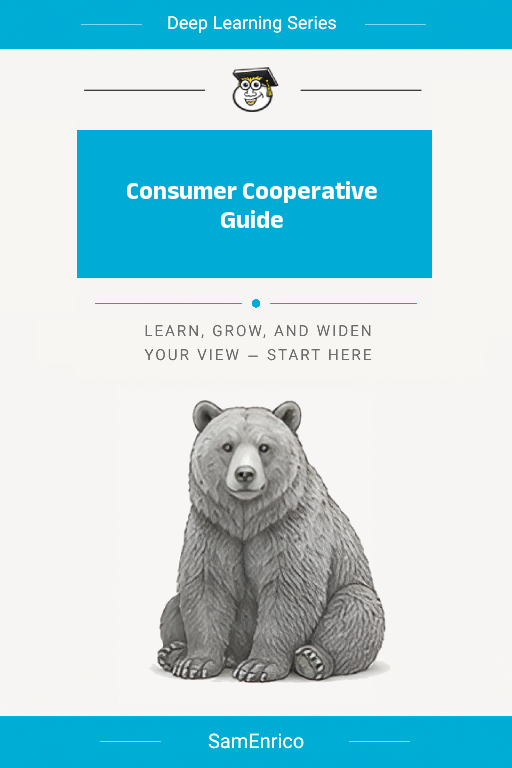
Consumer Cooperative Guide eBook
Form consumer cooperatives for bulk purchasing. Lo
Form consumer cooperatives for bulk purchasing. Lower prices for members on household goods.
Formats
Free sample
Chapter 1: The First Purchase...--The garage smelled like old lawn furniture and the faint, hopeful scent of lemon cleaner that Maria had sprayed on the folding table an hour earlier. It was a Tuesday evening in November, and she had exactly seventeen minutes to transform this cluttered two-car space into the first distribution hub for what she was calling, with cautious optimism, the "Phoenix Family Co-op."Three hours earlier, she had returned from Costco with a truck bed full of items she had never bought in these quantities before: a 25-pound bag of basmati rice, a 10-pound box of laundry powder that looked like it belonged in a commercial kitchen, six gallons of olive oil, and 864 individual coffee pods arranged in a box so heavy she had to drag it across the driveway. The receipt was $847. Normally, that much money on groceries would have triggered a small anxiety attack. Tonight, it felt like an investment.Seventeen families had committed to this experiment.
Each had paid 50intowhattheywerecalling"the Kitty"–asharedfundthat Mariamanagedthroughashared Google Sheetandalotoftrust.Inreturn,eachfamilywouldpickuptheirshareofthebulkgoodstonight,atpricesthataveraged34percentlowerthanwhattheywouldhavepaidatthesupermarket.For Maria,asinglemotheroftwowhohadwatchedhermonthlygrocerybillclimbfrom50 into what they were calling "the Kitty" – a shared fund that Maria managed through a shared Google Sheet and a lot of trust. In return, each family would pick up their share of the bulk goods tonight, at prices that averaged 34 percent lower than what they would have paid at the supermarket. For Maria, a single mother of two who had watched her monthly grocery bill climb from 50intowhattheywerecalling"the Kitty"–asharedfundthat Mariamanagedthroughashared Google Sheetandalotoftrust.Inreturn,eachfamilywouldpickuptheirshareofthebulkgoodstonight,atpricesthataveraged34percentlowerthanwhattheywouldhavepaidatthesupermarket.For Maria,asinglemotheroftwowhohadwatchedhermonthlygrocerybillclimbfrom680 to $940 over the past eighteen months, that 34 percent wasn't just a discount. It was the difference between saying yes to her daughter's field trip and saying no.But as she stood in the garage, staring at the mountain of goods, she realized something that no You Tube video or online forum had prepared her for: *She had no idea how to divide a 25-pound bag of rice into seventeen equal portions without making a mess that would haunt her for weeks.*This is the moment where most buying clubs die.The Invisible Graveyard of Good Intentions Across the United States, thousands of informal buying clubs are formed every year. A group of neighbors, coworkers, or fellow parents at a school decides to "pool their Costco runs." Someone volunteers to pick up the goods.
Everyone sends money via Venmo. For the first two months, it feels like a miracle. The savings are real. The sense of community is genuine. People high-five in the parking lot.Then, around month three, something breaks.The volunteer who has been doing all the work stops responding to texts.
The Venmo requests get ignored by one person, then two, then five. A bag of avocados goes bad because no one claimed them. Someone accuses someone else of taking more than their share of the toilet paper. The Whats App group goes silent. Within six months, 80 percent of informal buying clubs have dissolved, according to a 2021 study from the University of Wisconsin's Center for Cooperatives.Maria almost became that statistic.
She had tried this once before, two years ago, with a different group of neighbors. That attempt lasted exactly four months. The first two months were glorious. The third month, two families moved away without paying their final share. The fourth month, the remaining members got into a passive-aggressive argument about whether the organic olive oil was "worth the extra cost." Maria ended up eating $127 of unpaid-for lentils.
She told herself she would never organize anything again.But inflation had other plans.Why "Just Splitting the Cost" Never Works The reason most buying clubs fail is not because people are lazy or selfish, although those traits certainly accelerate the process. The reason is structural. Informal buying clubs operate on goodwill and social pressure, which are renewable resources only until they are exhausted. Every time the organizer has to remind someone to pay, a small amount of goodwill burns away. Every time someone takes more than their share, a small amount of trust evaporates.
After a few months, the emotional ledger is overdrawn.The solution is not better people. The solution is better rules.This chapter is about the four rules that transform a fragile buying club into a durable consumer cooperative. These rules are not new. They were written down in 1844 by a group of 28 weavers in a small town in northern England called Rochdale. Those weavers had tried and failed at cooperative buying multiple times before.
Their first two attempts collapsed because of debt, distrust, and disorganization. Their third attempt – the one that finally worked – succeeded not because they had better intentions, but because they wrote down a set of principles that protected the group from its own worst impulses.Those principles, slightly adapted for the 21st century, are the difference between Maria's failed buying club and her successful cooperative. Let me tell you what she learned the hard way.The Rule of Open Doors The first Rochdale principle is the easiest to understand and the hardest to practice. It is called open membership, and it means exactly what it sounds like: anyone who wants to join the cooperative can join, regardless of their background, income, or how much they plan to buy.This sounds obvious. Of course a buying club should be open to anyone.
But here is where it gets tricky. When Maria formed her first buying club, she started with a group of friends. They were all similar: similar income, similar taste in olive oil, similar schedules. That worked fine until one of the friends invited her sister, who had a very different income level and a very different idea of what "household essentials" meant. The sister bought mostly generic brands and asked if the co-op could source cheaper toilet paper.
The original members felt uncomfortable. Instead of having a conversation, they quietly excluded the sister from the next order. The sister told her friend. The friend felt hurt. The group fractured.The Rochdale weavers understood this dynamic intuitively.
If a cooperative is only open to people who are already like you, it will eventually shrink into irrelevance. Open membership means actively welcoming people who are different – different incomes, different preferences, different schedules – and then building systems that work for everyone, not just the original members.For Maria's second attempt, she made open membership explicit. Her member agreement (you can find the template in the Appendix) states that any household in the Phoenix area can join by paying the monthly dues and agreeing to the pickup schedule. There is no application process, no "voting on new members," no waiting period. If you pay your dues and show up on distribution day, you are in.This created an unexpected benefit.
When three new families joined in month four, the original members did not feel threatened. The rules applied equally to everyone. The open door became a source of strength, not anxiety.The practical takeaway: In your first meeting (see Appendix Template 3), explicitly state that membership is open to any household that agrees to the bylaws. Remove any language about "approving" new members. If you find yourself wanting to exclude someone, ask yourself whether…
This is the end of the free sample. Get the eBook to keep going. Buy now
About this book
Details
- Author
- Mclaurin Micaela
- Publisher
- SamEnrico
- Language
- English
- Genre
- Non-Fiction, Business Brief, Alternative Structures
- Released
- 2026-05-29
- Pages (approx.)
- 148
- Available as
- eBook, Audiobook

Read better in the ZLOADR app
Your eBooks on your phone or tablet. Sign in with your SamEnrico account and start reading.
More by Mclaurin Micaela
 U Boat Veterans ReunionsMclaurin Micaela$11.99
 Anger for LawyersMclaurin Micaela$11.99
 Forgiving Your Spouse Daily GuideMclaurin Micaela$11.99
 Work Addiction Recovery 12 StepsMclaurin Micaela$11.99
 The Robotics Industry Capital GuideMclaurin Micaela$11.99
 The Sweet Science of Love: Jenner and the Vaccine that Saved the WorldMclaurin Micaela$11.99
 Polyvagal Micro Break GuideMclaurin Micaela$12.99
 Understanding Spondyloepimetaphyseal Dysplasia Congenita, StrudwMclaurin Micaela$17.99
 How to Start a Dog Lead Made of Leather Business (Beginners Guide)Mclaurin Micaela$11.99
 Archive Digitization SpecialistMclaurin Micaela$11.99
You may also like
 Hong Kong Handover 1997Dunn Johnnie$11.99
 Zumba For Postnatal Recovery CourseNeal Christian$11.99
 Zumba for BeginnersLadner Nikia$11.99
 YouTube Comment Mining GuideHumes Pandora$12.99
 Worry Box MeditationCarlin Rudy$11.99
 Workplace Stress MeditationNguyen Lynn$11.99
 Workplace Stress and Sleep RepairHawley Ivory$11.99
 Workplace Perfectionism CureDelaney Jeffry$11.99
 Workplace Injustice Anger GuideWallen Isabelle$11.99
 Work Addiction and Burnout LinkGreenwood Ester$11.99
 Women in Yoga and WellnessBeattie Galina$11.99
 Women in Stand Up ComedyChun Evangeline$11.99