
Non-FictionBusiness BriefUtilityBudget
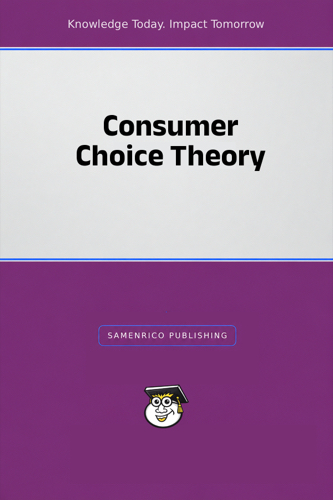
Consumer Choice Theory eBook
Model how consumers maximize utility given budget
by Mckeever Sam
Model how consumers maximize utility given budget constraints.
Formats
Free sample
Chapter 1: The Invisible Cage--–- Imagine for a moment that you are being watched. Not by a camera or a government agency, but by something far more intimate and inescapable. Every morning, when you hesitate between the blue sweater and the gray one, something records your choice. Every evening, when you scroll past the $4.99 app upgrade or linger on the $1,200 designer handbag, something takes note. When you decide to cook dinner rather than order delivery, when you transfer money to savings or leave it in checking, when you choose the aisle seat over the window—something is there, silently documenting.
That "something" is not a spy. It is not a marketer's algorithm, though those certainly exist. It is the hidden structure of your own preferences, the invisible cage of your budget, and the relentless logic of choice that economists have spent two centuries reverse-engineering.This book is about that cage. More importantly, it is about how to see it, how to map its bars, and—perhaps most critically—how to recognize that you are not the prisoner you think you are. The cage of consumer choice is real.
It is made of money, time, information, and biology. But unlike a literal cage, this one becomes more spacious the better you understand it. Every chapter of this book will hand you a new tool for seeing the invisible constraints that shape your daily decisions, for understanding why you want what you want, and for making those wants work for you rather than against you.Let us start with a story.The Coffee Conundrum Sarah is a 34-year-old marketing manager in Chicago. She earns $68,000 a year. After taxes, retirement contributions, and health insurance premiums, her monthly take-home pay is $3,950.
She is not rich, but she is not struggling either. Yet every month, without fail, Sarah finds herself staring at her bank balance on the 28th, wondering where the money went.Here is what Sarah buys each weekday morning: a large latte from the café next to her office. Sometimes she adds a breakfast sandwich. Total: $7.85. On weekends, she makes coffee at home.
That is $0.72 per cup. So her weekly coffee spending is $39.25 (five weekdays) plus $1.44 (two weekend days) for a total of $40.69. Monthly coffee spending: approximately $163. Annually: nearly $2,000.Sarah knows this. She has done the math.
She has read the personal finance articles that call the daily latte "the silent wealth killer." She has tried to stop. She bought a reusable thermos. She ground her own beans. For three weeks, she succeeded. Then a morning came when she had slept poorly, when her train was delayed, when her boss had already sent three emails by 7:45 AM.
She stopped at the café. The latte was warm and familiar and, for ten minutes, comforting. And then she was back to the old habit.Here is what a traditional economist would say about Sarah: She is irrational. She has revealed a preference for the latte (by buying it) but also a desire to save money (by trying to stop). These preferences are inconsistent.
If she truly valued saving $2,000 per year, she would simply stop buying lattes. Since she does not stop, she must not really value saving that money. Case closed.Here is what this book will teach you to say about Sarah: She is not irrational at all. She is a human being navigating a complex web of competing desires, biological impulses, social pressures, and cognitive limitations. The rational choice model—which we will spend most of this book building—does not call Sarah irrational.
It calls her a normal consumer who faces trade-offs that are far more interesting than the latte itself.To understand why, we have to open the "black box" of consumer choice.The Black Box For most of human history, the question of why people buy what they buy was answered with stories. Some people are frugal because of their upbringing. Others are spendthrifts because of their personality. Some purchases are driven by advertising, others by peer pressure, others by sheer impulse. These stories are not wrong, but they are incomplete.
They describe the what and the who but rarely the how—the actual machinery of decision-making that operates beneath the level of conscious narrative.Economists in the late nineteenth century began to suspect that beneath the chaos of individual stories lay a hidden order. They noticed that when the price of bread rose, people bought less bread—not always, not every person, but on average, across thousands of observations. When incomes rose, people bought more restaurant meals and fewer potatoes. When interest rates fell, people borrowed more to buy houses. These patterns were too consistent to be coincidence.
Something was driving them.That something, economists hypothesized, was a universal logic of choice. Just as planets obey the laws of gravity whether or not they know physics, consumers obey the laws of utility maximization whether or not they have ever heard the term. The goal of consumer choice theory is to make those laws explicit, to write them down as axioms and equations, and to test them against real-world data.But there is a catch. We cannot see inside Sarah's head. We cannot measure her happiness in units of "utils." We cannot know whether her third sip of latte brought more or less pleasure than her second.
The decision-making process itself is a black box—we see the inputs (prices, income, product availability) and the outputs (purchases), but the internal mechanism is invisible.This is not a weakness of economics. It is a deliberate methodological choice. Economics does not try to open the black box. It tries to predict what comes out of it based on what goes in, assuming that the box contains a rational calculator. This approach is called revealed preference theory: we infer what people prefer from what they choose.
If Sarah buys the latte every day, she has revealed a preference for the latte over the $7.85 in her pocket. End of story.Or is it? The beauty of the revealed preference approach is that it makes economics into a science with testable predictions. The cost is that it ignores everything interesting about psychology, emotion, habit, and identity. This book will ultimately argue that you need both: the clean logic of the rational model and the messy reality of behavioral economics.
But before we can appreciate the mess, we have to master the logic.The Three Axioms of Rational Choice Every scientific model begins with assumptions. The assumptions of consumer choice theory are called axioms—statements so fundamental that they cannot be derived from anything simpler. If you accept these axioms, everything else in Chapters 1 through 10 follows logically. If you reject them, you are building a different model (which is fine, but then you are reading the wrong book for the next few chapters).Axiom 1: Completeness For any two bundles of goods, Bundle A and Bundle B, a rational consumer can state one of three things: "I prefer A to B," "I prefer B to A," or "I am indifferent between A and B."This sounds obvious, but it is surprisingly strong. Completeness rules out indecision.
It says that given enough time and information, you can always rank any two options. You might need to think…
This is the end of the free sample. Get the eBook to keep going. Buy now
About this book
Details
- Author
- Mckeever Sam
- Publisher
- SamEnrico
- Language
- English
- Genre
- Non-Fiction, Business Brief, Utility, Budget
- Released
- 2026-06-09
- Pages (approx.)
- 141
- Available as
- eBook, Audiobook

Read better in the ZLOADR app
Your eBooks on your phone or tablet. Sign in with your SamEnrico account and start reading.
More by Mckeever Sam
 Body Scan Meditation RetreatMckeever Sam$11.99
 Menopause Books ListMckeever Sam$11.99
 The Jersey Shore Cast GuideMckeever Sam$11.99
 The Sky-Piercing Towers of Great Zimbabwe: Africa's Ancient EngineersMckeever Sam$11.99
 How to Produce Active ComponentsMckeever Sam$11.99
 Skills Gap Analysis GuideMckeever Sam$12.99
 Quality Control Lab TechnicianMckeever Sam$11.99
 How to Become a Paleontological HelperMckeever Sam$11.99
You may also like
 Hong Kong Handover 1997Dunn Johnnie$11.99
 Zumba For Postnatal Recovery CourseNeal Christian$11.99
 Zumba for BeginnersLadner Nikia$11.99
 YouTube Comment Mining GuideHumes Pandora$12.99
 Worry Box MeditationCarlin Rudy$11.99
 Workplace Stress MeditationNguyen Lynn$11.99
 Workplace Stress and Sleep RepairHawley Ivory$11.99
 Workplace Perfectionism CureDelaney Jeffry$11.99
 Workplace Injustice Anger GuideWallen Isabelle$11.99
 Work Addiction and Burnout LinkGreenwood Ester$11.99
 Women in Yoga and WellnessBeattie Galina$11.99
 Women in Stand Up ComedyChun Evangeline$11.99