
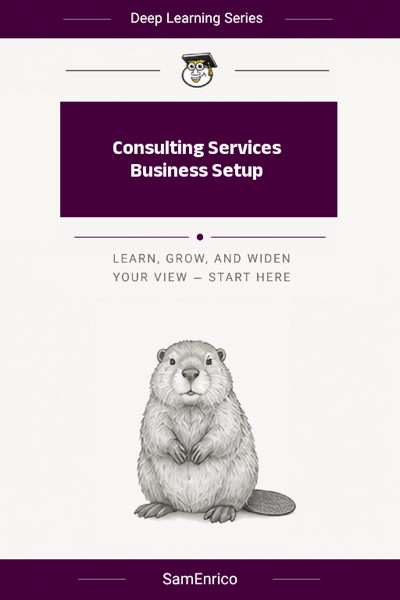
Non-FictionInformativeEducational
Consulting Services Business Setup eBook
A Coursebook on Consulting Services Business Setup
by Teel Mui
A Coursebook on Consulting Services Business Setup
Formats
Free sample
Chapter 1: The Feast-Famine Trap...--–- The email arrived on a Tuesday morning, three weeks after Sarah had proudly launched her consulting business. The subject line read: “Proposal Follow-Up – Great Conversation Last Month.” She didn't need to open it. She already knew what it would say: budget cuts, hiring freeze, “we'll circle back next quarter.” This was the fourth prospect to vanish in two weeks. Her savings account, which had looked so robust in a spreadsheet, was now a source of low-grade panic. She had done everything right—built a website, registered an LLC, printed business cards, even bought a new blazer for client meetings.
But eight weeks in, she had billed exactly zero dollars. Sarah was not a failure. She was a brilliant marketing director with fifteen years of experience, a master's degree, and a reputation for turning around troubled campaigns. She had consulted informally for years, giving friends advice over coffee, solving problems that stumped entire teams. Everyone told her she should hang a shingle.
So she did. And now she was lying awake at 3:00 AM, doing the math: rent, car payment, health insurance, her daughter's tuition. The numbers did not work. Sarah had walked headfirst into the Feast-Famine Trap, the single most destructive force in solo consulting. And she is not alone.The Feast-Famine Trap is the predictable, almost mechanical pattern that destroys sixty percent of new consultancies within eighteen months.
It works like this: you land a client, work intensely, feel validated, cash a nice check (the Feast). Then the project ends. You scramble for the next client. Weeks pass. No one calls.
You doubt everything. Your expertise, your value, your sanity (the Famine). Then, desperate, you lower your price, take a bad client, and the cycle repeats. Each cycle grinds down your savings, your confidence, and your relationships. Most consultants assume they failed because they were not good enough.
That is almost never true. They failed because they were not prepared for the psychological and financial reality of the cycle.This chapter is not about marketing, legal structures, or pricing models. Those come later. This chapter is about looking in the mirror before you file a single piece of paperwork. It is the Self-Assessment pillar of the five-part framework introduced in this book's Introduction.
Before you spend money on an LLC, before you build a website, before you tell a single soul you are open for business, you must answer one question honestly: Are you built for the Feast-Famine Cycle? Most people are not. That is not a character flaw. It is a data point. And ignoring that data point is the fastest route to becoming Sarah—brilliant, experienced, and broke.The Psychology of the Feast-Famine Cycle The Feast-Famine Cycle is not primarily a financial problem.
It is a psychological problem that manifests as a financial problem. Your brain is wired for predictability. Evolution favors the cave dweller who knows where tomorrow's berries will grow. Consulting offers none of that certainty. One month you are the smartest person in the room, flying first class to a client site, signing contracts that make you feel invincible.
The next month you are refreshing your inbox eighty times per hour, wondering if your phone is broken, convincing yourself that everyone was wrong about you.This whiplash creates a cascade of cognitive distortions. The first is recency bias—the tendency to believe that whatever just happened will keep happening. When you are feasting, you believe the good times will never end. You spend money, relax your marketing, and assume referrals will flood in. When you are famished, you believe you will never work again.
You panic, lower your prices, and chase bad clients. Both beliefs are equally irrational. The cycle always turns. The feast always ends. The famine always ends.
But your brain will fight this truth with every fiber of its being.The second distortion is impostor syndrome on steroids. In a traditional job, you receive regular feedback—paychecks, performance reviews, the simple fact that you still have a desk. In consulting, silence is the default state. A week without a client call feels like a verdict. Two weeks feels like evidence.
Three weeks feels like proof that you have been exposed as a fraud. The most common sentence spoken by new consultants in month three is not “I need more leads.” It is “Maybe I was never that good.” This is the impostor syndrome feeding the famine, and the famine feeding the impostor syndrome. They become indistinguishable.The third distortion is what psychologists call “agency depletion”—the exhausting work of generating your own motivation without external structure. In a corporate job, the structure is provided: meetings, deadlines, a boss, a calendar. In consulting, there is no one telling you to start work at 9:00 AM.
No one notices if you spend three hours on social media. No one applauds when you finish a difficult analysis. You must supply all of the structure, accountability, and reward. This is far more draining than most people anticipate. By week six, many new consultants find themselves paralyzed, staring at a screen, unable to start the very tasks that would bring in revenue.
They are not lazy. They are depleted. The feast-famine cycle is an engine of psychological attrition. It wears you down not through any single catastrophe, but through the steady drip of uncertainty.The Entrepreneurial Fit Test Before reading another word, you will take the Entrepreneurial Fit Test. This is a twenty-question assessment measuring your tolerance for the specific stressors of solo consulting.
Do not cheat. Do not answer how you want to be. Answer how you are. The test has no passing or failing score—only fit. A low score does not mean you cannot consult.
It means you should start part-time, or reconsider full-time self-employment entirely. That is a success, not a failure. Better to discover this now than after you have quit your job.For each statement, rate yourself from one to five: one means strongly disagree, five means strongly agree.I am comfortable with not knowing where my next paycheck will come from for months at a time.When I face rejection, I can make three calls immediately after without spiraling.I have a strong network of people who would actively refer me business within ninety days.I can work alone for days without external validation or encouragement.I have successfully managed irregular income before (freelancing, commissions, seasonal work).I do not need a regular schedule or fixed office to be productive.I am comfortable talking about money and asking for large fees directly.I can say no to a bad client, even when I have no other income.I have at least nine months of living expenses saved outside retirement accounts.My spouse or partner fully supports this venture, including the financial risk.I have a documented sales process that I have used successfully before.I can separate my professional worth from my recent revenue.I enjoy marketing myself and do not feel embarrassed by self-promotion.I have a specific niche, not a general category.I can convert a conversation into a proposal without anxiety.I am comfortable with legal contracts and basic accounting.I have a track record of finishing projects without supervision.I can handle a client yelling at me without taking it…
This is the end of the free sample. Get the eBook to keep going. Buy now
About this book
Details
- Author
- Teel Mui
- Publisher
- SamEnrico
- Language
- English
- Genre
- Non-Fiction, Informative, Educational
- Released
- 2026-05-11
- Pages (approx.)
- 133
- Available as
- eBook, Audiobook

Read better in the ZLOADR app
Your eBooks on your phone or tablet. Sign in with your SamEnrico account and start reading.
More by Teel Mui
 Qualified Intermediary Selection GuideTeel Mui$11.99
 Korean War POWTeel Mui$11.99
 Road Rage and Anger DisordersTeel Mui$11.99
 Children's AyurvedaTeel Mui$11.99
 The 20 20 20 Morning FormulaTeel Mui$11.99
 Caregiver Medical Alert GuideTeel Mui$11.99
 The Stress Nausea GuideTeel Mui$11.99
 Silicon Valley Immigrant Founder PlaybookTeel Mui$11.99
 Anki For Networking NamesTeel Mui$11.99
 The Frozen Equations: Calculus in the Age of Antarctic ExplorationTeel Mui$11.99
 Crowns and Conscience: The Prince Who Refused the ThroneTeel Mui$11.99
 The Last Stand of Chittorgarh: Rajput Blood Against the SultanateTeel Mui$11.99
You may also like
 Hong Kong Handover 1997Dunn Johnnie$11.99
 Zumba For Postnatal Recovery CourseNeal Christian$11.99
 Zumba for BeginnersLadner Nikia$11.99
 YouTube Comment Mining GuideHumes Pandora$12.99
 Worry Box MeditationCarlin Rudy$11.99
 Workplace Stress MeditationNguyen Lynn$11.99
 Workplace Stress and Sleep RepairHawley Ivory$11.99
 Workplace Perfectionism CureDelaney Jeffry$11.99
 Workplace Injustice Anger GuideWallen Isabelle$11.99
 Work Addiction and Burnout LinkGreenwood Ester$11.99
 Women in Yoga and WellnessBeattie Galina$11.99
 Women in Stand Up ComedyChun Evangeline$11.99