
Non-FictionSelf-HelpConstruction Stress
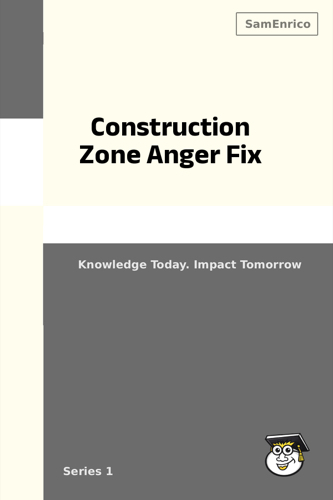
Construction Zone Anger Fix eBook
Manages frustration with delays and merging in wor
by Greco Rayna
Manages frustration with delays and merging in work zones.
Formats
Free sample
Chapter 1: The Orange Barrel Mystery--It begins, as it always does, with a single orange barrel.You are driving home after a long day. The highway has been flowing smoothly for twenty-three miles. Your favorite song is on the radio. The sun is at that perfect angle where it warms the dashboard but does not glare in your eyes. You are, by all objective measures, having a perfectly adequate commute.
And then you see it. A single orange barrel placed on the shoulder. Then a second. Then a dozen. Then a hundred.
The bright orange plastic cones multiply like rabbits, and the right lane ahead is choked with massive construction equipment, men in hard hats standing around doing nothing that you can discern, and a digital message board flashing: "RIGHT LANE CLOSED 1 MILE. EXPECT DELAYS."Something shifts inside your body. It is not a thought, not yet. It is something faster than thought. Your jaw tightens.
Your grip on the steering wheel hardens. Your breathing becomes shallow. The temperature in the car seems to rise by several degrees, even though the air conditioner is still blowing. You look at the car ahead of you, which has already slowed down, and you feel a flash of something that is not quite anger yet but is certainly its first cousin. Irritation.
Annoyance. A low-grade fury that you can feel building like pressure behind a dam.Why? Why does this happen? Why does a piece of molded orange plastic, no heavier than a gallon of milk, have the power to transform a perfectly reasonable human being into a seething, cursing, white-knuckled creature from a horror movie? You are not a violent person.
You have never thrown a punch in your adult life. You return your grocery cart to the corral. You hold doors open for strangers. And yet, when you see that orange barrel, something in your brain screams: This is not fair. This is being done to me.
And I will not stand for it.Welcome to the Orange Barrel Mystery. This entire book exists because of that single, maddening transformation. And before we can fix the anger, before we can learn the five-second sigh or the zipper merge or any of the tools that will save your blood pressure and your marriage, we have to understand what is actually happening inside your body and your brain when you see those orange cones. Because here is the truth that will shock you: the anger is not about the delay. The delay is real, yes.
You are going to arrive home seven to twelve minutes later than you expected. But seven minutes of lost time does not explain the volcanic rage that makes you want to accelerate toward the flagger with the stop sign. Seven minutes does not explain the fantasies of revenge that flash through your mind when someone merges aggressively. Seven minutes does not explain why you are still angry when you walk through your front door, why your spouse takes one look at your face and decides to have a quiet evening in the other room.Something else is happening. Something deeper.
And in this chapter, we are going to name it, dissect it, and understand it.The Anatomy of a Trigger Let us slow down time for a moment. Let us imagine that we could freeze the frame at the exact millisecond your eyes register that first orange barrel. What happens next is not one thing but a cascade of events, moving from the physical to the emotional to the behavioral, all in less time than it takes to blink.First, your visual cortex processes the shape and color of the barrel. Orange is a wavelength that the human eye is evolutionarily programmed to notice quickly—it is the color of fire, of warning, of ripe fruit that might be poisonous if eaten too early. Your brain does not have to learn to notice orange.
It is built into the hardware. But the barrel is not just orange. It is also unexpected. You have been driving in a state of what neuroscientists call "highway hypnosis"—that semi-automatic, low-attention state where your brain is handling the driving while you think about dinner, about that email you forgot to send, about the argument you had this morning. The barrel is a sudden violation of that predictable pattern, and your brain hates pattern violations more than it hates almost anything else.Second, within 150 milliseconds of seeing the barrel, your amygdala—the almond-shaped cluster of neurons deep in your temporal lobe that serves as the brain's emergency alarm system—sounds the alert.
The amygdala does not reason. It does not ask questions like "Is this actually dangerous?" or "How long will the delay really be?" The amygdala only asks one question: Is this a threat? And because the barrel signals a change in the predictable flow of traffic, and because any change in traffic could potentially lead to a collision, the amygdala answers "Yes, this is a threat" every single time. It is wrong, of course. The orange barrel is not a threat.
It is a warning about a threat that is a mile ahead. But the amygdala does not do nuance. It does not do future tense. It only does now, and right now, it is sounding the alarm.Third, that alarm triggers the release of two hormones: adrenaline (epinephrine) and cortisol. Adrenaline surges through your bloodstream, increasing your heart rate, dilating your pupils, shunting blood away from your digestive system and toward your large muscles.
Your breathing becomes faster and shallower. Your palms may become clammy. Your attention narrows to a laser focus on the road ahead, which is useful for evading a predator but less useful for noticing the beautiful sunset or the fact that your passenger is trying to tell you something important. Cortisol, meanwhile, begins a slower process of raising your blood sugar and suppressing non-essential systems like immune function and reproductive drive. A single cortisol spike, like the one caused by a construction zone, is harmless.
A hundred such spikes, week after week, year after year, is a recipe for hypertension, insomnia, and metabolic dysfunction. We will talk more about the long-term costs in Chapter 3. For now, just note that your body is treating the orange barrel as if it were a hungry lion.Fourth—and this is where the mystery deepens—your prefrontal cortex, the rational, decision-making part of your brain, tries to catch up. The prefrontal cortex is much slower than the amygdala. By the time your rational brain has processed what is happening, your body is already in a state of high arousal.
Your rational brain looks at the situation and says, "Well, this is annoying, but it is not an actual emergency." But the body does not listen. The body is already committed. And so you experience the strange, split-state feeling of knowing intellectually that you should not be angry while simultaneously feeling the anger burning in your chest. That dissonance—the gap between what you know and what you feel—is itself a source of additional frustration. You are not just angry at the construction.
You are angry at yourself for being angry.The Fairness Trap Now we arrive at the heart of the Orange Barrel…
This is the end of the free sample. Get the eBook to keep going. Buy now
About this book
Details
- Author
- Greco Rayna
- Publisher
- SamEnrico
- Language
- English
- Genre
- Non-Fiction, Self-Help, Construction Stress
- Released
- 2026-06-09
- Pages (approx.)
- 132
- Available as
- eBook, Audiobook

Read better in the ZLOADR app
Your eBooks on your phone or tablet. Sign in with your SamEnrico account and start reading.
More by Greco Rayna
 Creative Block for ADHDGreco Rayna$11.99
 Active Listening For Trauma SurvivorsGreco Rayna$11.99
 Tennis Injury Prevention GuideGreco Rayna$11.99
 Immigrant Liquor Store To DistributorGreco Rayna$11.99
 Wholesaling CRM Selection GuideGreco Rayna$11.99
 The Shame-Based ParentGreco Rayna$11.99
 Counting Breaths Meditation GuideGreco Rayna$11.99
 Assertiveness At The DentistGreco Rayna$11.99
 The Frozen Hell of Karelia: Finland's Winter War of Survival (1939-1940)Greco Rayna$11.99
 Silent Skies: The Untold Story of the 2014 Malaysia Airlines MH17 DisasterGreco Rayna$11.99
 Echoes of the Velvet Underground: How Lou Reed’s Raw Genius Redefined RockGreco Rayna$11.99
 Spot Trading Strategies for CryptocurrenciesGreco Rayna$11.99
You may also like
 Hong Kong Handover 1997Dunn Johnnie$11.99
 Zumba For Postnatal Recovery CourseNeal Christian$11.99
 Zumba for BeginnersLadner Nikia$11.99
 YouTube Comment Mining GuideHumes Pandora$12.99
 Worry Box MeditationCarlin Rudy$11.99
 Workplace Stress MeditationNguyen Lynn$11.99
 Workplace Stress and Sleep RepairHawley Ivory$11.99
 Workplace Perfectionism CureDelaney Jeffry$11.99
 Workplace Injustice Anger GuideWallen Isabelle$11.99
 Work Addiction and Burnout LinkGreenwood Ester$11.99
 Women in Yoga and WellnessBeattie Galina$11.99
 Women in Stand Up ComedyChun Evangeline$11.99