
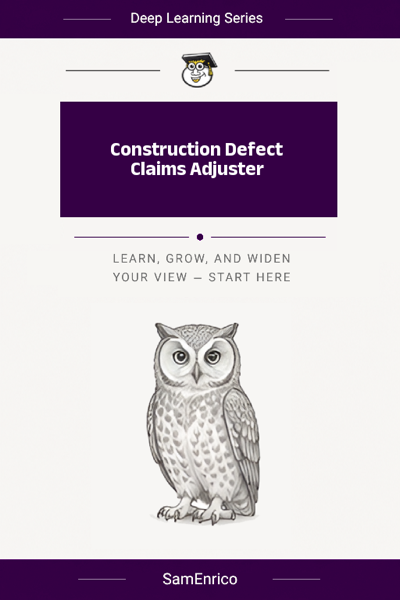
Non-FictionInformativeEducational
Construction Defect Claims Adjuster eBook
A Coursebook on Construction Defect Claims Adjuste
by Pryor Alaina
A Coursebook on Construction Defect Claims Adjuster
Formats
Free sample
Chapter 1: The Hidden Architect...--The first time Maria Vasquez watched a team of engineers cut through the tenth floor of a luxury condominium tower, she realized that everything she had been taught about property claims was about to become irrelevant. The drywall fell away in white sheets, revealing blackened wooden shear walls that crumbled at the touch of a gloved hand. A single missing drip edge—installed twenty-seven months earlier by a roofer who had since moved to another state—had channeled rainwater into the building envelope for two full rainy seasons. The estimated repair cost: 4.2million.Thegeneralcontractor’s CGLpolicylimit:4.2 million. The general contractor’s CGL policy limit: 4.2million.Thegeneralcontractor’s CGLpolicylimit:2 million.
And somewhere behind that rotting sheathing, mold had begun to colonize the insulation, triggering a separate bodily injury claim from a tenant with asthma.Maria was not an engineer. She was not a lawyer. She was a senior claims adjuster who had spent fifteen years handling auto accidents and slip-and-fall cases. She had been promoted to construction defect because she was “good with people” and “knew how to settle.” On that tenth floor, standing in the dust and the silence of a building that had been declared uninhabitable for four months, she understood the brutal truth: construction defect claims are not property claims with better documentation. They are a distinct species of litigation that demands knowledge of building science, insurance law, contract interpretation, and human psychology—all at once.This book is written for the adjuster who finds themselves in Maria’s position.
Whether you are a generalist P&C adjuster newly assigned to a defect file, a claims supervisor looking to build a specialized unit, or a legal professional who wants to understand what the adjuster actually does, the following chapters will transform you from a reactive claim processor into a proactive claim manager. We begin not with policy language or legal doctrine, but with the physical reality that underlies every construction defect claim: the building itself.Why Building Science Is Not Optional Construction defect claims are unique in the insurance world because the underlying injury is not an event—it is a condition. A car accident happens at 3:47 PM on a Tuesday. A slip on a wet floor happens in an instant. But a construction defect may begin the moment a subcontractor fails to install a flashing detail, then take three years to manifest as a water stain, and another six months before anyone files a claim.
By the time the adjuster receives the notice of loss, the physical evidence has been covered by layers of paint, drywall, and denial.You cannot evaluate what you do not understand. An adjuster who cannot distinguish between a foundation crack caused by settlement (potentially a construction defect) and a crack caused by thermal expansion (normal and expected) will either overpay for non-defective conditions or underpay for genuine failures. An adjuster who does not understand the sequence of construction will never be able to allocate responsibility among the general contractor and its fifteen subcontractors. And an adjuster who has never walked a roof, crawled under a pier-and-beam foundation, or watched a moisture meter climb from 12% to 78% will never earn the respect of the engineers and attorneys who dominate construction defect litigation.This chapter provides a “construction boot camp” for adjusters. It does not aim to make you a contractor or an engineer.
It aims to make you literate enough to ask the right questions, spot incomplete investigations, and identify when an expert’s opinion is built on sand. By the end of this chapter, you will be able to describe the major structural and mechanical systems of a building, explain how construction sequencing creates hidden defects, differentiate between patent and latent defects, and trace the lifecycle of a typical water intrusion claim.Part One: Breaking Down the Building – Structural Systems Every building, regardless of its size or purpose, consists of two interconnected categories of systems: structural and mechanical. The structural systems keep the building standing. The mechanical systems make it livable. Defects can arise in either, but the most expensive and complex claims almost always involve structural damage caused by water intrusion—which is why water will be our recurring theme throughout this book.Foundations.
The foundation is the interface between the building and the earth. Residential foundations are typically either slab-on-grade (a concrete slab poured directly on prepared soil) or pier-and-beam (concrete piers supporting wooden beams with a crawl space underneath). Commercial buildings may have deeper foundations, including drilled piers or mat foundations. The adjuster needs to know three things about foundations: they settle over time (some settlement is normal, excessive settlement is a defect), they crack (hairline cracks are often cosmetic, cracks wider than 1/4 inch or with vertical displacement are concerning), and they are almost impossible to repair completely. A foundation defect often leads to a total loss or a diminution-in-value claim because lifting and re-supporting a building is exponentially more expensive than building it correctly the first time.Load-Bearing Walls and Framing.
Above the foundation, the building’s weight is carried by load-bearing walls and framing. In wood-frame construction (the majority of residential and light commercial buildings in North America), the framing consists of studs, joists, rafters, and trusses. Studs are vertical members that form walls. Joists are horizontal members that support floors and ceilings. Rafters and trusses support the roof.
The adjuster must understand that not all walls are load-bearing. Removing a non-load-bearing wall is a minor renovation. Removing a load-bearing wall without installing a beam and posts will cause the roof to sag, then crack, then collapse. Many construction defect claims arise precisely because a homeowner or contractor removed or altered a load-bearing wall without proper engineering.Building Envelope (Exterior Walls, Windows, Doors, Roof). The building envelope is the barrier between the interior conditioned space and the exterior environment.
It is also the most common source of construction defect claims. A properly designed and installed envelope keeps water out, allows vapor to escape, and maintains thermal insulation. A defective envelope does the opposite. Water intrusion claims typically follow a predictable pattern: a failure in one component of the envelope (roof flashing, window seal, siding lap joint) allows liquid water to enter the wall cavity. That water soaks into wood framing or sheathing, causing rot and mold.
The rot weakens structural members. The mold triggers health complaints. And by the time the problem is discovered, the repair requires opening walls from the inside, replacing structural members, and remediating mold—costs that far exceed the original installation error.Part Two: Breaking Down the Building – Mechanical Systems (MEP)Mechanical, electrical, and plumbing systems—collectively known as MEP—are the building’s organs. They are hidden inside walls, above ceilings, and below floors. When they fail, the damage is often catastrophic because the failure is discovered only after water has been leaking for months or an electrical short has caused a fire.Plumbing Systems.
Plumbing consists of two separate subsystems: water supply (pressurized pipes bringing clean water in) and drain-waste-vent (DWV) (gravity-driven pipes taking waste out). Supply lines are typically copper, PEX (cross-linked polyethylene), or CPVC. They fail due to freezing (water expands, splitting the pipe), corrosion (copper…
This is the end of the free sample. Get the eBook to keep going. Buy now
About this book
Details
- Author
- Pryor Alaina
- Publisher
- SamEnrico
- Language
- English
- Genre
- Non-Fiction, Informative, Educational
- Released
- 2026-05-11
- Pages (approx.)
- 153
- Available as
- eBook, Audiobook

Read better in the ZLOADR app
Your eBooks on your phone or tablet. Sign in with your SamEnrico account and start reading.
More by Pryor Alaina
 Dreams in Complex PTSD RecoveryPryor Alaina$11.99
 Asynchronous Work CommunicationPryor Alaina$11.99
 Sex Addiction For Couples Healing CoursePryor Alaina$11.99
 Birth Pill Period ManagementPryor Alaina$11.99
 The MBSR for Insomnia GuidePryor Alaina$11.99
 The Hollow Crown: The Cursed Regalia of King TutPryor Alaina$11.99
 Frozen Dreams: The Arctic's Forgotten Explorers and the Race for the North PolePryor Alaina$11.99
 Research Proposal Writing HandbookPryor Alaina$12.99
 Renewable Energy Policy OutlookPryor Alaina$12.99
 Understanding Heart Hand Syndrome Spanish TypePryor Alaina$17.99
 How to Start a Brush Business (Beginners Guide)Pryor Alaina$11.99
You may also like
 Hong Kong Handover 1997Dunn Johnnie$11.99
 Zumba For Postnatal Recovery CourseNeal Christian$11.99
 Zumba for BeginnersLadner Nikia$11.99
 YouTube Comment Mining GuideHumes Pandora$12.99
 Worry Box MeditationCarlin Rudy$11.99
 Workplace Stress MeditationNguyen Lynn$11.99
 Workplace Stress and Sleep RepairHawley Ivory$11.99
 Workplace Perfectionism CureDelaney Jeffry$11.99
 Workplace Injustice Anger GuideWallen Isabelle$11.99
 Work Addiction and Burnout LinkGreenwood Ester$11.99
 Women in Yoga and WellnessBeattie Galina$11.99
 Women in Stand Up ComedyChun Evangeline$11.99