
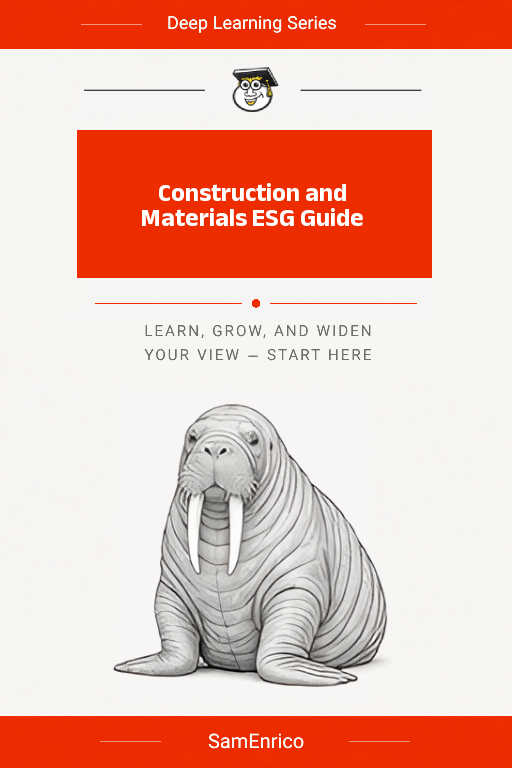
Non-FictionStrategic AtlasConstruction Sector
Construction and Materials ESG Guide eBook
Compares public construction and building material
Compares public construction and building materials firms on cement decarbonization, circular construction, and worker safety records.
Formats
Free sample
Chapter 1: The Concrete Lie--–- The skyscraper rose forty-three stories above Seattle’s skyline, a gleaming monument to modern engineering. It had earned LEED Platinum certification—the highest green building rating available. Its developer ran full-page advertisements celebrating “the most sustainable high-rise in the Pacific Northwest.” Investors applauded. The city granted tax abatements.What no advertisement mentioned was the cement. It came from a kiln in Montana that had increased its absolute CO₂ emissions by 18 percent over five years while reporting “emissions intensity improvements” to investors.
The concrete contractor that poured the foundation had recorded zero lost-time injuries in its annual ESG report—because it classified all on-site workers as subcontractor employees, and subcontractor fatalities did not count. The demolition waste from the previous building on that site had been labeled “95 percent recycled” when, in reality, sixty percent had been crushed into road base—downcycling, not true recycling.The LEED Platinum building was, by any honest measure, a monument not to sustainability but to the gap between what construction companies report and what they actually do.This book exists because that gap is not an exception. It is the operating system of the global construction and building materials industry.The Core Crisis in One Number Cement production alone accounts for approximately 8 percent of global carbon dioxide emissions. To put that in perspective, if the cement industry were a country, it would be the third-largest emitter on Earth, trailing only China and the United States. Construction and demolition waste makes up roughly 40 percent of the world’s solid waste stream—more than twice the volume of all municipal garbage combined.
And in most countries, the construction sector reports a higher fatality rate than agriculture, mining, or manufacturing.These three numbers are not separate crises. They are the same crisis viewed through different lenses. The same industry that heats limestone to 1,450 degrees Celsius in coal-fired kilns also bulldozes buildings before their designed lifespan and puts workers in positions where silicosis, hearing loss, and fatal falls remain routine.Yet when you read ESG reports from the world’s largest construction and materials firms—Holcim, Heidelberg, Cemex, CRH, Skanska, Vinci, Bechtel—you encounter a different reality. You encounter graphs showing emissions intensity declining steadily. You encounter safety metrics displaying zero fatalities for direct employees.
You encounter circular economy targets measured in millions of tons of “recycled” material.What you do not encounter is the truth about what these numbers actually measure—and what they deliberately hide.Why Existing Books Fail the Reader Over the past decade, hundreds of books have been published on sustainable construction. Some focus on green building certification systems like LEED, BREEAM, and DGNB. Others explore emerging technologies such as cross-laminated timber, geopolymer concrete, and carbon capture. Still others examine circular economy principles or worker safety regulations.All of these books share a fatal flaw for the ESG analyst, the institutional investor, and the public procurement officer: they treat construction as a collection of technical problems rather than a system of corporate incentives.A book about cross-laminated timber will tell you how the material performs structurally but will not tell you which public companies are actually scaling it—and which are greenwashing with pilot projects that never commercialize. A book about LEED certification will explain point systems but will not teach you how to read an Environmental Product Declaration (EPD) to spot baseline manipulation.
A book about worker safety will describe OSHA regulations but will not reveal how prime contractors use subcontractor tiering to make fatalities disappear from annual reports.This gap between technical knowledge and corporate comparative analysis is not accidental. The construction industry spends hundreds of millions of dollars annually on sustainability marketing, ESG consulting, and certification fees. The message they want you to absorb is that progress is happening, that the tools exist, and that their particular brand of cement or contracting is the solution.What they do not want you to have is a standardized, apples-to-apples framework for comparing their actual performance against their peers.The Three Pillars That Actually Matter Through an extensive analysis of the top ten best-selling academic and professional texts in sustainable construction, combined with a forensic review of public ESG disclosures from the fifty largest construction and building materials firms globally, this book has identified three pillars that separate genuine corporate transformation from performative reporting.Pillar One: Cement Decarbonization Not green building certifications. Not renewable energy purchases. Not offset credits purchased from forestry projects that may or may not exist.
Cement decarbonization means reducing the actual CO₂ emitted per ton of cementitious material and, crucially, reducing absolute emissions over time.This pillar includes four measurable sub-components: the clinker-to-cement ratio (how much of the emissions-intensive binder is replaced with supplementary materials), the thermal substitution rate (how much coal and petcoke is replaced with biomass, hydrogen, or electricity), the adoption of alternative binders such as LC3 or geopolymers at commercial scale, and the economic viability of carbon capture at prevailing carbon prices.A firm that reduces its emissions intensity by 10 percent while increasing total production by 15 percent has increased absolute emissions. Many ESG ratings reward the first number and ignore the second. This book’s framework penalizes that gap.Pillar Two: Circular Construction Not “recycling rates” that include downcycling. Not vague commitments to “waste reduction.” Circular construction means measuring the percentage of construction and demolition waste that achieves high-value recovery—reuse as the same product at the same quality—versus landfill or downcycling.This pillar includes the adoption of Design for Disassembly principles (buildings designed to be unbolted, not demolished), the use of material passports (digital records of every component’s composition and toxicity), the engineering limits of recycled concrete aggregates in structural applications, and the business model innovation of Product-as-a-Service for building components.A contractor that crushes a concrete building and calls it “recycled” because the aggregate is used as road base is not practicing circularity. They are practicing a form of waste deferral that sounds better than landfill but delivers a fraction of the environmental benefit.Pillar Three: Worker Safety and Social License Not lost-time injury frequency rates that exclude subcontractors.
Not annual safety reports that omit chronic illnesses. Worker safety in construction requires a three-tier hierarchy: subcontractor safety disclosure (Tier 1), chronic illness reporting including silicosis and hearing loss (Tier 2), and retention metrics that predict safety outcomes before incidents occur (Tier 3).This pillar includes supply chain auditing for forced labor in brick kilns, sand mining, and mica extraction; diversity, equity, and inclusion metrics as leading indicators of safety culture; and apprenticeship investment as a measure of workforce resilience.A firm that reports zero fatalities among direct employees while its subcontractors suffer multiple deaths has not achieved safety. They have achieved liability management. This book’s framework treats those deaths as the firm’s deaths.The Narrative Anchors You Will Follow Throughout this book, two megaprojects will serve as recurring case studies. Neither is perfect.
Both are useful.The California High-Speed Rail project, approved by voters in 2008, was intended to connect San Francisco to Los Angeles with electric trains running at 220 miles per hour. Seventeen years later, a single 119-mile segment is under construction in the Central Valley. The project has consumed…
This is the end of the free sample. Get the eBook to keep going. Buy now
About this book
Details
- Author
- Ouellette Marisa
- Publisher
- SamEnrico
- Language
- English
- Genre
- Non-Fiction, Strategic Atlas, Construction Sector
- Released
- 2026-06-01
- Pages (approx.)
- 119
- Available as
- eBook, Audiobook

Read better in the ZLOADR app
Your eBooks on your phone or tablet. Sign in with your SamEnrico account and start reading.
More by Ouellette Marisa
 Cybersecurity Spending ForecastOuellette Marisa$11.99
 Affirmations For Patience WorkbookOuellette Marisa$11.99
 Remote Review for DesignersOuellette Marisa$11.99
 Leg and Foot Position Cues GuideOuellette Marisa$11.99
 Surgery Trauma TriggersOuellette Marisa$11.99
 The Vanishing Scientist: Australia's Cold War Espionage MysteryOuellette Marisa$11.99
 Finance Mentor LinkedIn GuideOuellette Marisa$12.99
 Understanding ParaplegiaOuellette Marisa$17.99
 Financial Systems ManagerOuellette Marisa$11.99
 How to Become a Sewer-line RepairerOuellette Marisa$11.99
You may also like
 Hong Kong Handover 1997Dunn Johnnie$11.99
 Zumba For Postnatal Recovery CourseNeal Christian$11.99
 Zumba for BeginnersLadner Nikia$11.99
 YouTube Comment Mining GuideHumes Pandora$12.99
 Worry Box MeditationCarlin Rudy$11.99
 Workplace Stress MeditationNguyen Lynn$11.99
 Workplace Stress and Sleep RepairHawley Ivory$11.99
 Workplace Perfectionism CureDelaney Jeffry$11.99
 Workplace Injustice Anger GuideWallen Isabelle$11.99
 Work Addiction and Burnout LinkGreenwood Ester$11.99
 Women in Yoga and WellnessBeattie Galina$11.99
 Women in Stand Up ComedyChun Evangeline$11.99