
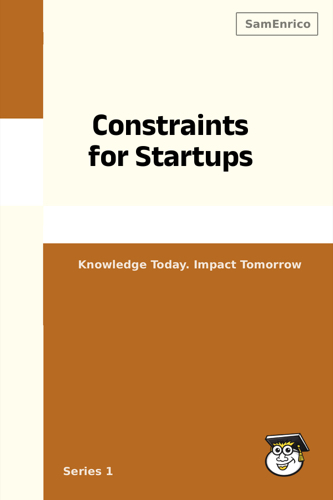
Constraints for Startups eBook
Limited funding drives creative business models.
Limited funding drives creative business models.
Formats
Free sample
Chapter 1: The Funeral Economy--– You have been lied to. Not maliciously, probably. But systematically. The lie sounds like wisdom. It sounds like this: "You need money to make money." "Raise capital before you raise revenue." "Get funded or get out." These phrases are repeated so often in startup circles that they have become scripture.
But scripture is not data. And the data tells a very different story. Let me take you to a funeral. It is the funeral of a startup called Stay Tuned. Maybe you have never heard of them.
That is the point. Stay Tuned raised $18 million in Series A funding. They had a beautiful office with exposed brick and a keg on tap. They hired 75 people in eighteen months. They were featured on Tech Crunch, Product Hunt, and every "startups to watch" list.
Eighteen months after raising that money, they were dead. Not acquired. Not pivoted. Dead. The keg was returned.
The office was subleased at a loss. The 75 people scattered to other startups that would also probably die. And here is the part that keeps me up at night: Stay Tuned did not die because they had a bad product. They died because they had too much money, too fast. The funding poisoned them.
It made them lazy. It let them hire before they had product-market fit. It let them run Facebook ads before they had a retention curve. It let them build features that no customer asked for because they had engineers sitting around with nothing to do. This is not an exception.
This is the rule.The Data That Will Piss You Off Let me give you a number: 75 percent. That is the percentage of venture-backed startups that never return capital to their investors. Not "fail to become unicorns." Not "fail to make a profit." They never return a single dollar. The money goes in. The money disappears.
The startup dies. Meanwhile, bootstrapped startups—the ones built on credit cards, savings accounts, and late-night freelance gigs—fail at roughly the same rate in the first year. But here is the difference. When a bootstrapped startup fails, it fails small. The founder loses $10,000 of their own money, learns a brutal lesson, and starts something else within six months.
When a VC-backed startup fails, it fails big. The investors lose millions. The founders are often barred from starting another company for years due to non-competes or burned reputations. And here is the killer: the bootstrapped startups that survive are more profitable, more resilient, and more likely to stay independent than their funded counterparts. The data is not ambiguous.
Scarcity forces discipline. Abundance breeds waste. This is not ideology. This is actuarial science.Let me walk you through the numbers from a 2023 study by the Kauffman Foundation, which has been tracking startup outcomes for thirty years. Among companies that raised venture capital, only 25 percent generated a return.
Among companies that bootstrapped past $1 million in revenue, 78 percent were still profitable five years later. Seventy-eight percent. That is not a margin. That is a landslide. Why?
Because bootstrapped companies learn to sell before they learn to spend. They develop the single most important muscle in business—revenue generation—before they develop the secondary muscles of hiring, marketing, and scaling. VC-backed companies often reverse that order. They raise money, hire a sales team, spend on ads, and only then try to figure out if anyone actually wants what they are building. That is not business.
That is arson.The Trap of "If Only"I have spoken to thousands of aspiring founders. I have heard the same phrase thousands of times. "If only I had $50,000, I could hire a developer." "If only I had $100,000, I could run a real marketing campaign." "If only I had a co-founder with money, I could quit my job and go all in." This is the Trap of If Only. It is the single most destructive force in early-stage entrepreneurship. Not competition.
Not regulation. Not bad ideas. The belief that money is the missing ingredient. Here is what actually happens to people who escape the Trap of If Only. They start with what they have.
A laptop. A credit card. A spare room. A skill they learned at their day job. They build something small.
They sell it to someone. They learn. They iterate. They sell again. They wake up eighteen months later with a real business, real customers, and real profit.
And they realize something that the "If Only" crowd will never understand: the money was never the missing ingredient. The missing ingredient was the willingness to start before they were ready.Let me tell you about Mark. You know him as Daymond John. Before he was the guy in the fancy suits on Shark Tank, he was a kid in Queens with a sewing machine and a dream. He did not have $50,000.
He did not have $5,000. He had $40. He used his mother's sewing machine to stitch t-shirts. He slept on floors. He printed his own flyers.
He stood on street corners selling hats. He turned his lack of capital into an identity. FUBU—"For Us, By Us"—was not a marketing slogan. It was a survival mechanism. He could not afford to market to everyone, so he marketed to the people who looked like him, talked like him, and trusted him.
That scarcity became his unfair advantage. By the time FUBU was doing $350 million in annual sales, Daymond had never taken a dollar of outside funding. He did not need to. He had built something more valuable than money. He had built a machine that turned sweat into revenue.
That machine is available to you. It costs nothing to build. It just costs your pride.The Myth of the Overnight Success Here is another lie: the startups you read about in the news got there because of brilliant ideas and massive funding rounds. This is backwards. The startups you read about in the news got there because of massive funding rounds and PR machines.
The brilliant ideas are almost never the ones that get funded. Let me prove it to you. In 2011, a company called Warby Parker raised $2.5 million. They sold glasses online. Great idea.
Not original—Zenni Optical had been doing it for years. But Warby Parker had a PR agency, a pitch deck, and a network of angel investors. They became a unicorn. In that same year, a company called Zenni Optical had $100 million in revenue. Zero funding.
Zero press. Zero Tech Crunch articles. They just kept selling glasses. Which one did you hear about? Exactly.
The myth of the overnight success is a marketing campaign designed to sell you on the idea that you need funding. The real success stories—the quiet, profitable, boring ones—do not write press releases. They just deposit checks.I am not telling you to avoid press or funding forever. I am telling you that the story you have been sold is a product. And you are the customer.
The venture capital industry needs you to believe that money is the missing ingredient because their business model depends on it. They have billions of dollars to deploy. They need entrepreneurs to take that money. They need…
This is the end of the free sample. Get the eBook to keep going. Buy now
About this book
Details
- Author
- Romano Malissa
- Publisher
- SamEnrico
- Language
- English
- Genre
- Non-Fiction, Self-Help, Startup
- Released
- 2026-06-05
- Pages (approx.)
- 117
- Available as
- eBook, Audiobook

Read better in the ZLOADR app
Your eBooks on your phone or tablet. Sign in with your SamEnrico account and start reading.
More by Romano Malissa
 Morning Commute Anger ControlRomano Malissa$11.99
 Meditation for AgoraphobiaRomano Malissa$11.99
 Postpartum Prolapse GuideRomano Malissa$11.99
 Pattern Recognition GamesRomano Malissa$11.99
 Operational Processes SummaryRomano Malissa$11.99
 Breast Pain Causes GuideRomano Malissa$11.99
 Boundary Setting for VeterinariansRomano Malissa$11.99
 The Silent Heist: How the Russian Mafia Hijacked Britain's HospitalsRomano Malissa$11.99
 The Poisoned Lovers: The Deadly Duet of the 19th CenturyRomano Malissa$11.99
 Chow-chows: The Fluffy Lion DogRomano Malissa$11.99
 A Collector's Handbook to the Triumph 1500 (1970-73)Romano Malissa$11.99
 How to Produce Packing OrganizersRomano Malissa$11.99
You may also like
 Hong Kong Handover 1997Dunn Johnnie$11.99
 Zumba For Postnatal Recovery CourseNeal Christian$11.99
 Zumba for BeginnersLadner Nikia$11.99
 YouTube Comment Mining GuideHumes Pandora$12.99
 Worry Box MeditationCarlin Rudy$11.99
 Workplace Stress MeditationNguyen Lynn$11.99
 Workplace Stress and Sleep RepairHawley Ivory$11.99
 Workplace Perfectionism CureDelaney Jeffry$11.99
 Workplace Injustice Anger GuideWallen Isabelle$11.99
 Work Addiction and Burnout LinkGreenwood Ester$11.99
 Women in Yoga and WellnessBeattie Galina$11.99
 Women in Stand Up ComedyChun Evangeline$11.99