
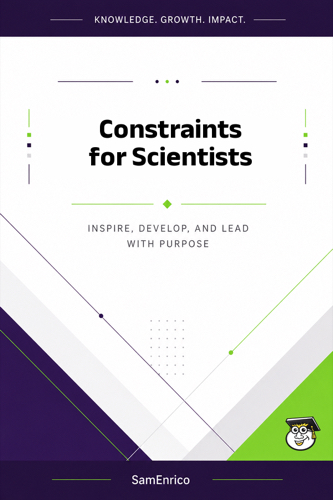
Constraints for Scientists Audiobook
Limited lab resources spark creative experiments.
Limited lab resources spark creative experiments.
Formats
Free sample
Chapter 1: The Abundance Trap...--Why having too many resources often leads to lazy thinking, while scarcity forces deeper engagement with problems.Every scientist knows the feeling. You walk into a newly renovated laboratory. The floors are polished epoxy, immaculate and chemical-resistant. Racks of pristine pipettes sit in their designated holders. A gleaming mass spectrometer—service contract included, warranty valid for three years—hums softly in the temperature-controlled corner.
Freezers line the far wall, each one empty, waiting, capable of storing ten thousand samples at negative eighty degrees Celsius. The grant came through. The equipment arrived. The postdocs have been hired. You have everything you could possibly need.And that, paradoxically, is when your creativity begins to die.This is the abundance trap.
It is not a problem of motivation, intelligence, or work ethic. It is a problem of cognitive ecology—the hidden ways that our environment shapes how we think. When resources overflow, our minds take shortcuts. We reach for expensive solutions because they are convenient, not because they are clever. We run kitchen-sink experiments because we can, not because we should.
We confuse activity with progress, data with understanding, equipment with insight.The most innovative science in history was not done in well-funded palaces of technology. It was done in cramped basements, repurposed horse stables, and borrowed space where researchers had to fight for every reagent, every hour of instrument time, every square inch of freezer space. This is not a romanticization of poverty. It is an empirical observation about how human cognition responds to constraints.This chapter introduces the scarcity spectrum—a framework that will guide the entire book. At one extreme lies destructive scarcity: so few resources that no meaningful hypothesis can be tested.
At the other lies destructive abundance: so many resources that creativity atrophies. Somewhere in the middle lies productive scarcity: enough resources to work, not enough to waste. The goal of this book is not to convince you to embrace poverty. The goal is to help you find your place on that spectrum and to recognize when you have drifted into the trap of abundance.The Cognitive Cost of Having Everything Let us begin with a simple experiment, one that you can perform in your own mind. Imagine that you need to attach a candle to a wall so that it burns without dripping wax onto the floor below.
You are given a box of thumbtacks, a book of matches, and the candle itself. Most people try to tack…
This is the end of the free sample. Get the Audiobook to keep going. Buy now
About this book
Details
- Author
- Hildebrand Cleotilde
- Publisher
- SamEnrico
- Language
- English
- Genre
- Non-Fiction, Self-Help, Science
- Released
- 2026-06-06
- Pages (approx.)
- 158
- Available as
- eBook, Audiobook

Listen in the VoxFlicks app
Audiobooks and audio dramas wherever you go. Sign in with your SamEnrico account and press play.
More by Hildebrand Cleotilde
 German Renewable IncentivesHildebrand Cleotilde$11.99
 Carson Science CommunicationHildebrand Cleotilde$11.99
 Partner Support Postpartum GuideHildebrand Cleotilde$11.99
 Store Replenishment AIHildebrand Cleotilde$11.99
 Chunking for History DatesHildebrand Cleotilde$11.99
 Assertiveness for CouplesHildebrand Cleotilde$11.99
 The Gold Bullion Robbery: London's Greatest Bank HeistHildebrand Cleotilde$11.99
 The Forgotten Champion: Samuel Wanjiru's Olympic Scandal and LegacyHildebrand Cleotilde$11.99
 How to Become a Balance TruerHildebrand Cleotilde$11.99
 How to Produce Construction MaterialsHildebrand Cleotilde$11.99
 Cats: Felis CatusHildebrand Cleotilde$11.99
 Pronoun Clarity PromptsHildebrand Cleotilde$12.99
You may also like
 Hong Kong Handover 1997Dunn Johnnie$11.99
 Zumba For Postnatal Recovery CourseNeal Christian$11.99
 Zumba for BeginnersLadner Nikia$11.99
 YouTube Comment Mining GuideHumes Pandora$12.99
 Worry Box MeditationCarlin Rudy$11.99
 Workplace Stress MeditationNguyen Lynn$11.99
 Workplace Stress and Sleep RepairHawley Ivory$11.99
 Workplace Perfectionism CureDelaney Jeffry$11.99
 Workplace Injustice Anger GuideWallen Isabelle$11.99
 Work Addiction and Burnout LinkGreenwood Ester$11.99
 Women in Yoga and WellnessBeattie Galina$11.99
 Women in Stand Up ComedyChun Evangeline$11.99