
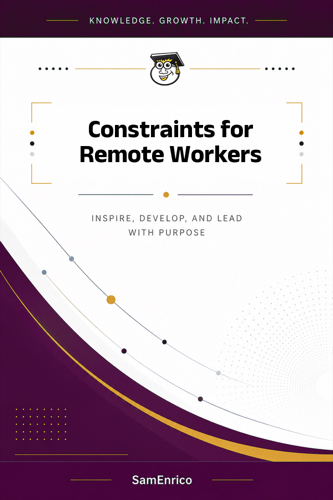
Constraints for Remote Workers eBook
Limited tools for creative problem solving.
by Pickens Meta
Limited tools for creative problem solving.
Formats
Free sample
Chapter 1: The Empty Promise--–- The most creative people I know don’t have more tools. They have fewer. Much fewer. And that is not a coincidence—it is the entire point.On a Tuesday morning in March, I watched a brilliant product manager named Sarah spend forty-seven minutes choosing a font.Not designing. Not solving.
Not even prototyping. Choosing. A. Font.She had eight tabs open: Figma for mockups, Miro for brainstorming, Canva for quick visuals, Google Fonts for browsing, Slack for soliciting opinions from her team, Zoom for a “quick sync” that ran thirty minutes over, Jira for tracking the decision she hadn’t made yet, and Notion for documenting the process she wasn’t following. Her calendar was almost empty, which should have been liberating.
Her notification tray was full of messages she felt obligated to answer immediately. Her screen was a kaleidoscope of half-finished thoughts, unread threads, and blinking cursors.She made zero progress.Then she cried.Not because she was weak. Not because she was incompetent. Not because she was lazy or unmotivated or bad at her job. She cried because she had been given everything—unlimited time, endless digital tools, complete asynchronous flexibility—and everything had broken her.This book is for everyone who has ever felt stupid in front of an infinite digital canvas.
You are not stupid. You are unconstrained. And unconstraint is a disease.The Great Misunderstanding of Remote Work Remote work sold us a promise. The promise was freedom. No commute, no rigid schedule, no manager hovering over your shoulder, no arbitrary boundaries.
You could work from anywhere, at any time, in any way that suited your creative process. You could choose your own tools, set your own hours, design your own workflow. The only limit was your imagination.That promise was a lie.Not because remote work is bad. Remote work, done well, is extraordinary. The lie is the assumption that more freedom leads to more creativity.
The lie is that constraints are the enemy. The lie is that the only thing holding you back is the absence of the right tool, the right meeting, the right workflow, the right software subscription.Here is the truth that Sarah discovered after forty-seven minutes of font selection, after the tears dried, after she closed six of her eight tabs and wrote a single sentence in a text file: The brain does not thrive in infinite space. The brain thrives in structured space. The brain needs walls.Physical offices have walls. Not just literal walls—cubicle partitions, closed doors, room capacities that force meetings to end.
Physical offices have social walls: the colleague who walks to your desk, the clock on the wall that says the meeting is almost over, the coffee machine that only has room for two people at a time. Each of these is a constraint. Each of these removes a decision. You do not decide to end the meeting—the next group needs the room. You do not decide to stop talking—someone is at your desk.
You do not decide to close your laptop—the train is arriving.Remote work removed all of those walls. And in their place, it gave you... nothing. A blank calendar. An empty notification tray.
A text editor with no word limit. A video call with no automatic ending. A chat channel that never sleeps.That is not freedom. That is a vacuum. And the human brain is not designed for vacuums.The Cognitive Tax of Infinite Choice Psychologists have known for decades that choice is not always good.
The phenomenon is called “choice overload” or “decision paralysis.” In one famous study, researchers set up a jam tasting booth in a grocery store. One day, they offered twenty-four varieties of jam. The next day, they offered only six. Shoppers were much more likely to stop at the booth with twenty-four jams—but they were ten times more likely to buy when there were only six. More choice attracted attention.
Less choice closed sales.The same principle applies to remote creative work. When you have unlimited tools, unlimited time, unlimited ways to solve a problem, you spend your cognitive energy on choosing rather than doing. Every decision—which app to open, which template to use, which notification to answer first, which problem to solve, which solution to pursue—drains the same limited reservoir of willpower and attention.This is called “decision fatigue.” And it is the hidden tax of remote work.Let me be specific about what decision fatigue looks like in practice. It looks like:Opening and closing four different apps before starting a task, because you cannot decide which one is “right” for the problem.Spending fifteen minutes scrolling through templates instead of writing a single sentence from scratch.Leaving a blank digital whiteboard open in a browser tab for three hours, hoping that inspiration will strike if you just look at it long enough.Postponing a decision until “more information arrives,” when the real problem is that you have too much information already.Finishing fewer creative tasks in an eight-hour remote day than you used to finish in four hours at an office.These are not signs of laziness. They are signs of an environment that has removed all of the cognitive scaffolding your brain evolved to use.Here is what your brain is doing while you stare at a blank screen, unable to start:Your prefrontal cortex—the part of your brain responsible for planning, decision-making, and impulse control—is running a continuous background process.
That process is asking: “What should I do next?” In a physical office, this question has a short list of possible answers: check email, walk to a colleague’s desk, go to a meeting, work on the thing on your monitor. The environment narrows the options for you.In a remote environment, the question has no short list. The answer could be anything. You could work on Project A or Project B or Project C. You could email a client or Slack a colleague or write a memo or design a prototype or research a competitor or reorganize your files or take a break or go for a walk or call your partner or scroll social media or watch a tutorial or read documentation or...Your brain is not lazy.
It is overwhelmed. And when the brain is overwhelmed, it defaults to one of two behaviors: paralysis (doing nothing) or random action (doing anything). Neither produces creative solutions. Both produce anxiety.The Remote Void vs. The Open Office I want to pause here and address an obvious objection.
Some of you are thinking: “But the open office was terrible. It was noisy, distracting, chaotic. I am so much more focused at home. How can you say the remote void is worse than the open office?”I am not saying the open office was good. I am saying that the open office provided different cognitive scaffolding than the remote void—and that some people mistake the absence of negative stimuli (noise, interruptions) for the presence of positive structure (scheduled breaks, natural meeting endings, visible social cues).Let me break this down.In a typical open office, the constraints are…
This is the end of the free sample. Get the eBook to keep going. Buy now
About this book
Details
- Author
- Pickens Meta
- Publisher
- SamEnrico
- Language
- English
- Genre
- Non-Fiction, Self-Help, Remote
- Released
- 2026-06-09
- Pages (approx.)
- 158
- Available as
- eBook, Audiobook

Read better in the ZLOADR app
Your eBooks on your phone or tablet. Sign in with your SamEnrico account and start reading.
More by Pickens Meta
 Meditation for PTSD HyperarousalPickens Meta$11.99
 Divorce and Friendship LossPickens Meta$11.99
 Core Competencies ListPickens Meta$11.99
 Boundary Setting for FirefightersPickens Meta$11.99
 Anticipatory Grief And FaithPickens Meta$11.99
 Driving Without Drama MethodPickens Meta$11.99
 Breast Biopsy Types GuidePickens Meta$11.99
 The Silk and the Scroll: The Forbidden Art of Shira Bint al-HakimPickens Meta$11.99
 The Silk Road Showdown: The Rivalry That Sparked Middle Eastern WrestlingPickens Meta$11.99
 A Collector's Handbook to the Triumph 1300 TcPickens Meta$11.99
 Rental Agreement Security Deposit HacksPickens Meta$12.99
 PESTLE Analysis PromptsPickens Meta$12.99
You may also like
 Hong Kong Handover 1997Dunn Johnnie$11.99
 Zumba For Postnatal Recovery CourseNeal Christian$11.99
 Zumba for BeginnersLadner Nikia$11.99
 YouTube Comment Mining GuideHumes Pandora$12.99
 Worry Box MeditationCarlin Rudy$11.99
 Workplace Stress MeditationNguyen Lynn$11.99
 Workplace Stress and Sleep RepairHawley Ivory$11.99
 Workplace Perfectionism CureDelaney Jeffry$11.99
 Workplace Injustice Anger GuideWallen Isabelle$11.99
 Work Addiction and Burnout LinkGreenwood Ester$11.99
 Women in Yoga and WellnessBeattie Galina$11.99
 Women in Stand Up ComedyChun Evangeline$11.99