
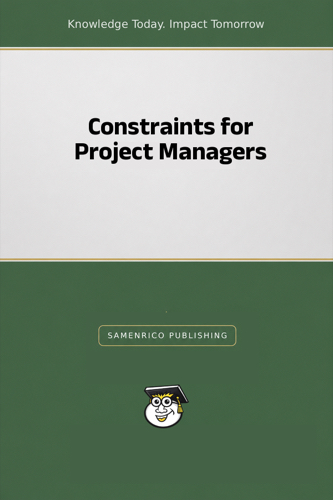
Constraints for Project Managers eBook
Limited resources for creative project delivery.
Limited resources for creative project delivery.
Formats
Free sample
Chapter 1: The Gift of Less--–- The email arrives at 4:47 PM on a Tuesday. The subject line reads: “Budget Realignment – Immediate Action Required.” Your stomach drops. You open it. A 15 percent budget cut. Twenty percent if you include the freeze on new hires.
Your first instinct is to fight. To write back demanding an explanation. To call the finance lead and argue. To gather your team and deliver the bad news with a solemn face. That instinct is wrong.Not because the budget cut isn't painful.
It is. Not because your team won't feel the squeeze. They will. But because your first instinct—the one etched into every project management textbook, every certification course, every war story told over stale pizza in conference rooms—is built on a lie. The lie is this: more resources produce better results.The data says otherwise.
The research says otherwise. And the most innovative creative teams in the world have learned what you are about to learn in this chapter: constraints are not the enemy of creativity. They are its engine.This chapter will do three things. First, it will dismantle the myth of abundance—the deeply held belief that more time, more money, and more people lead to better creative outcomes. Second, it will introduce the first layer of a three-layer reframing system that runs throughout this book: how to change your own relationship with scarcity before you try to change your team's or your stakeholders'.
Third, it will give you a practical tool to use the next time a budget cut or resource reduction lands on your desk—so that instead of panicking, you start designing.By the end of this chapter, you will no longer see a budget cut as a problem to be solved by begging for more. You will see it as a design parameter. And that shift—from victim to architect—is the single most important transformation this book will teach you.The Myth of Abundance Let us start with a simple experiment. Two groups of creative professionals are given the same brief: design a product concept that solves a specific user problem. Group A is told they have unlimited budget and eight weeks.
Group B is told they have half the budget and four weeks. Which group produces the more innovative solution?If you answered Group A—the team with more time and money—you are in the majority. And you are wrong.David Epstein, in his groundbreaking 2026 book Inside the Box, ran this exact experiment across multiple industries: software development, marketing campaign design, product engineering, and architectural concepting. The results were consistent and striking. Groups given "unlimited possibilities" took three times longer to produce solutions that were rated less creative by blind judges than groups given strict material constraints.
Epstein's conclusion: “Total freedom is psychologically paralyzing.”Why? Because constraints provide what psychologists call a "forcing function." When you have unlimited options, every decision becomes a negotiation with infinity. Should we try approach A or approach B? Why not both? And while we're at it, what about C, D, and E?
The team chases tangents. They gold-plate features no one asked for. They debate endlessly because there is no criterion to end the debate. The constraint—the thing they are missing—would have been the very thing that told them when to stop.This is not a niche finding. Harvard Business Review's analysis of the "Project Economy"—a dataset of more than ten thousand projects across industries—found that projects with "moderate resource scarcity" (defined as ten to thirty percent below the initial requested budget) scored twenty-two percent higher on stakeholder innovation ratings than fully funded projects.
Not slightly higher. Dramatically higher.The researchers offered a provocative explanation: when teams have exactly what they asked for, they feel no pressure to innovate. They execute the plan. They check the boxes. They deliver exactly what was promised, no more, no less.
But when teams have less than they asked for, something shifts. They can no longer execute the original plan. They must invent a new one. And that act of invention—forced by scarcity—produces work that is more focused, more distinctive, and more memorable.There is a psychological mechanism at work here as well. The psychologist Michael Norton and his colleagues identified what they called the "Ikea Effect"—the finding that people value products more highly when they have invested labor in assembling them.
The same principle applies to creative work under constraint. When a team overcomes resistance—when they figure out how to deliver a stunning result with half the budget they thought they needed—they don't just feel relief. They feel pride. They feel ownership. The constraint becomes part of the story they tell about the work.
And that story makes the work matter more.So if abundance is not the answer, what is? The answer is not to seek scarcity for its own sake. Starving artists and burnt-out teams are not romantic; they are dysfunctional. The answer is to stop fearing scarcity when it arrives. To stop reflexively fighting for more.
And to start asking a different question: what does this constraint make possible?The Two Faces of Time Pressure Before we go further, we need to address a critical distinction—one that will prevent confusion between this chapter and Chapter 7, where we explore time boxing in depth.Not all time pressure is created equal. There is a profound difference between panic-driven rushing and deliberate time pressure. Panic-driven rushing is what happens when a deadline pulls in unexpectedly, no one adjusts scope, and the team simply tries to work faster. Quality collapses. Mistakes multiply.
People burn out. This is bad. This chapter is not endorsing panic-driven rushing.Deliberate time pressure is something else entirely. It is the intentional compression of timelines with corresponding adjustments to scope, quality expectations, or both. It is the decision to say: "We have four weeks instead of six.
That means we cannot do everything we planned. What will we drop? What will we simplify? What will we defer?" This is good. This is what Chapter 7 will teach you to do systematically.The difference is planning.
Panic-driven rushing is reactive. Deliberate time pressure is proactive. Panic-driven rushing adds stress without adding structure. Deliberate time pressure imposes structure that forces prioritization. Throughout this book, when we talk about leveraging constraints, we are talking about deliberate, planned responses—not chaos.So when you read this chapter and hear that scarcity can be a gift, do not hear that you should slash your own budget for fun.
Hear this: when scarcity arrives at your door—as it inevitably will—you have a choice. You can react with panic and ask for more. Or you can respond with intention and ask a better question.The Resource Reflex: A Four-Step Framework Let us return to that Tuesday afternoon email. The budget cut has landed. Your heart is pounding.
Before you do anything else—before you reply, before you call a meeting, before you tell anyone—run the Resource Reflex.This is the first layer of the Unified Reframing Toolkit that will appear throughout this book. Layer one is for you, the manager, alone with the news. Layer two…
This is the end of the free sample. Get the eBook to keep going. Buy now
About this book
Details
- Author
- Preston Diamond
- Publisher
- SamEnrico
- Language
- English
- Genre
- Non-Fiction, Self-Help, Project
- Released
- 2026-06-05
- Pages (approx.)
- 117
- Available as
- eBook, Audiobook

Read better in the ZLOADR app
Your eBooks on your phone or tablet. Sign in with your SamEnrico account and start reading.
More by Preston Diamond
 Road Rage for New DriversPreston Diamond$11.99
 Intellectual Property ListPreston Diamond$11.99
 Meditation for Exam NervesPreston Diamond$11.99
 Divorce and Moving OutPreston Diamond$11.99
 Anticipatory Grief DepressionPreston Diamond$11.99
 Lifestyle Breast Cancer PreventionPreston Diamond$11.99
 Assertiveness for EngineersPreston Diamond$11.99
 The Siege of the Iranian Embassy in London: Terror in the Heart of the Cold WarPreston Diamond$11.99
 Ironclad Valor: The Harlem Hellfighters' Last Stand at Château-ThierryPreston Diamond$11.99
 How to Produce Contract Manufacturing For ElectronicsPreston Diamond$11.99
 Renting Out Your Action Camera FleetPreston Diamond$12.99
 UNC Argentina Student HandbookPreston Diamond$12.99
You may also like
 Hong Kong Handover 1997Dunn Johnnie$11.99
 Zumba For Postnatal Recovery CourseNeal Christian$11.99
 Zumba for BeginnersLadner Nikia$11.99
 YouTube Comment Mining GuideHumes Pandora$12.99
 Worry Box MeditationCarlin Rudy$11.99
 Workplace Stress MeditationNguyen Lynn$11.99
 Workplace Stress and Sleep RepairHawley Ivory$11.99
 Workplace Perfectionism CureDelaney Jeffry$11.99
 Workplace Injustice Anger GuideWallen Isabelle$11.99
 Work Addiction and Burnout LinkGreenwood Ester$11.99
 Women in Yoga and WellnessBeattie Galina$11.99
 Women in Stand Up ComedyChun Evangeline$11.99