
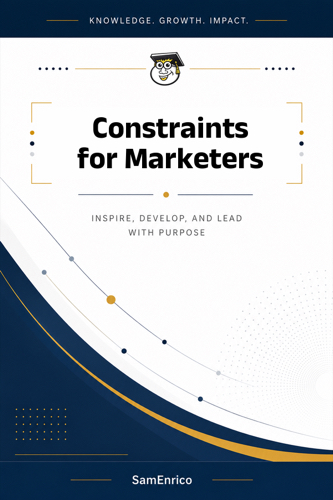
Constraints for Marketers eBook
Limited budget for creative campaigns.
by Frick Jon
Limited budget for creative campaigns.
Formats
Free sample
Chapter 1: The $10 Million Mistake...--–- The email arrived at 11:47 PM on a Tuesday. The CMO of a billion-dollar beverage company had just approved $10 million for a Super Bowl campaign. The brief was six words: "Make it memorable. Make it go viral." Three agencies pitched. One won.
The resulting 60-second spot featured dancing celebrities, special effects, and a jingle that cost $500,000 to produce. It aired in front of 100 million people. The company sold exactly 2,000 additional units the next week. That is a conversion rate of 0.002%. For $10 million, they could have hired 200 full-time salespeople, run 10,000 targeted Facebook campaigns, or given away 500,000 free samples.
Instead, they bought a memory that faded in 48 hours. This is not an exception. This is the rule.The myth of the Hail Mary—the belief that one big, expensive, creative swing will change everything—is the most expensive lie in marketing. It is perpetuated by agencies who bill by the hour, by platforms that sell reach, and by leaders who want to feel like they are doing something bold. But the data tells a different story.
A comprehensive analysis of 3,000 advertising campaigns conducted by the Institute of Practitioners in Advertising found that campaigns with budgets under $1 million generated a return on investment that was 47% higher than campaigns with budgets over $10 million. The smallest budgets delivered the largest returns. The biggest budgets delivered the smallest. This is not a coincidence. This is the Necessity Effect.This chapter dismantles the belief that solving a marketing problem requires more money.
You will learn why abundance destroys creativity, why the biggest failures in business history were funded by the deepest pockets, and how constraints force the kind of strategic focus that money cannot buy. By the end of this chapter, you will stop asking for more budget and start asking a much more powerful question: "What would I do if I had 90% less?" That forced choice is where the breakthrough lies.The Myth of the Hail Mary Every marketer has dreamed it. The Super Bowl spot. The Times Square billboard. The celebrity endorsement.
The viral video that breaks the internet. These dreams are not irrational. They are reinforced by survivor bias. We see the one campaign that worked—Old Spice's "The Man Your Man Could Smell Like," Dove's "Real Beauty Sketches," Apple's "1984"—and we ignore the 99.9% of big-budget campaigns that failed silently. The ones that cost $5 million and generated $500,000 in sales.
The ones that were forgotten by Monday morning. The ones that got the CMO fired.The Hail Mary myth rests on three false assumptions. First, that attention equals action. A million views on You Tube do not equal a million sales. In fact, a study by the Data & Marketing Association found that the average conversion rate for video ads viewed more than 1 million times is just 0.05%.
Second, that creativity scales with budget. This is demonstrably false. The most creative campaigns in history were born from scarcity, not abundance. Third, that big budgets buy safety. They do the opposite.
They buy the illusion of safety while masking the absence of strategy.Consider the most expensive marketing failure in history: New Coke. In 1985, Coca-Cola spent $4 million on research and development (approximately $12 million today) to reformulate its flagship product. They conducted 200,000 taste tests. They invested $10 million in advertising. They held a press conference that was broadcast to 1,500 journalists.
The result was a product that consumers hated so intensely that the company reintroduced the original formula 79 days later. The $12 million campaign did not fail because of bad execution. It failed because money replaced judgment. The company had so much budget that they never asked the basic question: "Should we do this at all?"The same pattern repeats across industries. Segway received $100 million in hype and PR before launch.
The company spent $1 million on a single ad campaign featuring Steve Jobs and Jeff Bezos (both declined to endorse the product, but the agency spent the money anyway). The product failed because it solved a problem no one had. Google Glass received $100 million in development and a brilliant marketing campaign featuring skydivers and fashion models. It failed because people did not want cameras on their faces. In every case, the budget was not the solution.
The budget was the distraction.The Spray and Pray Trap When budgets are large, marketers avoid difficult choices. They run ads on every channel because they can. They target everyone because it is easier than segmenting. They produce generic creative because customizing for each audience costs time and political capital. This is the Spray and Pray Trap: spray money across as many channels as possible, and pray that something works.The trap is seductive because it feels productive.
The marketing dashboard shows impressions, reach, and frequency all going up. The team is busy. The agency is happy. But beneath the surface, the trap is destroying value. When you run ads everywhere, you cannot measure anything.
If a campaign runs on Facebook, Instagram, Tik Tok, Linked In, You Tube, and Google Display, how do you know which channel drove the sale? You do not. You guess. And guessing with a large budget is not marketing—it is charity for advertising platforms.A landmark study by the Ehrenberg-Bass Institute for Marketing Science analyzed 1,000 campaigns across 50 countries. They found that campaigns targeting more than three channels simultaneously had a 70% higher rate of "attribution failure"—the inability to determine which channel generated the return.
In other words, the more channels you add, the less you know. And the less you know, the harder it is to improve.The Spray and Pray Trap also creates a culture of safety. When you spread your budget thinly, no single channel bears the weight of success or failure. If Facebook fails, you still have Google. If Google fails, you still have Tik Tok.
This diffusion of responsibility means no one is accountable. And when no one is accountable, no one learns. The same mistakes repeat quarter after quarter. The same waste continues. The only thing that changes is the size of the budget request for next year.This is not hypothetical.
I have consulted for a mid-sized e-commerce company that was spending $200,000 per month on paid ads across seven channels. Their CEO asked me to audit their performance. After three weeks of analysis, I discovered that 94% of their revenue was coming from two channels: Google Shopping and retargeting on Facebook. The other five channels—Linked In, Tik Tok, Snapchat, Pinterest, and Twitter—were generating 6% of revenue while consuming 40% of the budget. When I asked the CMO why they remained on those channels, he said, "We've always been on them.
And we might miss something if we leave." That is Spray and Pray. That is fear dressed as strategy. And it is expensive.The Necessity Effect: Why Constraints Force Innovation In 1943, the United States military faced a desperate problem. German submarines were sinking cargo ships faster than American shipyards could replace them. The standard solution was to build more ships, but steel was scarce and time was shorter.
The military asked a group of engineers to solve the problem with a brutal constraint: they could not use more steel. They could not build larger ships. They had to work with…
This is the end of the free sample. Get the eBook to keep going. Buy now
About this book
Details
- Author
- Frick Jon
- Publisher
- SamEnrico
- Language
- English
- Genre
- Non-Fiction, Self-Help, Marketing
- Released
- 2026-06-06
- Pages (approx.)
- 139
- Available as
- eBook, Audiobook

Read better in the ZLOADR app
Your eBooks on your phone or tablet. Sign in with your SamEnrico account and start reading.
More by Frick Jon
 Divorce After StillbirthFrick Jon$11.99
 PESTEL Analysis SummaryFrick Jon$11.99
 Tailgating Response StrategiesFrick Jon$11.99
 Fashion Inventory AIFrick Jon$11.99
 Assertiveness for PilotsFrick Jon$11.99
 Chunking for Seniors GuideFrick Jon$11.99
 Breast Cancer Symptoms ChecklistFrick Jon$11.99
 The Illuminated Deceiver: How a 15th-Century Persian Calligrapher Forged a MasterpieceFrick Jon$11.99
 The Alchemists' Feast: A Banquet of EnlightenmentFrick Jon$11.99
 How to Produce Packaging RopeFrick Jon$11.99
 How to Produce Contact Lens Care ProductsFrick Jon$11.99
 Chinchillas: PET Care, Habitat, Fur & BehaviorFrick Jon$11.99
You may also like
 Hong Kong Handover 1997Dunn Johnnie$11.99
 Zumba For Postnatal Recovery CourseNeal Christian$11.99
 Zumba for BeginnersLadner Nikia$11.99
 YouTube Comment Mining GuideHumes Pandora$12.99
 Worry Box MeditationCarlin Rudy$11.99
 Workplace Stress MeditationNguyen Lynn$11.99
 Workplace Stress and Sleep RepairHawley Ivory$11.99
 Workplace Perfectionism CureDelaney Jeffry$11.99
 Workplace Injustice Anger GuideWallen Isabelle$11.99
 Work Addiction and Burnout LinkGreenwood Ester$11.99
 Women in Yoga and WellnessBeattie Galina$11.99
 Women in Stand Up ComedyChun Evangeline$11.99