
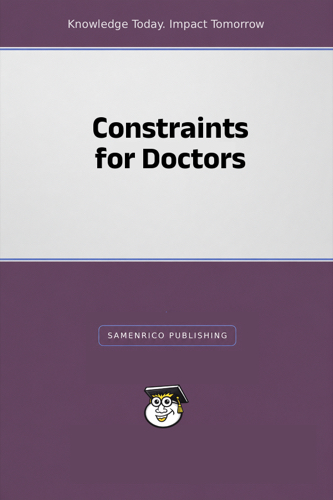
Constraints for Doctors eBook
Limited appointment time for creative diagnoses.
Limited appointment time for creative diagnoses.
Formats
Free sample
Chapter 1: The 15-Minute Lie...--–- The first time I watched a brilliant diagnostician fail, it wasn’t because she didn’t know the medicine. It was because the clock ran out. Dr. Elena Vasquez had twenty-two years of clinical experience, a near-photographic memory for rare disease presentations, and a waiting room full of patients who had transferred from other practices specifically to see her. But on a Tuesday afternoon in March, she sat across from a fifty-three-year-old man with intermittent fevers, weight loss, and a strange rash that came and went.
She had exactly fifteen minutes to figure out what three other doctors had missed over eighteen months.She started strong. Her first three minutes were a masterclass in targeted history-taking. She ruled out malignancy with a few pointed questions, eliminated autoimmune conditions with two more, and landed on a working hypothesis of subacute bacterial endocarditis—unlikely given the absence of a murmur, but possible. Then she had to stop. The electronic medical record was flashing a prior authorization request for a different patient.
A nurse knocked with a lab result that couldn’t wait. Her pager buzzed with a message from the front desk about a patient in room four who had been waiting thirty minutes. By the time she looked back at the man with the rash, nine minutes had evaporated. She ordered blood cultures, prescribed a broad-spectrum antibiotic “just in case,” and moved to the next room.The man returned two weeks later, sicker. His blood cultures were negative.
The rash had spread. Dr. Vasquez had to start over—but again, fifteen minutes. She ordered an ANA panel, an ESR, a CRP, a chest X-ray, and a referral to rheumatology. The rheumatologist saw him for twenty minutes and said, “I don’t think this is rheumatologic.” The man saw three more doctors over the next six months.
Eventually, a resident in infectious disease—who had the luxury of an hour-long appointment—noticed that the rash appeared only after hot showers. That single clue led to a diagnosis of erythema marginatum, a rare manifestation of an even rarer condition called hereditary angioedema with C1 inhibitor deficiency. The man had been suffering from intermittent episodes of subcutaneous and gastrointestinal swelling for two years. The treatment was a simple monthly infusion. He had it within a week.Dr.
Vasquez wasn’t incompetent. She wasn’t lazy. She was constrained.This book is about that constraint. It is not a clinical textbook. It is not a time-management guide.
It is a field manual for a specific, urgent problem: how to think creatively and diagnostically when the system has given you almost no time to think at all. The premise is simple but radical: the 15-minute appointment is not a medical necessity—it is an economic and historical artifact that has been mistaken for a law of nature. And once you see it as an artifact, you can redesign your cognitive processes, your workflow, and your environment to restore the creative thinking that drew you to medicine in the first place.The Invention of the Short Visit To understand why you feel perpetually rushed, you have to understand how the 15-minute slot came to dominate American medicine. It was not handed down from Mount Sinai. It was engineered.Before the 1980s, the typical primary care appointment lasted twenty to thirty minutes.
Physicians billed fee-for-service, but the coding system was primitive, and the pressure to maximize volume was tempered by professional norms that valued thoroughness. That changed with the introduction of the Resource-Based Relative Value Scale (RBRVS) in 1992, which systematically undervalued cognitive work (thinking, diagnosing, explaining) and overvalued procedural work (testing, injecting, scoping). Simultaneously, managed care organizations began demanding higher “throughput”—more patients per hour, shorter wait times, lower overhead per visit. The 15-minute slot emerged as the sweet spot: long enough to bill for a mid-level visit (99213 or 99214), short enough to squeeze four patients per hour into a physician’s schedule.The math was seductive. A primary care physician seeing four patients per hour for eight hours could bill for thirty-two visits per day.
At an average reimbursement of $100 per visit (adjusted for payor mix), that was $3,200 in daily revenue, or roughly $700,000 annually. Drop to three patients per hour (twenty-minute visits), and the annual revenue fell to $525,000. The message was clear: time was money, and money was time.But here is what that math conceals: diagnostic errors are expensive too. A missed diagnosis of aortic dissection costs an average of $2.3 million in malpractice payouts plus uncountable reputational damage. A delayed cancer diagnosis can lead to stage migration, worse outcomes, and lawsuits that bankrupt practices.
The 15-minute slot saves money on the front end—lower overhead, more patients per day—but it externalizes the cost to patients and to the physicians who bear the psychological weight of knowing they didn’t have enough time to think.The 15-minute lie, then, is the lie of false economy. It pretends that speed and depth are trade-offs that medicine has already optimized. In fact, they are trade-offs that finance departments have optimized. And you have been left to live with the consequences.System 1, System 2, and the Cognitive Cost of the Clock Why does time pressure kill diagnostic creativity? The answer lies in how the human brain makes decisions under different conditions.In Thinking, Fast and Slow, Daniel Kahneman describes two cognitive systems.
System 1 is fast, automatic, intuitive, and energy-efficient. It’s what you use when you glance at a patient and think, “That’s a cold,” or “That’s a urinary tract infection.” System 1 operates on pattern recognition. It works beautifully for common, straightforward presentations. But it is also prone to systematic biases—premature closure, confirmation bias, availability bias, anchoring. System 1 will happily diagnose the fiftieth cold of the day without ever considering that the fifty-first cold might be something else.System 2 is slow, analytical, deliberate, and energy-intensive.
It’s what you use when a patient’s presentation doesn’t fit a pattern, and you have to stop, review the data, generate a differential, and think through probabilities. System 2 is where creativity lives. It is also where rare diagnoses are made, atypical presentations are recognized, and diagnostic errors are prevented.Here is the problem: System 2 requires time and cognitive quiet. It cannot be rushed. It cannot be interrupted.
And it cannot operate when your working memory is already full of other tasks—prior authorizations, EMR clicks, patient flow logistics, lab result notifications, billing codes.The 15-minute appointment is explicitly designed to suppress System 2. It forces you into System 1 because System 1 is the only system that can keep up. When the clock is ticking, you don’t have time to generate three unlikely differentials. You have time to generate one likely differential, act on it, and move on. That’s fine for the 90% of visits that are straightforward.
But the other 10%—the diagnostic puzzles, the atypical presentations, the patients who have been suffering for months without answers—those are the visits where System 2 is essential. And those are exactly the visits that get sacrificed on the altar of throughput.Consider the data. A landmark study in BMJ Quality & Safety analyzed over 1,000 diagnostic errors in primary…
This is the end of the free sample. Get the eBook to keep going. Buy now
About this book
Details
- Author
- Schroeder Oswaldo
- Publisher
- SamEnrico
- Language
- English
- Genre
- Non-Fiction, Self-Help, Medical
- Released
- 2026-06-08
- Pages (approx.)
- 143
- Available as
- eBook, Audiobook

Read better in the ZLOADR app
Your eBooks on your phone or tablet. Sign in with your SamEnrico account and start reading.
More by Schroeder Oswaldo
 Postpartum Contraception GuideSchroeder Oswaldo$11.99
 Traffic Frustration First AidSchroeder Oswaldo$11.99
 Performance Anxiety MeditationSchroeder Oswaldo$11.99
 Partnerships and AlliancesSchroeder Oswaldo$11.99
 Mammogram Preparation HandbookSchroeder Oswaldo$11.99
 Anticipatory Grief Support GroupsSchroeder Oswaldo$11.99
 Boundary Setting for ChefsSchroeder Oswaldo$11.99
 The Cartel Laundromat: How Latin America's Banks Fueled Narco WarsSchroeder Oswaldo$11.99
 The Clockwork Oracle of DelphiSchroeder Oswaldo$11.99
 How to Produce a Consumer Electronics Hall of FameSchroeder Oswaldo$11.99
 How to Become a CoppersmithSchroeder Oswaldo$11.99
 Timeline Construction PromptsSchroeder Oswaldo$12.99
You may also like
 Hong Kong Handover 1997Dunn Johnnie$11.99
 Zumba For Postnatal Recovery CourseNeal Christian$11.99
 Zumba for BeginnersLadner Nikia$11.99
 YouTube Comment Mining GuideHumes Pandora$12.99
 Worry Box MeditationCarlin Rudy$11.99
 Workplace Stress MeditationNguyen Lynn$11.99
 Workplace Stress and Sleep RepairHawley Ivory$11.99
 Workplace Perfectionism CureDelaney Jeffry$11.99
 Workplace Injustice Anger GuideWallen Isabelle$11.99
 Work Addiction and Burnout LinkGreenwood Ester$11.99
 Women in Yoga and WellnessBeattie Galina$11.99
 Women in Stand Up ComedyChun Evangeline$11.99