
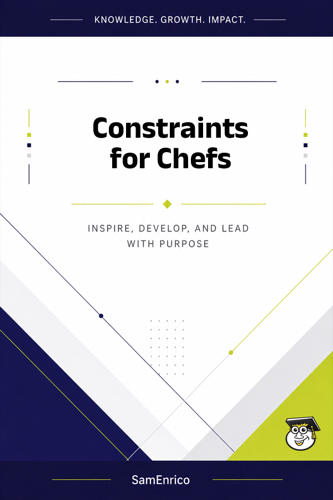
Constraints for Chefs
Limited ingredients lead to signature dishes.
by Potter Ramon
Limited ingredients lead to signature dishes.
Formats
About this book
Free sample
Chapter 1: The Three-Piece Suit--–- Every chef remembers the dish that humbled them. For me, it was a seared salmon fillet during my second year in a professional kitchen. I had fifteen ingredients laid out like soldiers: beurre blanc, caperberries, dill sprigs, microgreens, lemon oil, smoked paprika, pickled fennel, and seven other components I no longer remember. The plate looked like a farmers' market exploded on porcelain. My chef de cuisine took one look, scraped everything into the compost, and handed me a single piece of salmon, a ramekin of salt, and a pat of butter.
"Make me remember this," he said. "Not the garnish. The fish."That moment changed everything I believed about cooking. Until then, I had operated under what I now call the "More is More" fallacy—the unconscious belief that every additional ingredient adds proportional value to a dish. More spices mean more complexity.
More garnishes mean more visual appeal. More sauce means more forgiveness. The restaurant industry reinforces this fallacy relentlessly: cookbooks with thirty-ingredient shopping lists, social media posts loaded with impossible garnishes, and a persistent cultural whisper that simplicity is for amateurs who lack technique.The opposite is true. Simplicity is the arena where masters prove themselves.The Radical Proposition This chapter makes a claim that will sound absurd to anyone trained in the "add one more thing" school of cooking: a dish with more than three primary ingredients rarely improves beyond the third. Not sometimes.
Not in certain cuisines. Rarely. The law of diminishing returns in cooking is not linear—it is a steep cliff that drops dramatically after the third intentional component.I am not speaking about spices, aromatics, or the foundational elements that build a stock or a braise. I am speaking about what Rozanne Gold, whose work anchors this entire philosophy, calls "primary ingredients"—the distinct elements a diner can identify on the plate, each carrying its own texture, flavor profile, and structural role. A Caesar salad, properly made, has eight or nine primary ingredients: anchovy, garlic, egg yolk, Parmesan, lemon, Worcestershire, Dijon, olive oil, and croutons.
The version I want you to learn to make has three: garlic, oil, and salt—an emulsion so pure it becomes…
This is the end of the free sample. Get the eBook to keep going. Buy now
Contents
- Chapter 1
- Chapter 2
- Chapter 3
- Chapter 4
- Chapter 5
- Chapter 6
- Chapter 7
- Chapter 8
- Chapter 9
- Chapter 10
- Chapter 11
- Chapter 12
Details
- Author
- Potter Ramon
- Publisher
- SamEnrico
- Language
- English
- Genre
- Non-Fiction, Self-Help, Culinary
- Released
- 2026-06-11
- Pages (approx.)
- 145
- Available as
- eBook, Audiobook

Read better in the ZLOADR app
Your eBooks on your phone or tablet. Sign in with your SamEnrico account and start reading.
More by Potter Ramon
 Chunking for Presentation SlidesPotter Ramon$11.99
 Calm Driving Techniques HandbookPotter Ramon$11.99
 Assumptions Validation PlanPotter Ramon$11.99
 Postpartum Hair Loss GuidePotter Ramon$11.99
 Social Anxiety Meditation ScriptsPotter Ramon$11.99
 Italian Green IncentivesPotter Ramon$11.99
 Assertiveness for Customer ServicePotter Ramon$11.99
 The Lost Symphony: Mozart’s Unfinished MasterpiecePotter Ramon$11.99
 The Lost Kingdoms of the Indian Ocean: The Swahili Mariners' Secret ChartsPotter Ramon$11.99
 A Beginners Guide to Sumo Wrestling (Volume 1)Potter Ramon$11.99
 How to Produce Packaging and AssemblyPotter Ramon$11.99
 How to Produce Construction ProjectsPotter Ramon$11.99
You may also like
 The Executive Chef Stress GuideZielinski Ellie$11.99
 Chunking Recipes And CookingBernstein Ocie$11.99
 Flow in CookingTan Nicolette$11.99
 Creative Habits for ChefsGallant Tonie$11.99
 Loneliness And Cooking TogetherBacon Madie$11.99
 Anger for ChefsYu Jackelyn$11.99
 Alcoholism Recovery for Chefs and RestaurateursBou Adeline$11.99
 The EQ for Chefs GuideRamey Elvie$11.99
 Success Without Burnout for ChefsForsyth Ivory$11.99
 Food Service Chef Stress GuideShoemaker Shirleen$11.99
 Burnout Recovery For ChefsDuke Majorie$11.99
 Assertiveness for ChefsCarbone Reinaldo$11.99