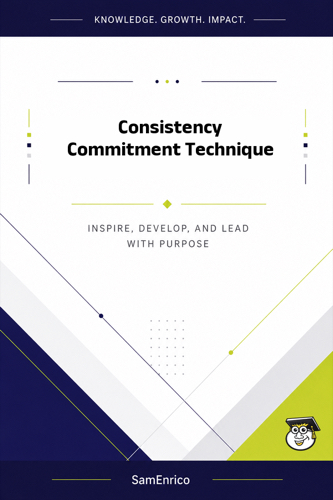
Consistency Commitment Technique eBook
Start with small yes to build toward big yes.
Start with small yes to build toward big yes.
Formats
Free sample
Chapter 1: The $47 Billion Mistake...--Picture this. You’re standing in a conference room. Twelve executives stare at you. You’ve spent six months preparing for this moment. Your slides are perfect.
Your data is airtight. Your product is brilliant. You take a breath and ask for the thing you came for: “We need two million dollars to launch.”Silence. Then a polite nod. Then the words that will haunt you for weeks: “We’ll think about it.”You walk out with nothing.
Not because your idea was bad. Not because your pitch was weak. Because you asked for too much, too fast. You made the $47 billion mistake.What is the $47 billion mistake? It’s the collective cost of every “no” that should have been a “yes.” Every sale that didn’t close.
Every promotion that went to someone else. Every habit that died after three days. Every relationship that stalled because someone asked the wrong question at the wrong time.This book exists because that mistake is completely avoidable. And the solution has nothing to do with being more persuasive, more charismatic, or more aggressive. It has to do with understanding a single, hidden lever inside every human brain: the drive for consistency.But let’s start with a story.
A true story from 1966 that changed everything we know about persuasion.The Sticker That Changed Psychology In the mid-1960s, two Stanford psychologists named Jonathan Freedman and Scott Fraser wanted to understand something that had puzzled salespeople for generations. Why do some “no’s” turn into “yes’s” over time? Why does a homeowner who slams the door in your face today sometimes invite you in for coffee next month?They designed a simple experiment. They went door to door in a suburban California neighborhood and asked homeowners a small, almost laughable favor: “Would you be willing to place a tiny, three-inch sticker in your window that says ‘Be a Safe Driver’?”Almost everyone said yes. Why wouldn’t they?
It was a sticker. It took three seconds to apply. It promoted a cause nobody disagreed with. It cost nothing. It was, in the language this book will teach you, a Micro-Yes.Two weeks later, the researchers returned to the same neighborhood with a completely different request.
This time, they asked homeowners to allow a massive, ugly billboard to be installed on their front lawn. The billboard read “Drive Carefully” and was so large it would block part of the house’s facade. The researchers knew from previous testing that asking for the billboard directly resulted in a “no” from nearly every homeowner. It was a Big Yes—a request almost nobody would grant.But something strange happened to the homeowners who had agreed to the tiny sticker two weeks earlier. They were five times more likely to allow the billboard on their lawn compared to neighbors who had never been asked about the sticker.
Five times.Think about that. A three-inch sticker led to a billboard that would dominate a front yard. A request that cost zero effort led to a request that would cost real visual and social space. The small yes paved the way for the big yes.Freedman and Fraser had discovered what psychologists now call the Foot-in-the-Door Technique. But they didn’t just discover a trick.
They uncovered something much deeper about human nature.Your Brain Hates Looking Stupid Why did the sticker work? It wasn’t because the homeowners suddenly loved traffic safety more than before. It wasn’t because they felt obligated to the researchers. The answer lies in something this book calls the Consistency Imperative.Here’s how it works. Once you take an action—any action—your brain immediately begins to construct a story about why you took that action.
And that story almost always involves your identity, your values, and your character. “I put that sticker in my window,” the homeowner thinks, “because I am the kind of person who cares about safety. I am a responsible citizen. I follow through on my commitments.”Now, two weeks later, when the researcher asks about the billboard, the homeowner faces a problem. If she says no, she creates an inconsistency.
She is now the person who agreed to promote safety (sticker) but refused to promote safety (billboard). To her own brain, that feels like hypocrisy. It feels like being a fraud.And your brain hates that feeling. Psychologists have a fancy term for it: cognitive dissonance. But let’s call it what it really is: the mental itch you can’t scratch.
It’s the discomfort of holding two contradictory beliefs at the same time. “I am a safe driver supporter” and “I refuse to display a safe driving sign” cannot coexist without creating psychological pain.So the brain solves the pain the easiest way possible. It says yes to the billboard. Not because the homeowner wants a giant ugly sign on her lawn. Because saying no would require admitting that she’s not actually the consistent, safety-loving person she thought she was.
The billboard is the price of avoiding the mental itch.This is not weakness. This is not stupidity. This is how every human brain is wired. And once you understand it, you can stop fighting against it and start working with it.The Big Lie About Big Yesses Here’s what most people get wrong. They believe that persuasion is about making a compelling case for the Big Yes.
They spend weeks perfecting their argument for the sale, the promotion, the date, the investment. They believe that if they can just explain why the Big Yes is the right decision, the other person will agree.That belief has cost billions of dollars in lost revenue and millions of hours in wasted effort.The truth is that people almost never say yes to the Big Yes itself. They say yes to the chain of small yesses that leads to the Big Yes. The Big Yes is not the decision point. It’s the finish line.
The real decisions happen much earlier, when the stakes are low and the commitments feel trivial.Think about the last major purchase you made. A car, a house, a phone, a vacation. Did you decide in a single moment? Or did you make a series of smaller decisions first? You clicked on an ad.
You read a review. You walked into a store. You asked a question. You took a test drive. You talked to a friend.
Each of those was a Micro-Yes. And each one made the final Big Yes feel less like a choice and more like an inevitability.The most successful salespeople, negotiators, leaders, and habit-builders understand this instinctively. They don’t ask for the Big Yes. They build a ladder of small yesses and then simply watch as the other person climbs it on their own.Introducing the Consistency Commitment Technique (CCT)This book is about a specific, teachable, repeatable method for building that ladder. I call it the Consistency Commitment Technique, or CCT.Here is the formal definition:The Consistency Commitment Technique is a structured method of designing micro-commitments—effortless, low-stakes “yeses”—that, by virtue of our need to appear consistent to ourselves and others, automatically create internal…
This is the end of the free sample. Get the eBook to keep going. Buy now
About this book
Details
- Author
- Swart Jannette
- Publisher
- SamEnrico
- Language
- English
- Genre
- Non-Fiction, Self-Help, Consistency
- Released
- 2026-06-06
- Pages (approx.)
- 128
- Available as
- eBook, Audiobook

Read better in the ZLOADR app
Your eBooks on your phone or tablet. Sign in with your SamEnrico account and start reading.
More by Swart Jannette
 Lean Business Plan TemplateSwart Jannette$11.99
 Stress Time Management HealthSwart Jannette$11.99
 Second Circle Third Circle BehaviorsSwart Jannette$11.99
 Quetzalcoatl’s Serpent Song: The Feathered Serpent’s RiseSwart Jannette$11.99
 Remote Presentation Setup GuideSwart Jannette$12.99
 Maintenance OutfitterSwart Jannette$11.99
 Learn to Play the HegelongSwart Jannette$11.99
 Ultimate Handbook Guide to Dengzhou : (China) Travel GuideSwart Jannette$11.99