
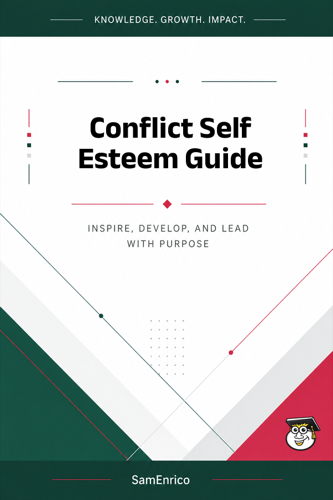
Non-FictionSelf-HelpConflict Resolution
Conflict Self Esteem Guide eBook
Stand up for yourself during arguments without fea
by Cerda Reggie
Stand up for yourself during arguments without fearing partner withdrawal or escalation.
Formats
Free sample
Chapter 1: The Filter You Never Knew You Had--–- Megan had not spoken a genuine disagreement to her husband in fourteen months. She knew the exact date because it was the last time he had gone silent for three days. Three days of eating dinner alone, sleeping on the edge of the bed, and walking through their home like a ghost passing through furniture. On the third day, she had apologized for something she still did not believe was wrong. The silence stopped immediately.
He kissed her forehead and said, "I just need you to be nice." Megan learned a lesson that day: her voice was the price of admission to her own marriage.This book is for Megan. It is for the person who just swallowed a complaint about a partner's chronic lateness, about a parent's invasive questions, about a friend's constant cancellations. It is for the person who tells themselves they are "choosing their battles" when they are actually erasing themselves. And it is for the person who is terrified that if they finally speak up, they will face one of two punishments: explosive rage or the slow, suffocating withdrawal of affection.Here is the first and most important idea of this book, and it may make you uncomfortable. Read it twice.If you stand up for yourself using the tools in these pages, and your partner leaves, that is not a failure.
That is a filter.A filter keeps out what does not belong. A filter lets through what can survive. If your partner cannot tolerate your assertiveness—cannot tolerate you having a voice, a boundary, a disagreement—then they were never capable of a healthy adult relationship. They were capable of a relationship with a silent version of you. And that is not a relationship.
That is a hostage situation where you are holding your own mouth shut.This framing is not an excuse to be cruel. It is not permission to stop trying. This book will teach you how to assert yourself in ways that minimize the risk of withdrawal or escalation. You will learn specific scripts, emotional regulation techniques, and negotiation strategies. But if you try those tools and your partner still leaves?
The filter worked. They were not your person. Your person does not need you to be small.Let me tell you about two types of silence, because most people confuse them.The Two Silences The first silence is strategic. You look at the clock. It is 11:45 PM.
You are both exhausted. Your partner just said something thoughtless, and you feel the familiar rise of anger in your chest. Instead of speaking, you take a breath and say, "I want to talk about this tomorrow when we are both rested." That is strategic silence. You are choosing the timing. You are not abandoning your concern; you are protecting it for a better moment.The second silence is erasure.
You feel the same rise of anger. But instead of postponing, you swallow it entirely. You tell yourself it is not a big deal. You tell yourself you are being too sensitive. You tell yourself that keeping the peace is more important than keeping yourself.
That is erasure. You are not choosing silence. Silence is choosing you. And over time, erasure becomes a habit. Then a personality.
Then a prison.Here is how you tell the difference. Ask yourself one question: If I knew with absolute certainty that speaking up would not lead to punishment, would I speak?If the answer is yes, your silence is not wisdom. It is fear dressed up as maturity.The Biology of Silence (Why You Cannot Just "Try Harder")Before we go any further, I need you to understand something that will change how you see every argument you have ever lost. Your silence is not a character flaw. It is not weakness.
It is biology.Deep in your brain, behind your eyes and slightly above your ears, sits a small almond-shaped cluster of neurons called the amygdala. Its job is to scan for threats. When your ancestors saw a saber-toothed tiger, their amygdala fired, their bodies flooded with cortisol and adrenaline, and they ran. This system kept humans alive for hundreds of thousands of years.Here is the problem. Your amygdala cannot tell the difference between a saber-toothed tiger and a partner who sighs, goes silent, or raises their voice.
To your ancient survival brain, social abandonment is a life-threatening event. For a mammalian species that evolved in small tribes, being cast out meant death. No tribe, no protection. No protection, no survival.So when your partner withdraws or escalates, your amygdala hijacks your nervous system. Your prefrontal cortex—the part of your brain responsible for logic, planning, and articulate speech—shuts down.
Blood flow redirects to your limbs (for fighting or fleeing). Your vocal cords tighten. Your working memory collapses. You literally cannot speak assertively when your body believes you are dying.This is not an excuse. It is an explanation.
And explanations are useful because they tell you where to aim your efforts. You cannot think your way out of an amygdala hijack. You cannot read the right sentence in a book and suddenly become calm during a fight. But you can learn to recognize the hijack. You can learn to pause.
You can learn to self-soothe before you speak. And you can learn to rebuild trust with your own nervous system.The first step is simply noticing. The next time you feel the urge to say "fine" or "never mind" or "it doesn't matter," pause and ask: Is my amygdala firing right now? Am I in tiger mode or human mode?The Three Styles (And Why Assertive Feels Wrong)Psychologist Randy Paterson, in his work on assertiveness, identified three core communication styles. Read them carefully.
Notice where you live.Passive. "Your needs matter, mine don't." The passive person speaks quietly, if they speak at all. They apologize for existing. They say "sorry" before asking for a glass of water. They believe that having needs is rude.
The result of passive communication is not peace. It is resentment. The resentment builds silently, like water behind a dam, until it bursts over something trivial.Aggressive. "My needs matter, yours don't." The aggressive person speaks loudly, interrupts, name-calls, and threatens. They believe that the only way to get their needs met is to overpower the other person.
The result of aggressive communication is not getting what you want. It is escalation. Fights get bigger. Partners get scared. Withdrawal follows explosion.Assertive.
"My needs matter, and so do yours." The assertive person speaks clearly, calmly, and directly. They state facts without judgment. They own their feelings without blame. They ask for what they want without demanding it. The result of assertive communication is not immediate peace.
It is anxiety. Assertiveness feels dangerous because it is new. Your nervous system has learned that silence is safe and explosion is familiar. Assertiveness is uncharted territory. But over time, anxiety gives way to respect.Here is what most books will not tell you.
When you first start being assertive, it will feel terrible. You will feel mean. You will feel exposed. You will…
This is the end of the free sample. Get the eBook to keep going. Buy now
About this book
Details
- Author
- Cerda Reggie
- Publisher
- SamEnrico
- Language
- English
- Genre
- Non-Fiction, Self-Help, Conflict Resolution
- Released
- 2026-06-09
- Pages (approx.)
- 130
- Available as
- eBook, Audiobook

Read better in the ZLOADR app
Your eBooks on your phone or tablet. Sign in with your SamEnrico account and start reading.
More by Cerda Reggie
 Parenting Disagreement RageCerda Reggie$11.99
 Health Record Data Breach ScriptsCerda Reggie$11.99
 Acupuncture For PsoriasisCerda Reggie$11.99
 Dual Recovery AnonymousCerda Reggie$11.99
 Reformation Printing Press Revolution CourseCerda Reggie$11.99
 TM for Creativity BoostCerda Reggie$11.99
 Marketing Team BurnoutCerda Reggie$11.99
 Andrew YoungCerda Reggie$11.99
 The Abyss Beneath the Rift: How a Fisherman and a Biologist Unlocked Africa's Hidden Hydrothermal VentsCerda Reggie$11.99
 Ragnarok and the Fox’s Wager: Loki’s Pact with the KitsuneCerda Reggie$11.99
 The Zodiac’s Last Stand: The Code That Wasn’t CrackedCerda Reggie$11.99
 Understanding Abdominal Neoplasm / Abdominal NeoplasmsCerda Reggie$17.99
You may also like
 Hong Kong Handover 1997Dunn Johnnie$11.99
 Zumba For Postnatal Recovery CourseNeal Christian$11.99
 Zumba for BeginnersLadner Nikia$11.99
 YouTube Comment Mining GuideHumes Pandora$12.99
 Worry Box MeditationCarlin Rudy$11.99
 Workplace Stress MeditationNguyen Lynn$11.99
 Workplace Stress and Sleep RepairHawley Ivory$11.99
 Workplace Perfectionism CureDelaney Jeffry$11.99
 Workplace Injustice Anger GuideWallen Isabelle$11.99
 Work Addiction and Burnout LinkGreenwood Ester$11.99
 Women in Yoga and WellnessBeattie Galina$11.99
 Women in Stand Up ComedyChun Evangeline$11.99