
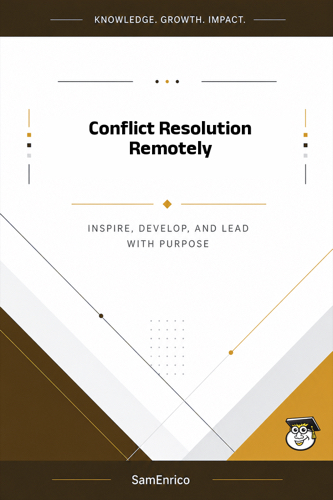
Non-FictionSelf-HelpConflict Management
Conflict Resolution Remotely eBook
Address disagreements over chat and video without
by Kong Darcie
Address disagreements over chat and video without escalation or avoidance.
Formats
Free sample
Chapter 1: The Pixelated Cage--–- Every remote worker knows the feeling. You are staring at a Slack message or a frozen Zoom face, and your chest tightens. Your fingers hover over the keyboard, typing and deleting the same sentence five times. You can feel the disagreement crystallizing—not because anyone has yelled, not because anyone has been cruel, but because something essential has gone missing. That something is what I call collision space.Collision space is the physical environment where spontaneous repair happens.
In an office, after a tense exchange, you might run into the same person in the breakroom. You might share a sigh, a shrug, or a muttered "that was rough" over the coffee machine. You might tap them on the shoulder ten minutes later and say, "Hey, I think I came off wrong." None of this is planned. None of it is in the meeting agenda. It simply happens because bodies occupy the same physical space, and bodies are hard to ignore.Remote work erased collision space overnight.
In its place, we got the pixelated face and the blinking cursor. And with that exchange, we lost something most of us never knew we had: the invisible infrastructure of human repair.This book is about building a new infrastructure. Not a replacement for the office—that ship has sailed—but a deliberate, teachable system for addressing disagreements over chat and video without escalation or avoidance. The stakes are higher than most people realize. Unresolved remote conflict doesn't just hurt feelings.
It kills projects, fractures teams, and drives good people to quiet quit or leave entirely. According to a 2023 study by the Harvard Business Review, remote teams report 42% more unresolved interpersonal tension than colocated teams, and those tensions take three times longer to surface because avoidance is so easy. By the time a remote leader notices a problem, it has often been festering for weeks.I have written this book for anyone who has ever stared at a message and not known how to reply. That includes team leads, individual contributors, executives, freelancers, and anyone who has ever been left on read and felt their stomach drop. You do not need to be a manager to use these tools.
You only need to be willing to try something different than what you have been doing—because what you have been doing is probably not working.The Core Argument of This Book Before we dive into the tools, let me state the central argument clearly: remote conflict is not harder because people are meaner or more fragile. Remote conflict is harder because the medium strips away the friction that makes repair possible. Friction—the awkward pause, the accidental eye contact, the shared discomfort of a silent elevator—is not a bug in human communication. It is a feature. Friction forces us to acknowledge each other's presence.
It creates micro-moments of accountability. When you remove friction, you remove the scaffolding that holds difficult conversations together.Think of it this way. In person, if you say something harsh, you immediately see the other person's face fall. That visual feedback triggers an almost involuntary repair response: "Wait, that came out wrong." You fix it in real time. Over chat, there is no face to see.
You hit send, and the message hangs there like a verdict. The other person reads it in whatever emotional state they happen to be in—tired, distracted, already annoyed about something else—and they interpret your words through that filter. By the time you realize how it landed, the damage is done. You cannot unsend. You can only apologize, which is its own minefield.Over video, the problem is different but related.
Video calls create a paradox of presence: you are visible but not fully there. Latency causes you to interrupt without meaning to. Your own image stares back at you, making you self-conscious. Half the participants have their cameras off, so you are speaking into a grid of initials and profile pictures. When someone's face freezes, your brain fills in the gap—and it almost always fills in negative intent.
("She rolled her eyes at me." No, her connection lagged.) These micro-misinterpretations accumulate. One frozen face becomes a grudge. One ambiguous text becomes a week of silence.This book will teach you to see the medium before you react to the message. That is the single most important skill in remote conflict resolution: distinguishing between what the disagreement is about and how the medium is distorting it.The Foundational Distinction: Topic vs. Medium Let me give you a concrete example.
Sarah and Jamal are on a distributed product team. Sarah posts a detailed proposal in the team Slack channel at 10:00 AM. Jamal replies at 10:15 AM with a single sentence: "This doesn't account for the backend constraints we discussed last week."Sarah reads the message and feels dismissed. She thinks: He didn't even acknowledge the work I put into this. He's always so abrupt with me.
Why doesn't he ever say anything positive first?Jamal, meanwhile, is in the middle of debugging a production issue. He typed his reply quickly between terminal windows, meaning nothing by the brevity. He assumed Sarah would know he was busy because everyone on the team knows he owns the backend.By 10:30 AM, Sarah has typed and deleted three replies. She finally sends: "Actually, I did account for backend constraints. See section 4."Jamal reads this as defensive and slightly hostile.
He sighs, types "Fine," and turns back to his debugging. Sarah spends the rest of the day convinced that Jamal has a problem with her. Jamal spends the rest of the day wondering why Sarah is so sensitive.This is not a personality conflict. This is a medium problem. The chat medium stripped away Jamal's context (he was busy), his tone (neutral, not dismissive), and his non-verbal cues (no eye roll, no sigh).
It also stripped away Sarah's ability to ask a clarifying question before assuming intent. The disagreement was never about the proposal. It was about the form of the reply. But because neither Sarah nor Jamal knew how to separate topic from medium, they turned a medium problem into a relationship problem.Throughout this book, you will learn a diagnostic checklist for exactly this situation. Here is a preview:Topic vs.
Medium Diagnostic Checklist Ask yourself these questions before responding to any message that triggers an emotional reaction:Is the disagreement about the content of what was said (facts, data, process), or is it about the form (tone, timing, length, medium)?If the form is the issue, could the form be explained by factors other than intent? (busy schedule, poor connection, typing on a phone, distraction, fatigue)Would this disagreement exist if the same words were spoken in person with normal tone and body language?If you answer "form" to question 1, "yes" to question 2, and "no" to question 3, you are likely dealing with a medium problem, not a topic problem. The solution is not to argue about the content. The solution is to change the medium or to explicitly name the medium distortion.We will spend the rest of this chapter building the foundational concepts you will need for the rest of the…
This is the end of the free sample. Get the eBook to keep going. Buy now
About this book
Details
- Author
- Kong Darcie
- Publisher
- SamEnrico
- Language
- English
- Genre
- Non-Fiction, Self-Help, Conflict Management
- Released
- 2026-06-11
- Pages (approx.)
- 138
- Available as
- eBook, Audiobook

Read better in the ZLOADR app
Your eBooks on your phone or tablet. Sign in with your SamEnrico account and start reading.
More by Kong Darcie
 Racial Trauma Dream ProcessingKong Darcie$11.99
 Sex Addiction Dating And Relationships GuideKong Darcie$11.99
 The MBSR for IBS GuideKong Darcie$11.99
 Menstrual Cup Insertion GuideKong Darcie$11.99
 The Great Thaw: How a Melting Glacier Reshaped a Nation's FutureKong Darcie$11.99
 Raven’s Gambit: The Hidden War of the Norn SpiesKong Darcie$11.99
 Renewable Energy in Europe OutlookKong Darcie$12.99
 Literature Review Proposal ManualKong Darcie$12.99
 Understanding Heart Tumor of The AdultKong Darcie$17.99
 Creative DesignerKong Darcie$11.99
 How to Start a Brush (electric) Business (Beginners Guide)Kong Darcie$11.99
You may also like
 Hong Kong Handover 1997Dunn Johnnie$11.99
 Zumba For Postnatal Recovery CourseNeal Christian$11.99
 Zumba for BeginnersLadner Nikia$11.99
 YouTube Comment Mining GuideHumes Pandora$12.99
 Worry Box MeditationCarlin Rudy$11.99
 Workplace Stress MeditationNguyen Lynn$11.99
 Workplace Stress and Sleep RepairHawley Ivory$11.99
 Workplace Perfectionism CureDelaney Jeffry$11.99
 Workplace Injustice Anger GuideWallen Isabelle$11.99
 Work Addiction and Burnout LinkGreenwood Ester$11.99
 Women in Yoga and WellnessBeattie Galina$11.99
 Women in Stand Up ComedyChun Evangeline$11.99