
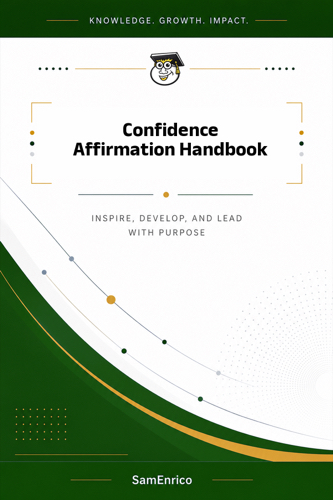
Non-FictionSelf-HelpConfidence Building
Confidence Affirmation Handbook eBook
Build unshakeable self belief with daily powerful
Build unshakeable self belief with daily powerful statements using this practical guide.
Formats
Free sample
Chapter 1: The Architecture of Belief--–- Every skyscraper begins as a single steel beam. Every forest begins as a single seed. Every confident person you have ever admired began as someone who repeated one small, true statement to themselves when no one else was listening.That is the secret that no one tells you about confidence. It is not a gift you are born with or without. It is not a switch that flips on during a moment of courage and off again when you fail.
Confidence is architecture. It is built beam by beam, word by word, repetition by repetition, in the quiet privacy of your own mind long before anyone else ever sees the result.Most people walk through life believing that their thoughts are just thoughts—ephemeral, meaningless, here one moment and gone the next. They believe that the voice in their head is simply narrating reality, not constructing it. This is the single most expensive misunderstanding in human psychology. Your thoughts are not observing your life.
Your thoughts are building your life. And the materials you use—the words you repeat, the beliefs you entertain, the self-talk you tolerate—determine the strength of everything you will ever try to build.This chapter is not a warm-up. It is not a motivational pep talk. It is a foundational blueprint. By the time you finish these pages, you will understand exactly how your brain transforms the words you say into the person you become.
You will learn why some affirmations work, why some backfire, and how to construct the kind of self-talk that actually rewires neural pathways rather than simply repeating empty phrases. Most importantly, you will finally have an answer to the question that has haunted every moment of self-doubt you have ever experienced: Why does my brain believe the bad things I tell myself so easily, but fight the good things?The answer is not that you are broken. The answer is that you have been building with the wrong tools. Let us fix that. Right now.The Great Asymmetry: Why Negativity Has a Fast Lane Imagine two paths through a dense forest.
The first path has been walked for years. Thousands of footsteps have beaten the grass flat, worn the soil smooth, and carved a shallow trench that guides every subsequent walker in the same direction. You could walk this path blindfolded. Your feet would find it automatically, without thought, without effort, without even conscious awareness that you are choosing a path at all.The second path is barely visible. Grass grows tall between scattered footprints.
Branches reach across the way. Taking this path requires intention, effort, and constant attention. You have to push through resistance with every single step.This is the exact architecture of your brain.The thoughts you think most often—whether they are true, whether they serve you, whether you chose them or inherited them—have worn deep neural pathways. These pathways are literally physical structures in your brain: bundles of neurons that have fired together so many times that they have wired together. This is the principle of Hebb's law, named for the Canadian neuropsychologist Donald Hebb, who famously summarized it as "neurons that fire together wire together."Every time you think "I cannot do this," a specific sequence of neurons fires.
Do it enough times, and those neurons build a superhighway. The thought becomes automatic. It arrives before you invite it. It feels like truth because it arrives so quickly and so smoothly that your conscious mind never has a chance to examine it. This is why your inner critic seems to have a faster connection than your inner encourager.
It is not because you are naturally pessimistic or because the universe has decided that you should struggle. It is because your critic has been practicing longer. It has logged more hours. It has built a wider road.Here is what most self-help books get wrong: they tell you to simply replace negative thoughts with positive ones. They act as if your brain is a whiteboard that can be wiped clean with sufficient enthusiasm.
But your brain is not a whiteboard. It is a landscape of deeply grooved pathways. You cannot erase the old road by wishing it away. You can only build a new road that is eventually wider, smoother, and more automatic than the old one.And building that new road requires understanding the single most powerful tool your brain has for deciding what to believe: the Reticular Activating System.The Reticular Activating System: Your Brain's Bouncer Deep within your brainstem, roughly where your skull meets your spine, there is a small but extraordinarily powerful bundle of nerves called the Reticular Activating System, or RAS. Its job is simple and staggering: it decides what you notice.Every second of every day, your senses are bombarded with approximately two million bits of information.
Your eyes see millions of colors and shapes. Your ears hear hundreds of frequencies. Your skin registers temperature, pressure, texture, and movement. Your nose and tongue detect countless chemical signals. If your brain processed all of this information consciously, you would be overwhelmed into catatonia within seconds.So your brain outsources.
The RAS acts as a filter, a gatekeeper, a bouncer at the door of your conscious awareness. It asks one question of every incoming piece of information: Does this match what I already believe?If the answer is yes, the information is admitted. You notice it. If the answer is no, the information is discarded. You never see it, hear it, or feel it at all.This is why pregnant women suddenly notice pregnant women everywhere.
Their RAS has been programmed with the belief "pregnancy is relevant to me," and suddenly the filter opens to admit all the pregnant women who were there all along. This is why someone who buys a red car suddenly notices red cars everywhere. The car did not change. The filter did.And this is why your inner critic is so devastatingly effective. When you believe "I am not good enough," your RAS dutifully scans the world for evidence that confirms this belief.
It admits every sideways glance, every ambiguous email, every polite but non-committal response. It discards every compliment, every success, every piece of counter-evidence. Not because it is malicious. Because it is efficient. It is doing exactly what it was programmed to do: find matches.Here is where the opportunity lies.
The RAS does not care whether your beliefs are true. It only cares that they are repeated. It does not ask, "Is this belief good for you?" It asks, "Is this belief familiar?" Familiarity is the only currency the RAS accepts. And familiarity is created through repetition.When you repeat an affirmation like "I am capable," you are not just saying nice words to yourself. You are programming your RAS.
You are changing the filter. You are telling your brain's bouncer, "Hey, from now on, admit evidence of capability. I want to see that." And slowly, impossibly, magically without any magic at all, you will start to notice opportunities, resources, and moments of competence that were always there but that your old filter blocked.This is not…
This is the end of the free sample. Get the eBook to keep going. Buy now
About this book
Details
- Author
- Perrin Francisca
- Publisher
- SamEnrico
- Language
- English
- Genre
- Non-Fiction, Self-Help, Confidence Building
- Released
- 2026-06-06
- Pages (approx.)
- 147
- Available as
- eBook, Audiobook

Read better in the ZLOADR app
Your eBooks on your phone or tablet. Sign in with your SamEnrico account and start reading.
More by Perrin Francisca
 Early Adopter Fitness TechPerrin Francisca$11.99
 Equifax's 143 Million Social Security NumbersPerrin Francisca$11.99
 Egypt Nasser Pan AfricanismPerrin Francisca$11.99
 John Wayne Gacy Artwork AnalysisPerrin Francisca$11.99
 Whispers in the Bamboo: The Forbidden Love of the Moon Princess and the Mortal ScholarPerrin Francisca$11.99
 Understanding Mucopolysaccharidosis Type Iv-bPerrin Francisca$17.99
 AI Talking Head Video GuidePerrin Francisca$12.99
 Remote Project Team Conflict GuidePerrin Francisca$12.99
 Procurement Supplier Contracts ManagerPerrin Francisca$11.99
 How to Become a Cloth SanderPerrin Francisca$11.99
You may also like
 Hong Kong Handover 1997Dunn Johnnie$11.99
 Zumba For Postnatal Recovery CourseNeal Christian$11.99
 Zumba for BeginnersLadner Nikia$11.99
 YouTube Comment Mining GuideHumes Pandora$12.99
 Worry Box MeditationCarlin Rudy$11.99
 Workplace Stress MeditationNguyen Lynn$11.99
 Workplace Stress and Sleep RepairHawley Ivory$11.99
 Workplace Perfectionism CureDelaney Jeffry$11.99
 Workplace Injustice Anger GuideWallen Isabelle$11.99
 Work Addiction and Burnout LinkGreenwood Ester$11.99
 Women in Yoga and WellnessBeattie Galina$11.99
 Women in Stand Up ComedyChun Evangeline$11.99