
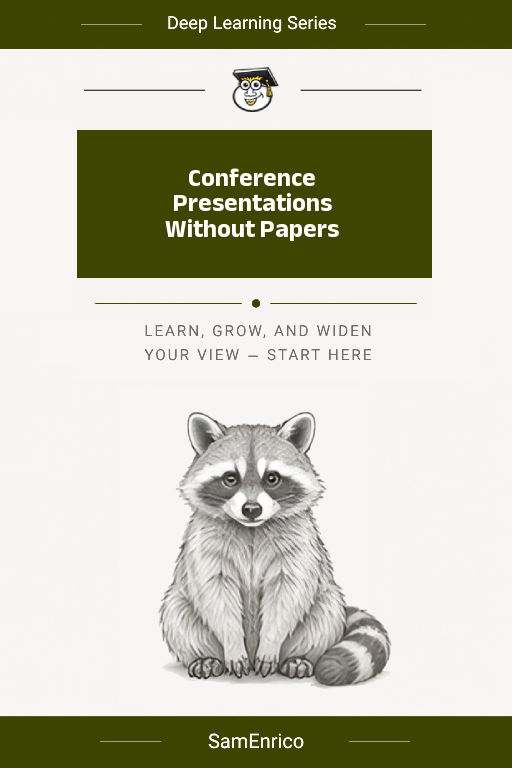
Non-FictionStudent's ShortcutConference Skills
Conference Presentations Without Papers eBook
Present posters or talks at conferences to demonst
Present posters or talks at conferences to demonstrate research activity before you publish.
Formats
Free sample
Chapter 1: The Isolation Trap--–- The fluorescent lights hummed overhead as Dr. Maya Chen stared at her computer screen for the seventh consecutive hour. Her manuscript—titled “Preliminary Observations on Thermal Conductivity in Perovskite Structures”—had been marked “in preparation” for fourteen months. Fourteen months of data collection, analysis, rewriting, and waiting. Fourteen months of telling herself the same story: I’ll present this work once it’s complete.
Once it’s perfect. Once I have nothing left to be criticized for.Maya was not lazy. She was not afraid of hard work. She was, by every measure, a productive and promising postdoctoral researcher in materials science. She had published three first-author papers during her Ph D.
Her advisor praised her rigor. Her collaborators respected her attention to detail. And yet, here she was, sitting alone in a windowless office on a Friday evening, paralyzed by a belief so common that no one had ever thought to question it: Real work gets presented only after it gets published.Across campus, in the psychology department, a fifth-year graduate student named James Torres was experiencing the same paralysis. His dissertation involved a longitudinal study of decision-making in adolescents. He had collected eighteen months of data.
He had preliminary findings that were surprising, even counterintuitive. His advisor had encouraged him to submit an abstract to the Society for Personality and Social Psychology annual convention. But James had declined. “The results aren’t robust yet,” he told his advisor. “I need at least two more waves of data before I’m comfortable presenting.”Six months later, James attended that same conference as a non-presenting attendee.
He sat in the back of a session on adolescent risk-taking and watched a researcher from a competing university present findings that were almost identical to his own preliminary results. The presenter cited no prior work in the area—because there was none. James had been first. But he had said nothing. He had waited.
And now someone else’s name would be associated with the finding that he had uncovered first.Maya and James are fictional composites, but their experiences are not. They represent a pattern so widespread in academic research that it has become invisible: the belief that conference presentations are rewards for completed work rather than tools for improving work in progress. This chapter names that pattern, diagnoses its costs, and offers the first step toward a different way of working.The Unspoken Rule That Governs Early-Career Research If you asked most graduate students and postdoctoral researchers to describe the proper sequence of academic output, they would likely say something like this: conduct research, analyze data, write manuscript, submit to journal, receive reviews, revise, publish, then present at a conference. The conference presentation sits at the end of the pipeline, a celebratory capstone rather than a generative step.Where did this sequence come from? No journal editorial explicitly requires it.
No graduate program handbook states it. No funding agency mandates it. And yet, the sequence feels self-evident to most early-career researchers. It feels like common sense. Why would you show incomplete work to a room full of experts?
Why would you risk being wrong in public? Why would you invite criticism before you have a polished product to defend?These questions are not unreasonable. But they are based on a hidden assumption: that the primary purpose of a conference presentation is to report finished research. This chapter argues the opposite. The primary purpose of a conference presentation—especially for early-career researchers—is to improve unfinished research.
The reporting function is secondary. The generative function is primary.To understand why this distinction matters, we need to examine what actually happens during those twelve to eighteen months when researchers wait for perfection. What is gained? What is lost?The Hidden Costs of Waiting Let us begin with what is gained. Waiting allows you to avoid the discomfort of public scrutiny.
It allows you to present a cleaner story with fewer caveats. It allows you to feel confident that you will not be embarrassed by a question you cannot answer. These are real benefits, and they are not trivial.But they come at a cost that most researchers systematically underestimate.Cost One: The Feedback Vacuum The first cost is the absence of external feedback during the most malleable stage of your research. In the early months of a project—after the initial data has arrived but before the analysis is locked—your thinking is still flexible. You have not yet committed to a particular interpretation.
You have not yet written the discussion section that will cement your narrative. You are, in cognitive terms, maximally receptive to new ideas.This is precisely when feedback is most valuable. Yet it is also when most researchers isolate themselves.Consider what happens when you receive feedback after your manuscript is complete. A journal reviewer tells you that your interpretation of a key finding is unconvincing. You have already written four thousand words based on that interpretation.
The revision requires restructuring your argument, re-analyzing your data, and rewriting large sections. The work is painful and time-consuming.Now imagine receiving that same feedback six months earlier, at a conference poster session. A senior researcher glances at your preliminary figure and says, “Have you considered an alternative explanation? It looks like your effect might be driven entirely by that outlier cluster.” You think about it. The researcher is right.
You re-analyze with the outlier cluster excluded. The effect disappears—but a different, more interesting effect emerges. You have just saved yourself six months of writing in the wrong direction.This is not a hypothetical. Studies of research workflows suggest that feedback received during the “problem framing” or “preliminary analysis” stages is five to ten times more influential on final paper quality than feedback received after a full draft is complete. The earlier the feedback, the lower the cost of acting on it.
Waiting does not make your research better. It makes your mistakes more expensive to fix.Cost Two: The Collaboration Window Closes The second cost is missed opportunities for collaboration. Research is increasingly team-based. The most cited papers in most fields have more authors than the average. Yet early-career researchers systematically delay the moment when they invite others into their work.Imagine you have a partial dataset that points toward an unexpected finding.
You are not certain about the interpretation. You could use expertise from another discipline—statistical modeling, qualitative analysis, computational simulation—but you do not know anyone with that expertise. A conference is precisely where you might meet such a person. But you are not presenting. You are waiting.At that same conference, another researcher presents preliminary work on a related problem.
They are three steps behind you in data collection but two steps ahead in theoretical framing. You realize that combining your dataset with their framework would produce a much stronger paper than either of you could write alone. But you are not there. You are in your office, alone, waiting for perfection.Collaborations formed at conferences rarely begin with completed work. They begin with unfinished problems.
“I have data on X but I need help with Y.” “I have a theory about Z but I cannot…
This is the end of the free sample. Get the eBook to keep going. Buy now
About this book
Details
- Author
- Cornish Efren
- Publisher
- SamEnrico
- Language
- English
- Genre
- Non-Fiction, Student's Shortcut, Conference Skills
- Released
- 2026-05-30
- Pages (approx.)
- 154
- Available as
- eBook, Audiobook

Read better in the ZLOADR app
Your eBooks on your phone or tablet. Sign in with your SamEnrico account and start reading.
More by Cornish Efren
 Building Relationship With CompetitorsCornish Efren$11.99
 Self Hypnosis For Esports ProCornish Efren$11.99
 Drug Dependency Cognitive Behavioral TherapyCornish Efren$11.99
 Exam Dream MeaningCornish Efren$11.99
 Coping With Cryptocurrency CrashesCornish Efren$11.99
 Anapanasati for HomelessCornish Efren$11.99
 Phone Free Morning Routine GuideCornish Efren$12.99
 Parent Medication ManagementCornish Efren$11.99
 Tibetan Mother Exile StoryCornish Efren$11.99
 Public Urination AnxietyCornish Efren$11.99
 Sarajevo's Siege: The City That Would Not Fall (1992-1996)Cornish Efren$11.99
 Bragi's Harp: The Song of the Norse God of PoetryCornish Efren$11.99
You may also like
 Hong Kong Handover 1997Dunn Johnnie$11.99
 Zumba For Postnatal Recovery CourseNeal Christian$11.99
 Zumba for BeginnersLadner Nikia$11.99
 YouTube Comment Mining GuideHumes Pandora$12.99
 Worry Box MeditationCarlin Rudy$11.99
 Workplace Stress MeditationNguyen Lynn$11.99
 Workplace Stress and Sleep RepairHawley Ivory$11.99
 Workplace Perfectionism CureDelaney Jeffry$11.99
 Workplace Injustice Anger GuideWallen Isabelle$11.99
 Work Addiction and Burnout LinkGreenwood Ester$11.99
 Women in Yoga and WellnessBeattie Galina$11.99
 Women in Stand Up ComedyChun Evangeline$11.99