
Non-FictionSelf-HelpConference Strategy
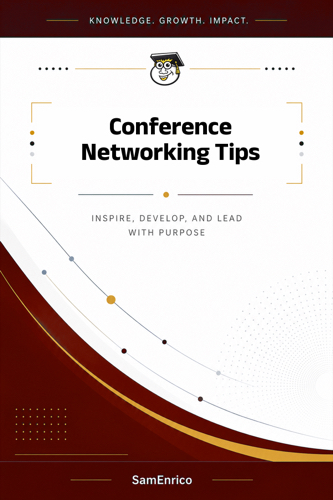
Conference Networking Tips eBook
Navigate large events and remember names.
Navigate large events and remember names.
Formats
Free sample
Chapter 1: The Collector‘s Fallacy–- The conference badge hung around my neck like a scarlet letter. Three thousand attendees. Three days. I had strategically planned my route through the expo hall like a military campaign, mapped the coffee stations for maximum interception, and prepared my "elevator pitch" until I could recite it in my sleep. By the end of day one, I had collected forty-seven business cards.
My palm was sweaty. My smile was frozen. And I couldn‘t remember a single name from the first ten conversations.I went home that night, spread the cards across my hotel bed like a victorious general displaying conquered territory, and realized something horrifying: I had just spent twelve hours becoming utterly forgettable.This is the Collector‘s Fallacy. It is the single most destructive belief in professional networking, and it goes like this: More contacts equal more success. Volume equals value.
A full pocket equals a full pipeline.Every single word of that is wrong.The Myth of the Room-Worker Let me introduce you to someone. Her name is Sarah. Sarah attends twelve conferences a year. She is the person you see weaving through crowds with purpose, a stack of business cards in one hand and a smartphone in the other, scanning QR codes like a cashier at a busy grocery store. Sarah will talk to anyone.
She has a script for every scenario. By the end of any given conference, Sarah has "connected" with over two hundred people.Six months later, Sarah is laid off. She sends a mass email to every single person she met at those twelve conferences. The open rate is three percent. No one responds.
Sarah is baffled. I did everything right, she thinks.Sarah fell for the Collector‘s Fallacy. She confused activity with achievement, volume with value.Now meet David. David attends three conferences a year. He arrives late to the first session and spends the first hour simply standing near the registration desk, drinking coffee, and watching.
David talks to exactly seven people over three days. He remembers the name of every single one. He knows their kids‘ names, their biggest professional frustration, and the specific favor they mentioned needing. Six months later, when David needs a job, he sends seven personalized emails. Six respond.
Two lead to offers.David is not smarter than Sarah. He is not more charismatic. He simply understands a truth that most networking books are afraid to tell you: your brain is a terrible database.Why Your Brain Sabotages You Before we fix the problem, let‘s understand why the Collector‘s Fallacy is so seductive. There are three psychological traps at work here.Trap One: The Illusion of Productivity Your brain releases a small hit of dopamine when you complete a discrete task. Shake a hand.
Get a card. Scan a badge. Each of these actions feels like progress. It feels like work. And because it feels like work, your brain assumes it must be valuable.But here is the dirty secret of the conference industry: the exhibitors and organizers want you to feel this way.
They want you moving, collecting, scanning. It makes the room look active. It makes their attendance metrics look good. It has absolutely nothing to do with whether you will remember anyone tomorrow.Trap Two: The Spotlight Fallacy You believe, on some level, that you are memorable. You think your firm handshake, your clever joke, or your interesting job title will make you stand out in a crowd of three thousand people.It will not.You are not the main character of the conference.
Neither is anyone else. The research on social memory is brutal: after a single conversation of less than five minutes, the other person will retain approximately fourteen percent of what you said. After three more conversations, that drops to four percent. After a good night‘s sleep, they will remember your approximate height, your gender, and whether you seemed friendly or hostile. Everything else is gone.This is not a criticism of you.
It is the fundamental architecture of human memory. We are built to forget most people, most of the time, because remembering everyone would be a cognitive catastrophe.Trap Three: The Scarcity Illusion"Conferences are rare opportunities," the conventional wisdom goes. "You have to make the most of every minute."This is half-true and entirely destructive. Yes, the opportunity is scarce. But the response to scarcity is not more — it is better.
If you were given one hour with a private chef, would you ask for a single perfect meal or forty-seven cold appetizers? You would choose the perfect meal. But at conferences, we do the opposite. We fill our plates with everything in sight and then complain that we‘re hungry an hour later.The Small Pond Strategy The solution is almost embarrassingly simple. It requires no charisma, no memory tricks, and no special technology.
It just requires that you stop trying to meet everyone and start trying to meet the right people.I call this the Small Pond Strategy.Here is the core principle: You will remember exactly as many people as you deliberately choose to remember, and not one more.Your working memory — the part of your brain that holds information temporarily — has a capacity of roughly four chunks of information. Four. That is it. You can hold four names, four faces, four facts in your conscious mind at any given time. Everything else is either stored in long-term memory (which takes time and repetition) or lost forever.This means that if you try to "work the room" and meet fifty people, you are guaranteeing that you will remember approximately zero of them.
You are not multitasking. You are task-switching at catastrophic speed, and every switch erases the previous conversation.The Small Pond Strategy acknowledges this biological reality and works with it, not against it. Instead of trying to drain the ocean, you build a small, deep pond. You stock it with a few high-quality fish. And you remember every single one.The Pareto Principle for Conferences You have probably heard of the Pareto Principle, or the 80/20 rule: eighty percent of effects come from twenty percent of causes.
In a conference context, this means that eighty percent of the value you will receive comes from twenty percent of the attendees.The trick, of course, is identifying that twenty percent before the conference begins.Most people show up blind. They wander the expo hall, read name tags randomly, and hope for serendipity. That is not strategy. That is gambling with your time.Here is how you identify your twenty percent.Step One: The Speaker Wall Every conference has a speaker wall — either physical (near registration) or digital (on the app). This is not decoration.
This is a goldmine. Speakers are, by definition, people who have been vetted as interesting and knowledgeable. They are also notoriously approachable before their sessions, when they are standing alone, reviewing notes, and hoping someone will talk to them.Go to the speaker wall. Pick three speakers whose topics genuinely interest you. Not the famous ones — everyone will mob them.
Pick the second-tier speakers, the breakout session leaders, the panelists. Read their bios. Find one specific detail that you can…
This is the end of the free sample. Get the eBook to keep going. Buy now
About this book
Details
- Author
- Rickard Dayna
- Publisher
- SamEnrico
- Language
- English
- Genre
- Non-Fiction, Self-Help, Conference Strategy
- Released
- 2026-06-08
- Pages (approx.)
- 141
- Available as
- eBook, Audiobook

Read better in the ZLOADR app
Your eBooks on your phone or tablet. Sign in with your SamEnrico account and start reading.
More by Rickard Dayna
 Forgiveness for Family EstrangementRickard Dayna$11.99
 Craps Addiction RecoveryRickard Dayna$11.99
 Corporate PR to Nonprofit AdvocacyRickard Dayna$11.99
 Twelve Step Programs Explained For Professionals GuideRickard Dayna$11.99
 Pet Euthanasia Grief GuideRickard Dayna$11.99
 Combat Soldier Stress GuideRickard Dayna$11.99
 Calming Anger Before It EscalatesRickard Dayna$11.99
 The Last Empress: Wu Zetian's Shadow EmpireRickard Dayna$11.99
 Backstage at the Palace: The Untold Story of the 1964 'Funny Girl' FeudRickard Dayna$11.99
 How to Produce Service EquipmentRickard Dayna$11.99
 Cash Flow for Accounting FirmsRickard Dayna$12.99
 Mailchimp Social Proof in EmailsRickard Dayna$12.99
You may also like
 Hong Kong Handover 1997Dunn Johnnie$11.99
 Zumba For Postnatal Recovery CourseNeal Christian$11.99
 Zumba for BeginnersLadner Nikia$11.99
 YouTube Comment Mining GuideHumes Pandora$12.99
 Worry Box MeditationCarlin Rudy$11.99
 Workplace Stress MeditationNguyen Lynn$11.99
 Workplace Stress and Sleep RepairHawley Ivory$11.99
 Workplace Perfectionism CureDelaney Jeffry$11.99
 Workplace Injustice Anger GuideWallen Isabelle$11.99
 Work Addiction and Burnout LinkGreenwood Ester$11.99
 Women in Yoga and WellnessBeattie Galina$11.99
 Women in Stand Up ComedyChun Evangeline$11.99