
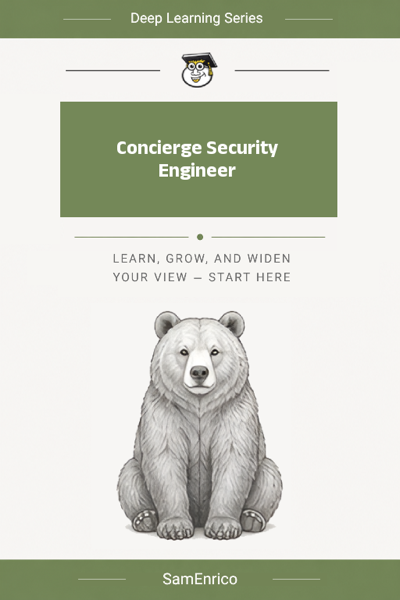
Concierge Security Engineer eBook
A Coursebook on Concierge Security Engineer
by Stacy Sirena
A Coursebook on Concierge Security Engineer
Formats
Free sample
Chapter 1: The Ticket Trap...--–- The alert blazed across the screen in urgent red: "CRITICAL: Suspicious Power Shell execution on domain controller FIN-DC-02." Within seconds, the security operations center analyst closed it as a false positive. The playbook said to investigate only after three similar alerts within an hour. This was only the second. The analyst moved to the next ticket, then the next, then the next. Two hundred and seventeen alerts later, the shift ended.Seventy-two hours after that, the client's CFO called the MSSP's emergency hotline.
Her voice was not panicked. It was cold, controlled, and infinitely more terrifying than screaming. "Our wire transfer system initiated a $470,000 payment to an unknown vendor in Eastern Europe," she said. "The payment was authorized using my credentials. I did not authorize it.
I am holding you personally responsible, and I have already called our legal team."The Power Shell alert, the one marked false positive, was the first sign of a credential harvesting campaign that escalated to domain admin within forty-five minutes. The attacker spent the next forty-eight hours learning payment schedules, then struck on a Friday afternoon when the SOC was understaffed. The MSSP lost the client the following quarter. The analyst was fired. No one ever explained to the CFO why the alert was closed or what business value the SOC actually provided.This is the cost of the ticket trap.The Hidden Epidemic in Security Operations The scene above is not hypothetical.
It is a composite of real incidents that have occurred across the managed security services industry over the past decade. The specifics change—different credentials, different attack vectors, different dollar amounts—but the pattern remains disturbingly consistent: security operations centers (SOCs) generate massive volumes of alerts, analysts close them at impressive speeds, and clients still get breached. The problem is not a lack of technology. It is not a lack of staffing. It is a fundamental mismatch between how security engineers are trained to work and what clients actually need.The ticket trap is the name for this phenomenon.
It occurs when security professionals measure their success by the number of alerts closed, tickets resolved, or incidents handled rather than by the security outcomes delivered to the client. The ticket trap rewards speed over understanding, closure over communication, and volume over value. It is the default operating system of most SOCs, and it is failing.This book introduces a different way. The Concierge Security Engineer (CSE) role emerged in the mid-2010s as a direct response to the ticket trap. Leading managed security service providers—most notably Arctic Wolf Networks and later Palo Alto Networks' Unit 42 consulting arm—discovered a counterintuitive truth: clients were not churning because of poor detection rates.
They were churning because of poor communication and a perceived lack of ownership. Clients could tolerate the occasional missed alert. They could not tolerate feeling abandoned, confused, or unheard during a crisis.The CSE role was designed to solve this problem by placing a single, dedicated engineer at the center of each client relationship. Unlike traditional SOC analysts who rotate through hundreds of clients and thousands of alerts, the CSE owns a small portfolio of clients deeply. They do not just close tickets.
They explain what the tickets mean, why they matter, and what the client should do next. They anticipate problems before they become emergencies. And when things go wrong, they apologize, take ownership, and rebuild trust.The Birth of the Concierge Security Engineer To understand the CSE role, we must first understand what came before. Traditional SOCs operate on a factory model. Alerts arrive from security tools—endpoint detection systems, firewalls, identity platforms—and flow through a tiered structure.
Tier 1 analysts triage and close the obvious false positives. Tier 2 investigates what remains. Tier 3 handles the most complex incidents. The model is efficient for processing high volumes of data, but it is terrible at building relationships.The factory model assumes that security is a technical problem requiring a technical solution. If you have enough analysts closing enough alerts, the reasoning goes, the client will remain secure.
This assumption fails for two reasons. First, context matters. An alert about a Power Shell execution on a developer's workstation means something different than the same alert on a domain controller. The factory model strips away context in the name of efficiency. Second, communication matters.
Clients do not see the three hundred alerts you closed correctly. They see the one you missed. And when you miss one, they need someone to explain what happened, why it happened, and what will change. The factory model has no room for explanation.The CSE role emerged as an intentional rejection of the factory model. The first dedicated CSE teams appeared within MSSPs that served mid-market clients—organizations with enough security needs to justify managed services but not enough internal staff to interpret SOC outputs.
These clients did not need more alerts. They needed a trusted advisor who could translate alert data into business decisions.The early CSEs were hybrid creatures. They needed technical fluency across multiple security domains because they could not rely on deep specialists for every client. They needed communication skills because their clients had no internal security team to interpret findings. And they needed business acumen because their clients judged security work by its impact on operations, revenue, and reputation.
The role was difficult to fill and harder to scale, but the client retention numbers were undeniable. Accounts assigned to dedicated CSEs renewed at rates twenty to thirty percent higher than accounts served by traditional SOCs.The Service-Umbrella Model Throughout this book, we will return to a central framework: the Service-Umbrella Model. Imagine a large umbrella with three distinct layers. The top layer, the one that catches the rain, is technical execution. This is where alerts are investigated, configurations are fixed, and incidents are contained.
It is the visible work of security engineering, and it is necessary but not sufficient.The middle layer of the umbrella is communication and translation. This is where technical findings become client-facing explanations. Where a raw alert about "Suspicious Power Shell execution" becomes a conversation: "We saw an unrecognized script trying to access your finance system. We blocked it, and here is what we need you to do to prevent recurrence." The middle layer is what transforms a ticket closer into a trusted advisor.The bottom layer, the handle that the client holds, is business alignment. This is where security work connects to client outcomes.
Where a firewall rule change is not just a configuration update but a protection against a specific business risk. Where an incident response is not just containment and eradication but a demonstration that the CSE values the client's operational uptime as much as their security posture.The Service-Umbrella Model is called such because the CSE stands above all three layers simultaneously. Unlike a traditional SOC where Tier 1 handles execution and passes findings up the chain, the CSE owns the entire relationship from alert to explanation to business impact. This is what concierge means in practice: one engineer, one client, complete coverage from technical details to strategic advice.Consider how the model applies to our opening story. The analyst…
This is the end of the free sample. Get the eBook to keep going. Buy now
About this book
Details
- Author
- Stacy Sirena
- Publisher
- SamEnrico
- Language
- English
- Genre
- Non-Fiction, Informative, Educational
- Released
- 2026-05-09
- Pages (approx.)
- 154
- Available as
- eBook, Audiobook

Read better in the ZLOADR app
Your eBooks on your phone or tablet. Sign in with your SamEnrico account and start reading.
More by Stacy Sirena
 Parent Child Anger Trigger Patterns HandbookStacy Sirena$11.99
 Nightmare Processing for Bullying VictimsStacy Sirena$11.99
 The Caregiver Faith And Hope GuideStacy Sirena$11.99
 Advanced Pomodoro Workflow GuideStacy Sirena$11.99
 Fertility and Egg FreezingStacy Sirena$11.99
 The Medici Code: Banking, Art, and the Birth of Modern EuropeStacy Sirena$11.99
 Understanding Ogilvie's SyndromeStacy Sirena$17.99
 How to Become a Drier Operator IStacy Sirena$11.99
 Meta Remote Internship MasteryStacy Sirena$12.99
 Becton Dickinson SWOTStacy Sirena$12.99