
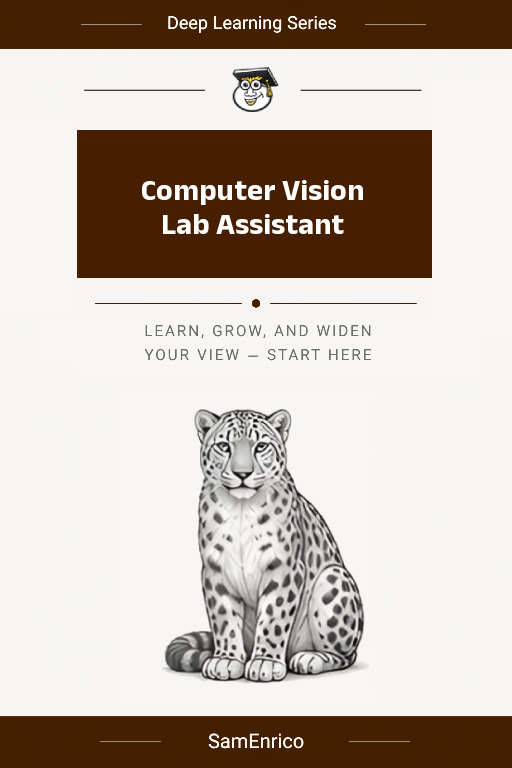
Non-FictionForecast & OutlookVirtual Labs
Computer Vision Lab Assistant eBook
Explore AI that guides students through science ex
Explore AI that guides students through science experiments, ensuring safety and proper technique.
Formats
Free sample
Chapter 1: The Digital Blindness...--–- Dr. Elena Vasquez had been teaching high school chemistry for nineteen years when she almost lost a student to a textbook-perfect AI tutor.The incident happened on a Tuesday in October. Her student, Marcus, had asked Chat GPT for help with a titration lab. The AI generated flawless step-by-step instructions—accurate chemical equations, proper measurements, correct terminology. Marcus followed every word.
But when the AI said "gently swirl the flask," Marcus rotated his wrist incorrectly, splashing 0.1 molar sodium hydroxide onto his lab partner's arm. The AI did not see the splash. It did not see the student flinch. It continued generating helpful suggestions about endpoint detection while a minor chemical burn developed three feet away.Elena ran to the eyewash station, not to her computer.That evening, she sat in her empty classroom and stared at the ceiling camera she had installed for remote learning during the pandemic. The camera had recorded everything.
It saw the splash. It saw the wrong wrist angle. It saw the student reaching for his face two seconds before the splash. But the AI—the supposedly intelligent assistant—had seen nothing at all.This book is for everyone who has had that Elena Vasquez moment. For the teacher who realizes that language models, for all their brilliance, are completely blind to the physical reality of the science classroom.
For the curriculum developer who understands that the next frontier of educational technology is not generating better explanations but witnessing better actions. For the ed-tech professional who knows that a lab assistant that cannot see a student about to touch a hot plate is not an assistant at all—it is a liability waiting to happen.This is the book about building something that actually watches.The False Promise of the Digital Teaching Assistant In the past three years, artificial intelligence in education has undergone a revolution. Large Language Models (LLMs) like Chat GPT, Claude, and Gemini have transformed how students write essays, solve math problems, and generate study guides. These tools are extraordinary at manipulating symbols, retrieving information, and producing human-like text. They have passed bar exams, medical licensing tests, and Advanced Placement assessments.
By almost every metric of academic measurement, they are becoming smarter than the average student—and in some cases, smarter than the average teacher.But there is a problem hiding in plain sight: these models have no eyes.Every LLM, regardless of how many billions of parameters it contains or how many trillions of tokens it was trained on, operates in a world of pure text. It ingests words and produces words. It has never seen a Bunsen burner. It has never watched a student tilt a pipette too far. It has never noticed the subtle tremor in a hand holding a beaker of acid.
It does not know that "gently swirl" means a specific wrist motion that takes most students three tries to master. It does not know that "waft the chemical toward your nose" requires a hand trajectory that arcs downward from nose level, not a straight pull from the bottle to the nostrils.The AI sees nothing. It understands nothing about the physical world. And yet, we are placing these blind oracles into science classrooms and asking them to assist with hands-on laboratory work.This is not a minor oversight. This is a fundamental category error.The Three Failures of Text-Only AI in the Lab Let us be precise about why LLMs fail in the physical laboratory.
Based on analysis of documented incidents (including the Elena Vasquez case) and systematic testing of leading AI tutors, we can identify three distinct failure modes that no text-only system can overcome.Failure One: Procedural Hallucination The first failure is the most widely discussed in AI research but least understood in educational contexts. LLMs are designed to generate plausible-sounding text, not to verify facts against reality. When asked about a lab procedure they have not been trained on—or when asked to fill in gaps in their knowledge—they invent steps with complete confidence. This is called hallucination.Consider a student asking an LLM how to dispose of a particular chemical mixture. The AI might generate a response that sounds authoritative but is completely wrong.
It might suggest pouring the mixture down the sink when the correct procedure is solid waste disposal. It might invent a neutralization step that does not exist. Because the AI has no access to the actual chemicals on the bench, it cannot check its own output against reality. It simply generates text that looks like other disposal instructions it has seen.In a writing assignment, a hallucinated fact is embarrassing. In a chemistry lab, a hallucinated disposal instruction is a potential hazmat event.Failure Two: Physical Blindness The second failure is more fundamental.
Even when an LLM's instructions are perfectly accurate—even when every word matches the best-practice procedure from a peer-reviewed journal—the AI cannot see whether the student is executing those instructions correctly.This is the failure that injured Elena Vasquez's student. The Chat GPT instructions for titration were flawless. The AI correctly stated the volumes, the concentrations, the indicator color change, the safety precautions. But when Marcus rotated his wrist incorrectly, creating a splash trajectory, the AI had no mechanism to detect the error. When the sodium hydroxide traveled three feet through the air, the AI had no sensors to register the event.
When the affected student reached for his burning skin, the AI continued generating helpful suggestions about phenolphthalein.Physical blindness is not a bug that can be patched by better training data or larger models. It is a structural limitation of any system that processes only text. An LLM will never see a student's grip strength, never notice a beaker teetering on the edge of a bench, never detect the difference between a safe waft and a dangerous sniff. These are perceptual problems, not linguistic ones.Failure Three: Context Collapse The third failure is more subtle but equally dangerous. LLMs are trained on text from every conceivable source: university lab manuals, high school worksheets, industrial safety data sheets, hobbyist chemistry forums, and everything in between.
The model has no inherent understanding that these contexts have different risk profiles, different equipment standards, and different supervision requirements.When a student asks "how do I heat a test tube," the AI might draw equally from a university organic chemistry lab (where students have flame-resistant lab coats and fume hoods) and a middle school physical science classroom (where students have safety goggles and a teacher six feet away). The resulting instructions might be technically correct for one context but dangerously insufficient—or unnecessarily restrictive—for another.The AI cannot ask "what grade are you in?" and adjust its response accordingly. It cannot see that your lab does not have a fume hood. It cannot check whether you are wearing goggles. It collapses all contexts into one generic text response, because context—real, physical, situational context—is invisible to it.The Distinction That Changes Everything: Generative vs.
Observational AIThese three failures point to a fundamental distinction that most discussions of AI in education have missed. We need to separate two very different…
This is the end of the free sample. Get the eBook to keep going. Buy now
About this book
Details
- Author
- Cantwell Jennell
- Publisher
- SamEnrico
- Language
- English
- Genre
- Non-Fiction, Forecast & Outlook, Virtual Labs
- Released
- 2026-06-01
- Pages (approx.)
- 138
- Available as
- eBook, Audiobook

Read better in the ZLOADR app
Your eBooks on your phone or tablet. Sign in with your SamEnrico account and start reading.
More by Cantwell Jennell
 Greek Net Metering RetirementCantwell Jennell$11.99
 Falling Dream Symbols HandbookCantwell Jennell$11.99
 Referral Email AutomationCantwell Jennell$11.99
 Prescription Opioid Taper WorkbookCantwell Jennell$11.99
 Grace in Motion: The Royal Ballet of the African DiasporaCantwell Jennell$11.99
 The Phantom Pain: The Mystery of the 1950s Polio Vaccine ScandalCantwell Jennell$11.99
 Understanding HypothermiaCantwell Jennell$17.99
 USPTO Fee And Deadline Guide 2025Cantwell Jennell$12.99
 Grip StrengthCantwell Jennell$11.99
 How to Start a Press Clipping Service Business (Beginners Guide)Cantwell Jennell$11.99
You may also like
 Hong Kong Handover 1997Dunn Johnnie$11.99
 Zumba For Postnatal Recovery CourseNeal Christian$11.99
 Zumba for BeginnersLadner Nikia$11.99
 YouTube Comment Mining GuideHumes Pandora$12.99
 Worry Box MeditationCarlin Rudy$11.99
 Workplace Stress MeditationNguyen Lynn$11.99
 Workplace Stress and Sleep RepairHawley Ivory$11.99
 Workplace Perfectionism CureDelaney Jeffry$11.99
 Workplace Injustice Anger GuideWallen Isabelle$11.99
 Work Addiction and Burnout LinkGreenwood Ester$11.99
 Women in Yoga and WellnessBeattie Galina$11.99
 Women in Stand Up ComedyChun Evangeline$11.99