
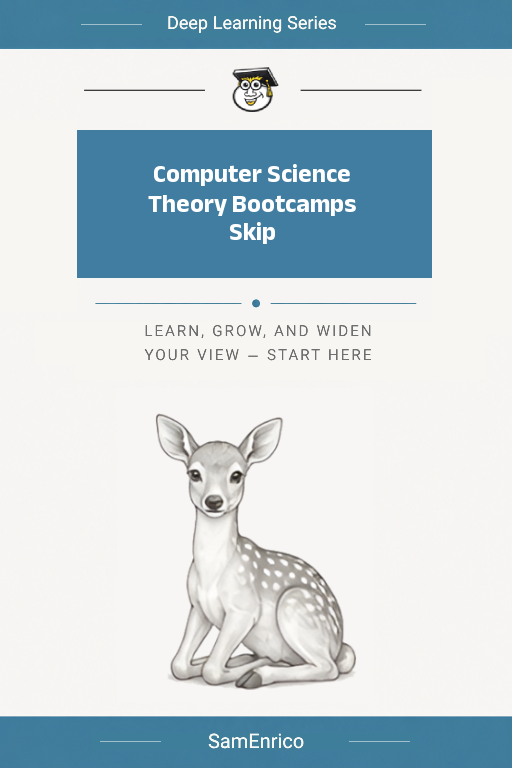
Non-FictionStudent's ShortcutTheory Gap
Computer Science Theory Bootcamps Skip eBook
Identify which algorithms data structures and theo
Identify which algorithms data structures and theory topics you can learn on your own versus what degrees require.
Formats
Free sample
Chapter 1: The $120,000 Question--You finished your bootcamp three months ago. You built a full-stack app, deployed it to AWS, and you can talk confidently about React hooks, REST APIs, and Mongo DB aggregations. You've sent out 200 job applications. You've gotten 15 first-round interviews. And then, somewhere between the "tell me about yourself" and the coding challenge, everything fell apart.The interviewer asked you to explain why a hash table lookup is O(1) on average but can degrade to O(n).
You felt your chest tighten. You knew hash tables. You'd used them thousands of times. But the words wouldn't come. Not the right words.
Not the words that proved you understood what was actually happening inside the machine. You mumbled something about collisions. The interviewer nodded politely and moved on. You didn't get the callback.Or maybe your story is different. Maybe you're still in bootcamp, scrolling through Reddit threads about "degree vs.
bootcamp" at 2 AM, terrified that you're making a $20,000 mistake. Maybe you have a degree already — in English, or history, or business — and you're wondering if you need to go back for a second bachelor's just to get past resume screens. Maybe you're a self-taught developer who's been building production apps for three years but froze during a system design interview when someone asked about cache coherence.Whatever your path, you're here because you've sensed something uncomfortable: there's a gap between what you know and what you're expected to know. And you're not sure if that gap is something you can close with a few late nights and a stack of programming books, or if it's a chasm that requires four years and $120,000.This book exists because that question — what can you actually learn on your own versus what truly requires a degree — is almost never answered honestly.The Lie You've Been Told Let's start with what bootcamps won't tell you. Bootcamps are not computer science programs.
They never claim to be, at least not in the fine print. But their marketing lives in a gray area. "Become a software engineer in 12 weeks." "Learn the skills employers actually need." "No CS degree required." These statements are technically true. You can become a software engineer. You can learn job-relevant skills.
You can get hired without a degree.But there's an unspoken asterisk the size of a small moon.The jobs you'll qualify for after a bootcamp are real. They pay well. They offer interesting work. But they exist in a specific slice of the tech industry: web development, mobile apps, CRUD applications, internal tools, and front-end engineering. These are valuable, respectable careers.
Thousands of bootcamp graduates build them every day.The jobs you will struggle to get — at least without significant additional self-study — include machine learning engineering, compiler development, database engine work, operating systems,高频 trading systems, embedded systems, graphics programming, and any role where latency, memory, or correctness proofs matter. Also, notably, many positions at the companies bootcamps love to name-drop: Google, Meta, Apple, Amazon, Microsoft, and Netflix. Not because these companies hate bootcamp graduates — many of them hire bootcamp alumni every year — but because their interview processes specifically test the theory that bootcamps skip.This isn't a conspiracy. It's a mismatch of incentives.Bootcamps need you to get a job quickly so they can report high placement rates. They teach the fastest path to "employable" — frameworks, libraries, tools, patterns.
They teach you what works, not why it works or when it breaks. A bootcamp that spent three weeks on memory allocation and cache locality would see its graduates lose job offers to graduates who spent those three weeks learning the hot new front-end framework.Universities have the opposite problem. They need to justify four years and six figures of tuition. They teach theory, proofs, and fundamentals — the things that don't change when the Java Script framework of the month inevitably dies. But they often fail to teach practical skills, leaving graduates who can prove the halting problem undecidable but can't ship a feature to production.Neither path is complete.
Neither path is wrong. But the conversation about them is poisoned by marketing on one side and credentialism on the other.The Unified Rubric: A New Way to Decide This book introduces a simple, consistent framework for deciding whether you can learn any given computer science topic on your own or whether you need the structure of a formal course. We call it the Unified Rubric, and it has exactly four rules. Every topic in every chapter will be evaluated against these same rules, so you never get contradictory advice.Rule 1: Implementation is always self-learnable.If you can write working code that demonstrates a concept, you can teach yourself that concept. This includes building data structures from scratch, implementing algorithms, and creating working software.
The internet has an infinite supply of tutorials, documentation, and open-source code. With discipline and time, anyone can learn to implement anything.Rule 2: Formal proofs are always degree-optimal.If the topic requires you to write a mathematical proof — not just understand one, but produce one from scratch — you are almost certainly better off learning it in a structured course. Proofs require feedback loops that self-study cannot provide. You cannot reliably grade your own proof. You cannot spot your own logical leaps.
The subtle errors in a pumping lemma proof or a reduction argument are invisible to the person who wrote them. A good instructor, a teaching assistant, or a peer review group can catch these errors. Solo, you will simply reinforce your own misunderstandings.Rule 3: Concurrency debugging and manual memory management are degree-required.Some things cannot be learned in high-level languages. You cannot truly understand memory leaks, segmentation faults, dangling pointers, or race conditions until you have debugged them in C, C++, or Rust. These experiences require structured labs with tools like Valgrind, GDB, and Thread Sanitizer — and they require graded assignments that force you to fix real concurrency bugs.
Reading about these concepts is not enough. Watching You Tube videos is not enough. You must bleed on the sharp edges of manual memory management, and a classroom setting is the safest place to do that.Rule 4: Recognition is self-learnable; creation is degree-optimal.You can learn to recognize an NP-Complete problem. You can learn the definition of a context-free grammar. You can learn to spot when a reduction might apply.
But creating a novel reduction proof, designing a new algorithm with a correctness proof, or proving that a language is not regular — these are creation-level skills that benefit enormously from formal instruction. The line is simple: if you need to use a concept, you can learn it yourself. If you need to extend a concept or prove something new about it, take a class.These four rules will appear in every chapter. We will apply them consistently. When you finish this book, you will not only know what you can learn on your own — you will know what you should outsource, and exactly where to outsource it.The Degree Divide Throughout this book, we will refer to a single term: The Degree Divide.
This is the line we draw, chapter by chapter, between topics that fall on the self-learn side of the Unified Rubric and topics that…
This is the end of the free sample. Get the eBook to keep going. Buy now
About this book
Details
- Author
- Kinder Jaimee
- Publisher
- SamEnrico
- Language
- English
- Genre
- Non-Fiction, Student's Shortcut, Theory Gap
- Released
- 2026-05-29
- Pages (approx.)
- 131
- Available as
- eBook, Audiobook

Read better in the ZLOADR app
Your eBooks on your phone or tablet. Sign in with your SamEnrico account and start reading.
More by Kinder Jaimee
 Anger in Trauma BondingKinder Jaimee$11.99
 Talking About Suicidal Thoughts GuideKinder Jaimee$11.99
 Grandparents Raising GrandkidsKinder Jaimee$11.99
 Directory Era French HistoryKinder Jaimee$11.99
 The Interruption Signal SystemKinder Jaimee$11.99
 Postpartum Depression Nutrition GuideKinder Jaimee$11.99
 Pelvic Floor AppsKinder Jaimee$11.99
 The Feedback Delivery MethodKinder Jaimee$11.99
 Self Esteem For Short PeopleKinder Jaimee$11.99
 The Archimedes Code: A Heist of Ancient GeniusKinder Jaimee$11.99
 Power Couple: The Billion-Dollar Betrayal of the MurdochsKinder Jaimee$11.99
 Enki’s Riddle: The God Who Spoke in WaterKinder Jaimee$11.99
You may also like
 Hong Kong Handover 1997Dunn Johnnie$11.99
 Zumba For Postnatal Recovery CourseNeal Christian$11.99
 Zumba for BeginnersLadner Nikia$11.99
 YouTube Comment Mining GuideHumes Pandora$12.99
 Worry Box MeditationCarlin Rudy$11.99
 Workplace Stress MeditationNguyen Lynn$11.99
 Workplace Stress and Sleep RepairHawley Ivory$11.99
 Workplace Perfectionism CureDelaney Jeffry$11.99
 Workplace Injustice Anger GuideWallen Isabelle$11.99
 Work Addiction and Burnout LinkGreenwood Ester$11.99
 Women in Yoga and WellnessBeattie Galina$11.99
 Women in Stand Up ComedyChun Evangeline$11.99