
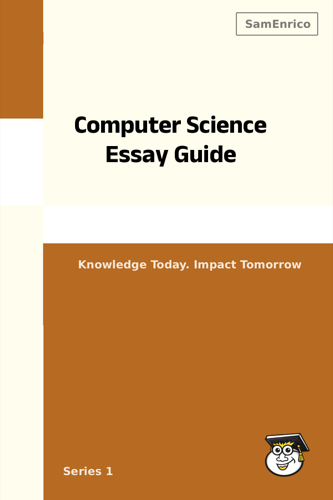
essaysStudent's ShortcutComputer Science
Computer Science Essay Guide Audiobook
Discuss algorithms and computing ethics with techn
Discuss algorithms and computing ethics with technical prompts.
Formats
Free sample
Chapter 1: The Efficiency Fallacy--–- The first time Sarika ran her sorting algorithm on real loan data, it worked beautifully. The O(n²) bubble sort she’d written as a proof-of-concept processed three thousand applications in under a second. Her professor gave her an A. Her code passed all tests. “It works on my machine,” she wrote in the comments, and she meant it as a boast.Six months later, that same algorithm was denying mortgages to seventy-two-year-old applicants because the bank’s real-time system timed out after 800 milliseconds, and bubble sort – unlike merge sort – gets exponentially slower as input grows.
No one had asked about time complexity during the ethics review. No one had considered that efficiency isn’t just a performance metric. It’s a moral category.This book exists because Sarika’s story is not an exception. It is the rule.Computer science students learn to write code that runs. They learn to write documentation that describes.
But almost no one teaches them to write arguments that evaluate – to move from “this algorithm works” to “this algorithm should or should not be used.” The Computer Science Essay Guide bridges that gap. It teaches you to write rigorously about algorithms and ethics, combining formal reasoning (logic, pseudo-code, systems thinking) with normative argumentation (justice, bias, welfare). By the end of this book, you will not only spot the ethical fault lines in code – you will write about them with precision, evidence, and persuasive power.This first chapter establishes the foundation for everything that follows. You will learn the difference between empirical claims and normative claims, why “it works on my machine” is an ethical failure not a technical success, and – most importantly – the one rule that will save you from the most common mistake in student ethics writing: the Anthropomorphism Ban. You will never again write “the algorithm thinks” or “the AI believes.” By the time you finish this chapter, you will have written your first technical ethics paragraph, transforming a simple Big-O comparison into a moral argument about efficiency and human welfare.Welcome to the hardest writing you’ve ever done.
It’s also the most important.The Two Languages of Computer Science Every piece of code speaks two languages, though most programmers learn only one.The first language is empirical. It deals with facts that can be measured, tested, and verified. “This sorting algorithm runs in O(n log n) time.”…
This is the end of the free sample. Get the Audiobook to keep going. Buy now
About this book
Details
- Author
- Childs Trinidad
- Publisher
- SamEnrico
- Language
- English
- Genre
- essays, Student's Shortcut, Computer Science
- Released
- 2026-06-07
- Pages (approx.)
- 160
- Available as
- eBook, Audiobook

Listen in the VoxFlicks app
Audiobooks and audio dramas wherever you go. Sign in with your SamEnrico account and press play.
More by Childs Trinidad
 Home Office Distraction Management GuideChilds Trinidad$11.99
 Jamaican BPO Legal ComplianceChilds Trinidad$11.99
 Divorce and Premarital AgreementsChilds Trinidad$11.99
 The Siege of Calahorra: Blood on the Ebro (920 AD)Childs Trinidad$11.99
 The Hillel and Shammai Debate GuideChilds Trinidad$11.99
 How to Start a Television Broadcasting BusinessChilds Trinidad$11.99
 QuickBooks Sales Receipt GuideChilds Trinidad$12.99
 Construction Materials M&AChilds Trinidad$12.99
 Understanding Plasmalogenes Synthesis Deficiency IsolatedChilds Trinidad$17.99
 Aurora Borealis GuideChilds Trinidad$11.99
You may also like
 YouTube Video Essay DepthLeon Lala$11.99
 TOEFL Independent Essay GuideMintz Alex$11.99
 Music Theory Essay GuideWilkinson Maisha$11.99
 Expository Essay AI PromptsApplegate Dalia$11.99
 Exam Essay MemorizationMcgovern Johna$11.99
 Compare Contrast Essay PromptsOntiveros Marx$11.99
 College Application Essay GuideSisson Aimee$11.99College Application Essay GuideSisson Aimee$11.99
 The 100 Word Essay ChallengeAli Luciana$11.99
 Journalism Essay PromptsThatcher Williemae$11.99
 Finance Essay PromptsShrader Lamont$11.99
 Cause Effect Essay GPT GuideBland Jacelyn$11.99