
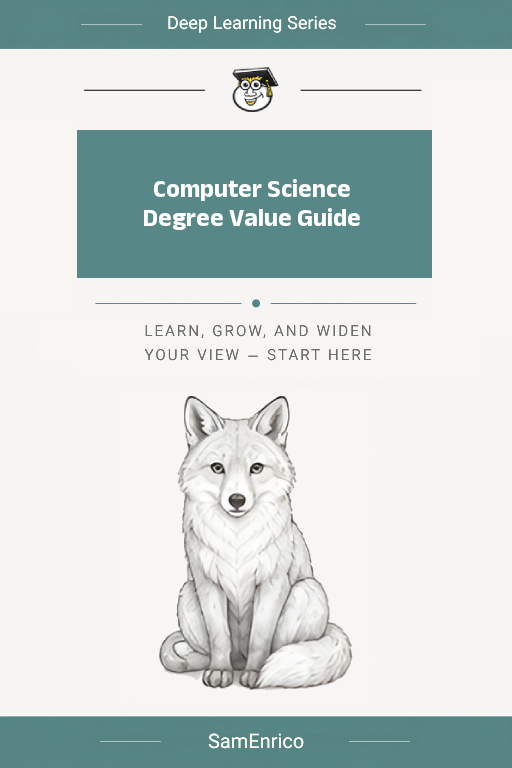
Non-FictionStudent's ShortcutDegree ValueUniversity Path
Computer Science Degree Value Guide Audiobook
Assess the long term value of traditional CS degre
Assess the long term value of traditional CS degrees including alumni networks research opportunities and visa pathways.
Formats
Free sample
Chapter 1: The Million-Dollar Lie--–- The day Raj received his coding bootcamp completion certificate, he framed it and posted a triumphant photo on Linked In. "No degree, no debt, no limits," his caption read. Within six weeks, he had a job offer: $85,000 as a front-end developer at a mid-sized marketing tech firm in Austin. He was 24 years old, and he believed he had beaten the system.–- Eighteen months later, Raj was laid off in a 7% workforce reduction. The company replaced his position with an AI-assisted development tool and a junior developer in Monterrey, Mexico, who cost one-third of his salary.
Raj spent the next nine months applying to 473 jobs. He received exactly four interview requests. Each time, the recruiter asked the same question: "Do you have a bachelor's degree in computer science or a related field?" Each time, he said no. Each time, the conversation ended.–- Meanwhile, his former college roommate, Priya, had taken a different path. She graduated the same year as Raj—not from a bootcamp, but from a middling state school with a middling GPA and a bachelor's degree in computer science.
Her starting salary was 78,000,seventhousanddollarslessthan Raj′s.Shespentherfirsttwoyearswritingunglamorousinternaltoolsforabank,notbuildingthenextunicornstartup.Butwhenlayoffscametohercompany,shesurvived.Herdegreegavehertheformalcredentialstoslideintoasolutionsarchitectrole.Byyearfour,sheearned78,000, seven thousand dollars less than Raj's. She spent her first two years writing unglamorous internal tools for a bank, not building the next unicorn startup. But when layoffs came to her company, she survived. Her degree gave her the formal credentials to slide into a solutions architect role. By year four, she earned 78,000,seventhousanddollarslessthan Raj′s.Shespentherfirsttwoyearswritingunglamorousinternaltoolsforabank,notbuildingthenextunicornstartup.Butwhenlayoffscametohercompany,shesurvived.Herdegreegavehertheformalcredentialstoslideintoasolutionsarchitectrole.Byyearfour,sheearned135,000.
By year six, with a master's degree her employer paid for, she cleared $185,000. Raj, at year six, was managing a car wash his uncle owned in New Jersey, having abandoned tech altogether.–- This book is not a polemic against bootcamps. Some bootcamp graduates thrive. Some degree holders flounder. But the data tells a story that the tech industry's hustle culture does not want you to hear: over a ten-year horizon, the median CS degree holder earns nearly twice as much as the median bootcamp graduate.
Not because they are smarter or more talented, but because the degree functions as a risk mitigation asset—insurance against layoffs, visa denials, and the slow creep of automation.–- This chapter dismantles the most dangerous myth in technology careers: that starting salary is the true measure of a degree's value. We…
This is the end of the free sample. Get the Audiobook to keep going. Buy now
About this book
Details
- Author
- Beavers Katelyn
- Publisher
- SamEnrico
- Language
- English
- Genre
- Non-Fiction, Student's Shortcut, Degree Value, University Path
- Released
- 2026-06-01
- Pages (approx.)
- 154
- Available as
- eBook, Audiobook

Listen in the VoxFlicks app
Audiobooks and audio dramas wherever you go. Sign in with your SamEnrico account and press play.
More by Beavers Katelyn
 Job Interview Nervousness GuideBeavers Katelyn$11.99
 Opioid Dependency Stigma Reduction GuideBeavers Katelyn$11.99
 Faith in CaptivityBeavers Katelyn$11.99
 Diet and Sleep for Parental RageBeavers Katelyn$11.99
 Agoraphobia Elevator Fear HandbookBeavers Katelyn$11.99
 The Pacific Skywatchers: Unveiling the Cosmos from Earth's Largest OceanBeavers Katelyn$11.99
 Code of the Centenarians: The DNA Secrets of the Blue ZonesBeavers Katelyn$11.99
 Mobile Commerce Five Year OutlookBeavers Katelyn$12.99
 Understanding Brachydactyly Type A1Beavers Katelyn$17.99
 Employee Benefits Sales RepresentativeBeavers Katelyn$11.99
 10 Ways to Use Citrus Fruit (Recipe Book)Beavers Katelyn$11.99
You may also like
 Hong Kong Handover 1997Dunn Johnnie$11.99
 Zumba For Postnatal Recovery CourseNeal Christian$11.99
 Zumba for BeginnersLadner Nikia$11.99
 YouTube Comment Mining GuideHumes Pandora$12.99
 Worry Box MeditationCarlin Rudy$11.99
 Workplace Stress MeditationNguyen Lynn$11.99
 Workplace Stress and Sleep RepairHawley Ivory$11.99
 Workplace Perfectionism CureDelaney Jeffry$11.99
 Workplace Injustice Anger GuideWallen Isabelle$11.99
 Work Addiction and Burnout LinkGreenwood Ester$11.99
 Women in Yoga and WellnessBeattie Galina$11.99
 Women in Stand Up ComedyChun Evangeline$11.99