
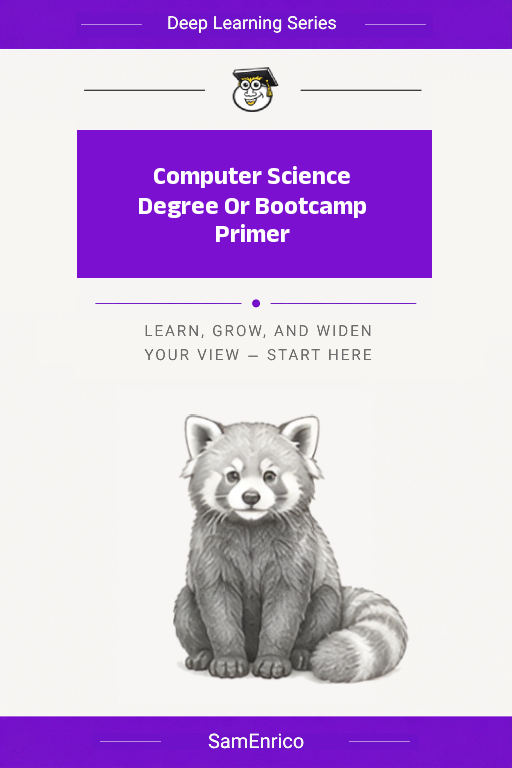
Non-FictionStudent's ShortcutPrimerFoundational Guide
Computer Science Degree Or Bootcamp Primer eBook
Understand the fundamentals gap between four-year
Understand the fundamentals gap between four-year degrees and intensive coding camps. Covers algorithms, system design, and which path suits different career goals.
Formats
Free sample
Chapter 1: The Great Gate Debate...--–- In the summer of 2014, two students graduated from the same high school in Austin, Texas. Both loved computers. Both could build a simple website. Both dreamed of working at Google. Then they took different paths.
Maria enrolled in a four-year computer science program at a state university. She graduated in 2018 with 42,000instudentdebtandadegree.Jamesattendeda14−weekcodingbootcamp.Hegraduatedin2014with42,000 in student debt and a degree. James attended a 14-week coding bootcamp. He graduated in 2014 with 42,000instudentdebtandadegree.Jamesattendeda14−weekcodingbootcamp.Hegraduatedin2014with14,000 in tuition and a certificate. Four years later, Maria was a mid-level backend engineer at Microsoft making 142,000.Jameswasaseniorfrontendengineerata Series Cstartupmaking142,000.
James was a senior frontend engineer at a Series C startup making 142,000.Jameswasaseniorfrontendengineerata Series Cstartupmaking138,000. Maria had survived three brutal algorithm interviews. James had built and shipped six production applications. Both were successful. Both were anxious.
And both were convinced the other had made the wrong choice.This chapter dismantles the tribalism that surrounds the degree-versus-bootcamp debate. It is not a sales pitch for either path. It is a data-driven map of the terrain so you can decide which route makes sense for your specific goals, risk tolerance, and learning style.The False War The rhetoric online is vicious. CS graduates call bootcamp alumni "framework monkeys" who lack fundamental knowledge. Bootcamp graduates call CS graduates "theoretical dinosaurs" who cannot ship code.
This war sells books and generates clicks, but it does not reflect how hiring actually works.Consider the numbers. According to the Stack Overflow Developer Survey aggregated across 2021 through 2023, between 30 and 45 percent of professional developers lack a formal computer science degree. That range fluctuates by region and seniority level. In the United States, the number leans toward the lower end. In emerging markets, it leans higher.
But the trend is unmistakable: the percentage of working developers without degrees has grown every year since 2016.The 43.3 percent figure sometimes cited originated from a 2018 survey that has since been criticized for sampling bias. The accurate statement is that roughly one in three professional developers in the United States lacks a CS degree, and roughly two in five globally lack one. That is not a niche. That is a substantial portion of the engineering workforce.Yet hiring managers still filter by degree. Why?
Because recruiting is a game of reducing risk with limited information. A hiring manager at a large company might receive five hundred applications for a single junior position. They cannot interview everyone. They need heuristics.HR Filter Theory The concept of HR Filter Theory explains how recruiters use credentials as cognitive shortcuts. A degree from an accredited university signals several things at once.
First, it signals completion: the candidate finished a multi-year program with structured requirements, deadlines, and consequences for failure. Second, it signals baseline ability: the candidate passed courses in calculus, discrete mathematics, data structures, and operating systems. Third, it signals social conformity: the candidate navigated bureaucratic systems, dealt with advisors, and showed up to classes for four years.None of these signals guarantee that a candidate is a good engineer. But they are cheap for recruiters to evaluate. A resume that lists a BS in Computer Science from a known university moves to the top of the pile in six seconds.
A resume that lists a bootcamp certificate moves to the "maybe" pile. A resume that lists neither moves to the bottom unless the candidate has exceptional project work or referrals.This is not fair. It is also not irrational from the recruiter's perspective. Large companies process thousands of applications. They cannot afford to give every self-taught candidate a deep look.
The degree acts as a pre-filter.Bootcamps, however, have carved out their own signal. A bootcamp certificate from a reputable program (Hack Reactor, App Academy, Flatiron School, or similar) signals several different things. It signals intensity: the candidate completed 60 to 100 hours per week of coding for three to four months. It signals recent practice: bootcamp curricula emphasize modern frameworks like React, Node, and Django. It signals the ability to ship: most bootcamps require portfolio projects and group work.The difference in signals explains the difference in hiring outcomes.
Large companies with deep engineering teams often prioritize degree signals because they need engineers who can understand systems at multiple levels of abstraction. Startups often prioritize bootcamp signals because they need engineers who can ship features quickly and adapt to changing requirements.The FAANG versus Startup Matrix The hiring matrix is not binary. Different companies weigh credentials differently based on their stage, size, and technical challenges.FAANG companies (Facebook/Meta, Amazon, Apple, Netflix, Google) and their equivalents (Microsoft, Stripe, Snowflake, Databricks) prioritize algorithms and systems design. These companies operate at enormous scale. A small inefficiency in a Google service multiplied by billions of requests becomes a major cost.
They need engineers who understand Big O notation, data structure internals, distributed systems trade-offs, and performance analysis. The degree curriculum aligns closely with these needs.In practice, this means that a FAANG interview process typically includes four to six technical rounds. At least two rounds focus on data structures and algorithms. One round focuses on system design (for mid-level and senior candidates). One round focuses on behavioral questions about past projects and teamwork.
A degree does not guarantee passing these rounds, but it provides the foundation for preparing for them.Startups, particularly those between Series A and Series C, prioritize shipping speed and stack familiarity. A startup needs to release features before competitors. They care less about whether you can implement a red-black tree and more about whether you can build a React component, wire it to an API, and deploy it to AWS in an afternoon. Bootcamp graduates often excel at these tasks because they have done them repeatedly during their program.A typical startup interview includes a take-home project (build a small app in 24-48 hours), a live coding session focused on practical implementation (not abstract algorithms), and meetings with the CTO or lead engineer to discuss past projects. Bootcamp graduates often shine in this format because they have built several complete applications and can talk about deployment, testing, and trade-offs.There are exceptions on both sides.
Some FAANG teams value practical shipping skills and hire bootcamp graduates. Some startups require deep algorithmic knowledge for specialized domains like computer vision or natural language processing. But the general pattern holds across most of the industry.Niche Roles That Require Depth Certain engineering roles demand the depth that a degree typically provides. If your goal is to work in one of these domains, a degree is not just helpful but nearly necessary.Artificial Intelligence and Machine Learning require linear algebra, multivariable calculus, probability theory, and optimization. Bootcamps rarely teach these topics.
While you can learn them independently, most hiring managers in AI/ML expect to see either a graduate degree or a strong undergraduate CS degree with relevant coursework.Quantitative Finance and High-Frequency Trading firms like Jane Street, Two Sigma, and Citadel hire almost exclusively from top CS programs. They require deep understanding of algorithms, data structures, and systems programming. These firms also pay two to five times what standard tech companies pay, which justifies the investment in a degree.Compilers and Programming Languages is a niche domain where a…
This is the end of the free sample. Get the eBook to keep going. Buy now
About this book
Details
- Author
- Bernier Nguyet
- Publisher
- SamEnrico
- Language
- English
- Genre
- Non-Fiction, Student's Shortcut, Primer, Foundational Guide
- Released
- 2026-05-30
- Pages (approx.)
- 142
- Available as
- eBook, Audiobook

Read better in the ZLOADR app
Your eBooks on your phone or tablet. Sign in with your SamEnrico account and start reading.
More by Bernier Nguyet
 Land Reform GrievancesBernier Nguyet$11.99
 GAD Disability Benefits GuideBernier Nguyet$11.99
 Birth Trauma Nightmare GuideBernier Nguyet$11.99
 Dreams After Combat Trauma GuideBernier Nguyet$11.99
 Period Product Comparison GuideBernier Nguyet$11.99
 The Arctic Star Chasers: Ancient Inuit Cosmology and the Northern LightsBernier Nguyet$11.99
 The Cursed Chariot of DiomedesBernier Nguyet$11.99
 Understanding Hashimoto StrumaBernier Nguyet$17.99
 Artificial Intelligence Transportation OutlookBernier Nguyet$12.99
 How to Start a Hobby in Off-roadingBernier Nguyet$11.99
 Associate Affiliate ManagerBernier Nguyet$11.99
You may also like
 Hong Kong Handover 1997Dunn Johnnie$11.99
 Zumba For Postnatal Recovery CourseNeal Christian$11.99
 Zumba for BeginnersLadner Nikia$11.99
 YouTube Comment Mining GuideHumes Pandora$12.99
 Worry Box MeditationCarlin Rudy$11.99
 Workplace Stress MeditationNguyen Lynn$11.99
 Workplace Stress and Sleep RepairHawley Ivory$11.99
 Workplace Perfectionism CureDelaney Jeffry$11.99
 Workplace Injustice Anger GuideWallen Isabelle$11.99
 Work Addiction and Burnout LinkGreenwood Ester$11.99
 Women in Yoga and WellnessBeattie Galina$11.99
 Women in Stand Up ComedyChun Evangeline$11.99