
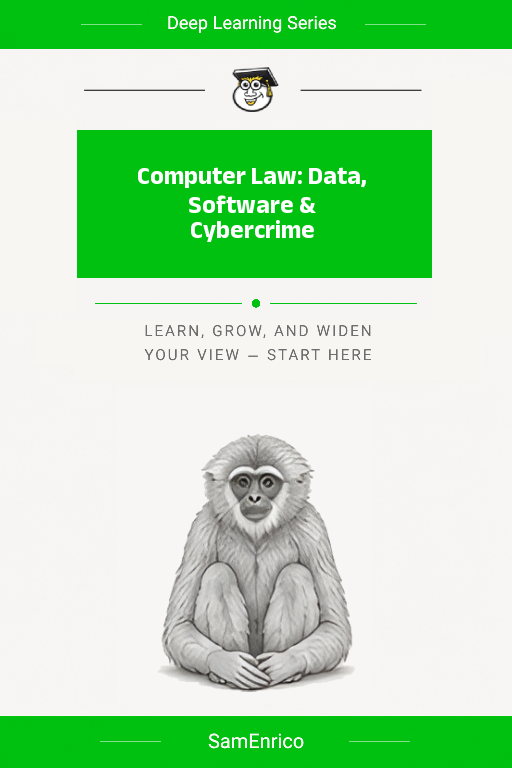
Computer Law: Data, Software & Cybercrime
This publication, published by SamEnrico, covers C
by Mcnabb Tobie
This publication, published by SamEnrico, covers Computer Law: Data, Software & Cybercrime
Formats
About this book
Free sample
Chapter 1: The Judge Who Hated Code--Judge Rebecca Chen stared at the screen in frustration. Before her, on the docket, was United States v. Mikhail Volkov, a case alleging that the defendant had stolen over two million credit card numbers from a New York-based retailer. The evidence was a string of characters – a Python script, forty-seven lines long – that the prosecution claimed was a "hacking tool." The defense argued it was "source code," protected speech under the First Amendment. Judge Chen, a brilliant jurist with thirty years on the bench, had never written a line of code in her life.
She had no idea whether those forty-seven lines were a digital crowbar or a digital poem. And under the law, that distinction might determine whether Volkov went to prison for twenty years or walked free.This is the central crisis of computer law. The people who write the rules – judges, legislators, regulators – are, with few exceptions, digital outsiders. The people who write the code – engineers, developers, hackers – are, with few exceptions, legal outsiders. The gap between them grows wider every year.
And that gap is where this book begins.The Fundamental Mismatch: Law's Past, Technology's Future Law is, by design, backward-looking. Courts decide cases based on precedent – what happened before. Legislatures pass statutes in response to crises that have already occurred. This is not a flaw; it is a feature. Stare decisis (the doctrine of following prior decisions) provides stability, predictability, and fairness.
But when technology changes faster than law can react, stability becomes stagnation.Consider the timeline. The United States Copyright Act of 1976, still the foundation of software copyright law, was written when the dominant computer was the mainframe – a room-sized machine accessible only to specialists. The Computer Fraud and Abuse Act of 1984 was written in response to a single movie (War Games, in which a young Matthew Broderick nearly starts a nuclear war by hacking a military mainframe) and did not anticipate the internet, let alone cloud computing, ransomware, or AI. The Fourth Amendment's protection against "unreasonable searches and seizures" was written in 1791, when "papers and…
This is the end of the free sample. Get the eBook to keep going. Buy now
Contents
- Chapter 1
- Chapter 2
- Chapter 3
- Chapter 4
- Chapter 5
- Chapter 6
- Chapter 7
- Chapter 8
- Chapter 9
- Chapter 10
- Chapter 11
- Chapter 12
Details
- Author
- Mcnabb Tobie
- Publisher
- SamEnrico
- Language
- English
- Genre
- Non-Fiction, Informative, Educational
- Released
- 2026-06-02
- Pages (approx.)
- 146
- Available as
- eBook, Audiobook

Read better in the ZLOADR app
Your eBooks on your phone or tablet. Sign in with your SamEnrico account and start reading.
More by Mcnabb Tobie
 Pet Loss and Complicated GriefMcnabb Tobie$11.99
 The L Arginine for ED GuideMcnabb Tobie$11.99
 Cash Conversion Cycle GuideMcnabb Tobie$12.99
 Wholesaling Divorce PropertiesMcnabb Tobie$11.99
 Biology Palace BuilderMcnabb Tobie$11.99
 Assertiveness for VeteransMcnabb Tobie$11.99
 Work Stress NightmaresMcnabb Tobie$11.99
 ED Vacuum Device GuideMcnabb Tobie$11.99
 Freelance Career PivotMcnabb Tobie$11.99
 The Desert Fox: Rommel's Duel in the Sands (1941-1943)Mcnabb Tobie$11.99
 The Bone Orchard's Guardian: The Legend of the Chinese JiangshiMcnabb Tobie$11.99
 How to Produce a Fan SystemMcnabb Tobie$11.99