
Non-FictionSelf-Help12-Step Programs
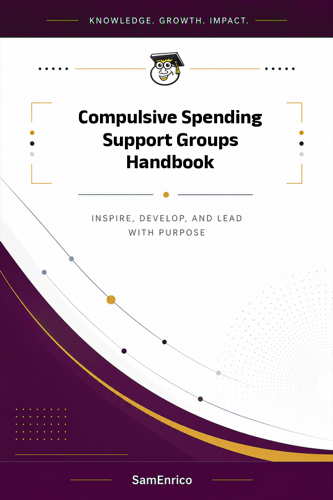
Compulsive Spending Support Groups Handbook eBook
Teaches how to find and participate in Debtors Ano
Teaches how to find and participate in Debtors Anonymous or Spenders Anonymous meetings.
Formats
Free sample
Chapter 1: The Great Illusion--–- The first time Jennifer walked into a Debtors Anonymous meeting, she brought a spreadsheet. It was color-coded, meticulously organized, and completely useless. She had tracked every dollar she spent for three months—every coffee, every late fee, every hidden online purchase she had smuggled past her husband like contraband. She knew exactly where her money went. She knew she was drowning in twenty-seven thousand dollars of credit card debt.
She knew the interest rates, the minimum payments, and the exact date each card would max out. What she did not know was why she kept spending anyway.That spreadsheet represented the single most dangerous misconception about compulsive spending: the belief that this is a math problem. If you just understand your finances, the thinking goes, you will control them. If you just learn to budget, you will stop overspending. If you just calculate the interest, you will put the card down.Jennifer had all the math.
She was an accountant. And she was hiding purchases in the trunk of her car.This chapter dismantles the great illusion—the lie that willpower and financial literacy are enough to stop compulsive spending. It begins by distinguishing between a financial problem and a spending addiction, introduces the clinical and recovery frameworks for understanding this behavior, and provides a clear comparison of the support groups available. By the end, you will understand why your budget has failed and why the first step toward recovery has nothing to do with money at all.The Spreadsheet Trap: Why Knowledge Is Not Power Let us be precise about something that most personal finance books get wrong. There is a difference between a financial problem and a spending addiction.
A financial problem is a lack of information or skill. It looks like this: you do not know how to balance a checkbook, you have never heard of compound interest, you think a credit score is a type of musical notation. A financial problem is solved with education. You take a class, read a book, learn the terminology, and the problem resolves.A spending addiction is not a financial problem. It is a behavioral and emotional disorder that expresses itself through money.
The person with a spending addiction often has excellent financial literacy. They know exactly what they are doing. They understand that the interest rate on that store card is twenty-six percent. They know they cannot afford the purchase. They know they will feel shame tomorrow.
And they buy it anyway.This is the spreadsheet trap. You fill out the columns and rows. You track every expense. You feel a momentary sense of control—the illusion of mastery. And then something happens: a bad day at work, a fight with your partner, a wave of loneliness at 10 PM.
The spreadsheet does not help you then. It sits there, a silent witness to your failure, making you feel worse because you knew better and did it anyway.The trap is seductive because it keeps you busy. As long as you are tracking, calculating, and planning, you feel like you are doing something. But tracking is not recovery. Tracking is data collection.
Recovery requires something much harder: looking at why you needed to buy that thing in the first place.The Neurology of the Buy Button To understand why willpower fails, you have to understand what happens inside your brain the moment you decide to make a purchase. This is not a metaphor. This is neurology.When you anticipate a reward—a purchase, a food, a drug—your brain releases dopamine. Dopamine is not the chemical of pleasure; it is the chemical of wanting. It drives motivation, craving, and anticipation.
The spike of dopamine happens before you buy, not after. This is why the online shopping cart feels so good. This is why the click of "Place Order" delivers a rush. The package arriving three days later is often a letdown—the thing sits on your counter, ordinary and unmagical—but by then, the dopamine has already done its work.Compulsive spending hijacks this system. The more you buy, the more your brain associates the act of purchasing with relief.
Over time, the threshold lowers. You do not need a bad day to trigger a purchase. You just need boredom. You just need an email with a discount code. You just need to see someone else buying something on social media.This is why telling a compulsive spender to "just stop" is like telling someone with depression to "just be happy." The neural pathways have been carved deep.
The behavior is no longer a choice; it is a response to a trigger. And triggers are everywhere.A financial problem says: "I spent too much because I did not understand my cash flow." A spending addiction says: "I spent too much because I needed to feel something different than what I was feeling, and for three seconds, that purchase worked."Oniomania: The Clinical Framework The medical term for compulsive buying disorder is oniomania, from the Greek onios (for sale) and mania (madness). It is recognized in the psychiatric literature as a behavioral addiction, closely related to gambling disorder and substance use disorders. The diagnostic features include:Persistent, intrusive thoughts about buying Recurrent failure to resist impulses to purchase Significant distress or impairment in social, occupational, or financial functioning Buying that is not primarily explained by mania or hypomania Researchers estimate that oniomania affects between five and six percent of the adult population in developed countries. It is not rare.
It is not a moral failing. It is a diagnosable condition with predictable patterns and, crucially, treatable outcomes.The clinical literature identifies several subtypes. Some people compulsively buy luxury goods they cannot afford—handbags, watches, cars. Others engage in what is called "retail therapy"—small, frequent purchases that accumulate into disaster. Still others hoard items they never use, finding comfort in the possession itself rather than the utility.What all subtypes share is the cycle: trigger, urge, purchase, relief, shame, and then the trigger again.
The shame drives the next purchase, because shame is uncomfortable, and the brain has learned that buying provides temporary relief from discomfort. This is the engine of the addiction.Financial Anorexia: The Hidden Pole There is another presentation of this disorder that receives far less attention. It is called financial anorexia, and it is the mirror image of compulsive spending. Where the spender cannot stop acquiring, the financial anorexic cannot stop depriving.Financial anorexia is characterized by:Refusing to spend money on necessities, even when funds are available Extreme anxiety around any purchase, no matter how small Under-earning: turning down raises, working for free, charging below market rates A belief that deprivation is virtuous and spending is dangerous Physical or emotional distress caused by the lack of basic needs (food, heat, medical care)The financial anorexic and the compulsive spender often come from the same root: a deep relationship with scarcity. The spender tries to fill the void with objects.
The anorexic tries to control the void by making it smaller and smaller until they disappear into it.In recovery communities, these two presentations often appear in the same person at different life…
This is the end of the free sample. Get the eBook to keep going. Buy now
About this book
Details
- Author
- Lyons Lucille
- Publisher
- SamEnrico
- Language
- English
- Genre
- Non-Fiction, Self-Help, 12-Step Programs
- Released
- 2026-06-09
- Pages (approx.)
- 125
- Available as
- eBook, Audiobook

Read better in the ZLOADR app
Your eBooks on your phone or tablet. Sign in with your SamEnrico account and start reading.
More by Lyons Lucille
 Russian Prison Tattoo CodeLyons Lucille$11.99
 Therapeutic Dream JournalingLyons Lucille$11.99
 Food Addiction Intuitive Eating IntegrationLyons Lucille$11.99
 The Meditation Space SetupLyons Lucille$11.99
 The Unsinkable Dream: How the SS United States Defied the AtlanticLyons Lucille$11.99
 The Last Broadcast: The Rise and Fall of the Golden Age of RadioLyons Lucille$11.99
 Understanding Congenital Antithrombin Iii DeficiencyLyons Lucille$17.99
 Lighting EngineerLyons Lucille$11.99
 How to Start a Automotive Glass Replacement Shop BusinessLyons Lucille$11.99
 Return on Education IndexLyons Lucille$12.99
 Seasonal Income AdaptationLyons Lucille$12.99
You may also like
 Hong Kong Handover 1997Dunn Johnnie$11.99
 Zumba For Postnatal Recovery CourseNeal Christian$11.99
 Zumba for BeginnersLadner Nikia$11.99
 YouTube Comment Mining GuideHumes Pandora$12.99
 Worry Box MeditationCarlin Rudy$11.99
 Workplace Stress MeditationNguyen Lynn$11.99
 Workplace Stress and Sleep RepairHawley Ivory$11.99
 Workplace Perfectionism CureDelaney Jeffry$11.99
 Workplace Injustice Anger GuideWallen Isabelle$11.99
 Work Addiction and Burnout LinkGreenwood Ester$11.99
 Women in Yoga and WellnessBeattie Galina$11.99
 Women in Stand Up ComedyChun Evangeline$11.99