
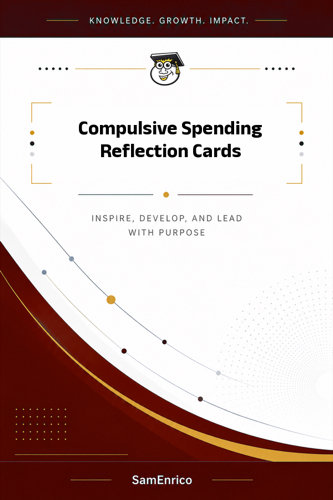
Compulsive Spending Reflection Cards eBook
Use 52 question prompts to uncover your unique spe
Use 52 question prompts to uncover your unique spending drivers weekly.
Formats
Free sample
Chapter 1: The Receipt Never Lies--–- You are about to do something that most personal finance books explicitly tell you not to do. You are going to stop trying to change. For the next thirty days, you will not create a budget. You will not delete your shopping apps. You will not promise yourself that tomorrow will be different.
You will not shame yourself for past purchases. You will not swear off coffee, cancel your subscriptions, or announce a spending fast on social media. In fact, you will do the opposite of every piece of conventional financial advice you have ever received. You will simply collect paper.Let me explain why this matters.Every year, thousands of people resolve to get their spending under control. They download budgeting apps with aggressive red notifications.
They watch You Tube videos about cash stuffing envelopes. They read articles with titles like “10 Things You Should Never Buy Again.” And three weeks later, they are standing in a Target parking lot at 9:47 PM holding a shopping bag full of items they cannot remember putting in the cart. The shame arrives before the car even starts. They tell themselves they have no willpower. They tell themselves they are bad with money.
They tell themselves something is fundamentally broken inside them.That voice is wrong. But it is very loud.The problem is not your willpower. The problem is that you have been trying to solve a puzzle without looking at the pieces. You cannot budget your way out of a behavior you do not understand. You cannot delete an app that is not the real problem.
The app is not the addiction; the feeling you are chasing is. The sixty-five dollar candle is not the issue; the loneliness you felt at 10 PM on a Tuesday is. The new jacket is not the issue; the quiet fear that your colleagues do not respect you is. Every purchase is a message. And for thirty days, you are going to learn how to read your own handwriting.This chapter introduces the 30-Day Spending Autopsy, a radical departure from traditional financial advice.
You will collect every receipt, log every transaction, and analyze every purchase using a framework called the Three A's: Asset, Atmosphere, and Affect. You will build a Trigger Heat Map that shows you exactly when, where, and under what emotional conditions you spend money. And you will do all of this without changing a single behavior. No restrictions. No judgment.
No shame. Just data.By the end of this chapter, you will know more about your spending patterns than ninety percent of people who have tried budgeting for years. More importantly, you will have replaced the familiar voice of shame with something far more useful: curiosity.Why Most Spending Advice Fails You Before we begin the autopsy, we need to understand why every other method has let you down. If you have ever tried to budget, you have experienced some version of the following cycle.Week one brings excitement. You create a beautiful spreadsheet or download a highly rated app.
You categorize your expenses into neat colored bars: Groceries, Dining Out, Shopping, Entertainment. You feel organized. You feel hopeful. You feel like this time will be different.Week two introduces friction. You forget to log a coffee.
Then you forget to log lunch. The app sends you a notification that you have exceeded your Shopping category by forty dollars. You feel a familiar tightening in your chest. You tell yourself you will do better tomorrow.Week three brings avoidance. You stop opening the app.
The notifications pile up like unread emails. You know what they will say, and you do not want to see it. Shame replaces hope. You start to believe that you are simply not the kind of person who can stick to a budget.Week four ends in abandonment. You delete the app or close the spreadsheet.
You tell yourself that budgets do not work for people with irregular income or high stress jobs or a family that does not understand. You return to your old patterns, but now you carry an extra layer of shame about your failure.This cycle is not your fault. It is the inevitable result of a system designed for the wrong problem.Traditional budgeting assumes that spending is a purely rational act. It assumes that if you simply see where your money is going, you will naturally choose to redirect it toward better things. This assumption is false.
Spending is rarely rational. It is emotional, habitual, social, and neurological. You cannot Excel spreadsheet your way out of a dopamine loop.The second problem with traditional budgeting is that it asks you to change your behavior before you understand it. Imagine a doctor who prescribes medication without running any tests. Imagine a mechanic who replaces your engine without looking under the hood.
That is what most financial advice does. It hands you a template, spend fifty percent on needs, thirty percent on wants, twenty percent on savings, and tells you to force your life into its boxes. When you cannot, the advice blames you.The 30-Day Spending Autopsy is the opposite. It asks nothing of you except attention. It makes no moral claims about your purchases.
It does not care if you buy a twelve dollar smoothie every morning or a four hundred dollar handbag once a month. It only asks: what happened, where did it happen, and how did you feel before it happened?This is not budgeting. This is archaeology.The Three A's: Your Analytical Framework Every purchase you make contains hidden information. The Three A's are the tools you will use to excavate that information. Unlike complex financial ratios or confusing categories, the Three A's are simple enough to remember while standing in a checkout line and deep enough to reveal patterns you have never noticed before.Asset: The What The first A stands for Asset, the actual item or service you purchased.
This seems obvious, but most people remember what they bought inaccurately. They remember the idea of the purchase rather than the purchase itself. I bought some things at Target is not data. I bought a scented candle, a pack of pens I did not need, a sweater on clearance, and a bag of dark chocolate almonds is data.Here is the rule for logging the Asset: describe the item without evaluation. Do not write useless junk or another impulse buy or something I regret.
Write the name of the thing as if you were reading it from a receipt. Neutral. Clinical. Boring.Examples of good Asset entries include a medium latte with oat milk, one paperback novel in the mystery genre, a three-pack of athletic socks in black, a monthly subscription to a meditation app, and takeout dinner for two from a Thai restaurant.Examples of bad Asset entries include stupid coffee, which is evaluation; thing I bought because I was sad, which is interpretation rather than observation; groceries, which is too vague; and another mistake, which is shame.The Asset column is not where you judge yourself. The Asset column is where you become a witness.Atmosphere: The Where and When The second A stands for Atmosphere…
This is the end of the free sample. Get the eBook to keep going. Buy now
About this book
Details
- Author
- Verdin Tiesha
- Publisher
- SamEnrico
- Language
- English
- Genre
- Non-Fiction, Self-Help, Reflection
- Released
- 2026-06-07
- Pages (approx.)
- 145
- Available as
- eBook, Audiobook

Read better in the ZLOADR app
Your eBooks on your phone or tablet. Sign in with your SamEnrico account and start reading.
More by Verdin Tiesha
 Voice Recording Dream LogVerdin Tiesha$11.99
 Sibling Addiction ReconciliationVerdin Tiesha$11.99
 Mindful Walking Beginners GuideVerdin Tiesha$11.99
 Stimulant Malnutrition RecoveryVerdin Tiesha$11.99
 The Retirement Home Equity StrategyVerdin Tiesha$11.99
 Medical Diagnosis TalksVerdin Tiesha$11.99
 SMART Goals for Retirement PlanningVerdin Tiesha$11.99
 The Lioness of Dahomey: Agafay and the Warrior Queens of BeninVerdin Tiesha$11.99
 The Silent Coup: What If the 1973 Yom Kippur War Never Happened?Verdin Tiesha$11.99
 How to Produce Used HardwareVerdin Tiesha$11.99
 How to Become a Round-corner-cutter OperatorVerdin Tiesha$11.99
 API Integration ROI GuideVerdin Tiesha$12.99
You may also like
 Remote Work End of Day ReviewPoland Iliana$11.99
 The Empathy and Mirroring GuideMarlow Shizue$11.99
 Group Creative Pause GuideQuinones Sheilah$11.99
 Reflective Statement TechniqueRooney Maye$11.99
 Tide Pool StillnessBoling Alisha$11.99
 The Full Moon Over LakeMalloy Lamonica$11.99
 Atomic Habits For ReflectionCarlos Theriault$11.99
 Life Review Gratitude JournalCarmichael Carry$11.99
 Post Exam Reflection GuideDeleon Carmelita$11.99
 Goal Review Retrospective GuideMosby Salome$11.99
 Review and Reflect BlockDuarte Fanny$11.99
 Post Listening ReflectionSorensen Albina$11.99