
Non-FictionSelf-HelpFinancial Audit
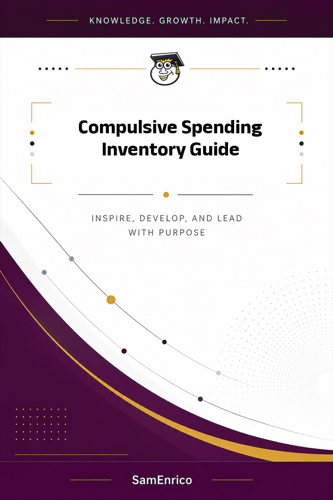
Compulsive Spending Inventory Guide eBook
Teaches conducting a complete spending audit to re
Teaches conducting a complete spending audit to reveal hidden patterns and totals.
Formats
Free sample
Chapter 1: The Receipt Graveyard–- The first time I asked a client to empty her purse onto my desk, she burst into tears. Not because she was embarrassed. Not because she was ashamed of what I might find. She cried because she had been carrying the same crumpled receipt for a $4.87 vending machine purchase for eleven months. She had no idea why she kept it.
She had no idea why she hadn't thrown it away. And she had absolutely no idea that she had bought that same snack 147 times in the past year—a fact we would discover only after she completed the first exercise in this chapter.That woman’s name is Lisa, and she is not unusual. She is a 41-year-old project manager with a 401(k), a mortgage, two kids, and a compulsive spending pattern she had successfully hidden from everyone—including herself—for nearly a decade. Before we started working together, Lisa believed she spent about $200 per month on “miscellaneous small purchases.” After completing the Receipt Graveyard exercise, we discovered the real number was $847 per month. That is not a typo.
$847. On snacks, apps, candles, gas station coffee, and one very unfortunate subscription to a meditation app she never opened.Lisa’s story opens this book because it contains every element you will encounter in the next twelve weeks: the underestimation of spending (she was off by more than 400%), the hiding of receipts (both physical and emotional), the shame that prevented her from looking closely, and the profound relief that came when she finally saw the truth. She did not need a budget. She did not need more willpower. She needed an inventory.
And that is exactly what this chapter will help you begin.Why Your Brain Lies to You About Money Before you collect a single receipt, you need to understand the biological and psychological machinery that has been hiding your spending from you. This is not about moral failure. It is not about laziness or irresponsibility. Your brain is doing exactly what evolution designed it to do: conserving energy, avoiding pain, and habituating to repeated stimuli. The problem is that these ancient survival mechanisms are catastrophically mismatched with modern consumer culture.Let us start with the first mechanism: habituation.The human brain is wired to ignore things that happen repeatedly in predictable patterns.
This is why you no longer feel the weight of your watch on your wrist, why you stop noticing the hum of your refrigerator, and why the emergency broadcast system scares you every time—it breaks the pattern. Habituation is an energy-saving feature. Your brain does not have the bandwidth to consciously process every sensory input, so it learns to filter out the predictable.Now apply this to spending. The first time you bought a $4.50 coffee on your way to work, you probably noticed. You may have even felt a small pang of guilt.
The tenth time? Your brain stopped registering it. The fiftieth time? That purchase became as invisible as the hum of your refrigerator. This is not forgetfulness.
This is neurobiology. Your brain has literally reclassified that recurring expense as background noise.The second mechanism is even more insidious: shame-induced amnesia.When you experience shame, your brain activates the same neural pathways associated with physical pain. The anterior cingulate cortex—a region that processes both social rejection and physical injury—lights up on an f MRI scan. To protect you from this pain, your brain deploys a defense mechanism: avoidance. You stop looking at your bank account.
You shove the receipt into the bottom of your bag. You tell yourself you will “deal with it later.” And because you never look at the evidence, the memory of the purchase never consolidates from short-term to long-term memory.In plain English: shame literally erases your memories of spending.This is why Lisa could not remember buying the $4.87 snack. It was not that she was careless or irresponsible. It was that the shame of each purchase triggered an avoidance response, which prevented memory consolidation, which meant her brain never recorded the transaction in the first place. She was not hiding from me.
She was hiding from herself, and her brain was helping.The combination of habituation and shame-induced amnesia creates what behavioral economists call the “visibility gap.” Most people underestimate their discretionary spending by 30 to 50 percent. In clinical populations—the readers of this book—that number often exceeds 70 percent. You are not bad with money. You are blind to money. And blindness is not a moral failing; it is a correctable condition.The Receipt Graveyard: Your First Inventory Tool The first exercise of this book is deceptively simple.
It will feel tedious, pointless, and possibly humiliating. That is how you will know it is working.For the next seven days, you will collect every single receipt. Every one. Not just the big ones. Not just the ones you remember.
Every receipt. Physical receipts from gas stations, grocery stores, coffee shops, vending machines, parking garages, and drugstores. Digital receipts from Amazon, Uber, Door Dash, Seamless, Pay Pal, Venmo, and any app that has ever sent you a confirmation email. If money left your possession, you will capture the evidence.Here is the rule that makes this a “graveyard” rather than a filing system: do not sort them. Do not categorize them.
Do not add them up. Do not judge them. Do not show them to anyone. Do not throw them away. You are merely collecting corpses and placing them in a container.
That container—physical or metaphorical—is the Receipt Graveyard.I recommend a physical envelope for paper receipts. Write “RECEIPT GRAVEYARD – DO NOT OPEN UNTIL DAY 7” on the front. For digital receipts, create a folder in your email with the same name. Every time you make a purchase, forward the confirmation email to that folder. If a digital receipt does not arrive immediately (common with in-app purchases), take a screenshot of the confirmation screen and save it.Do you use cash?
Cash is the most dangerous spending method because it leaves the smallest trail. For cash purchases, you will need to create your own receipt. Keep a small notepad in your wallet—or use the Notes app on your phone. Immediately after any cash transaction, write down the amount, the merchant, and one word about your emotional state. Do not skip cash.
Cash is where habituation and shame-induced amnesia work their darkest magic.What counts as a receipt?A $0.50 refillable coffee mug discount at a gas station. Yes.A $1.50 tip added to a takeout order. Yes.A $0.99 in-app purchase for extra game lives. Yes.A $5.00 charitable donation made at a grocery store checkout. Yes.A $200 dinner with friends where you paid for the table and they Venmo you later.
Yes—but note that the Venmo reimbursements will be tracked separately. We will handle the math in Chapter 7.What does NOT count?Automatic bill payments for rent, mortgage, utilities, insurance, and student loans. These are fixed expenses, not discretionary spending. The inventory is focused on the spending you have control over.Transfers between your own accounts (e.g., moving money from checking to savings).Purchases made on a shared account where you are not the primary spender (e.g., a…
This is the end of the free sample. Get the eBook to keep going. Buy now
About this book
Details
- Author
- Reinhardt Janessa
- Publisher
- SamEnrico
- Language
- English
- Genre
- Non-Fiction, Self-Help, Financial Audit
- Released
- 2026-06-11
- Pages (approx.)
- 158
- Available as
- eBook, Audiobook

Read better in the ZLOADR app
Your eBooks on your phone or tablet. Sign in with your SamEnrico account and start reading.
More by Reinhardt Janessa
 Russian Real Estate LaunderingReinhardt Janessa$11.99
 Food Addiction and Caffeine InteractionReinhardt Janessa$11.99
 Mindful Waiting in LineReinhardt Janessa$11.99
 Dream Journal Maintenance PlanReinhardt Janessa$11.99
 The Diamond and the Duel: How a Royal Wedding Sparked a 19th-Century ScandalReinhardt Janessa$11.99
 The Last Broadcast: The Disappearance of the SS BaychimoReinhardt Janessa$11.99
 How to Start a Axial Compressor Business (Beginners Guide)Reinhardt Janessa$11.99
 Understanding Congenital Craniosynostosis Maternal HyperthyroiditisReinhardt Janessa$17.99
 Referral Program For BoPReinhardt Janessa$12.99
 China Health Insurance GuideReinhardt Janessa$12.99
 Model Shop ManagerReinhardt Janessa$11.99
You may also like
 Hong Kong Handover 1997Dunn Johnnie$11.99
 Zumba For Postnatal Recovery CourseNeal Christian$11.99
 Zumba for BeginnersLadner Nikia$11.99
 YouTube Comment Mining GuideHumes Pandora$12.99
 Worry Box MeditationCarlin Rudy$11.99
 Workplace Stress MeditationNguyen Lynn$11.99
 Workplace Stress and Sleep RepairHawley Ivory$11.99
 Workplace Perfectionism CureDelaney Jeffry$11.99
 Workplace Injustice Anger GuideWallen Isabelle$11.99
 Work Addiction and Burnout LinkGreenwood Ester$11.99
 Women in Yoga and WellnessBeattie Galina$11.99
 Women in Stand Up ComedyChun Evangeline$11.99