
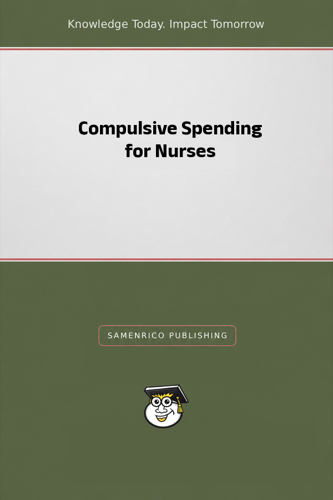
Compulsive Spending for Nurses eBook
Shift work and stress driven retail therapy.
by Dorn Jonie
Shift work and stress driven retail therapy.
Formats
Free sample
Chapter 1: The Depletion Gap--The fluorescent lights of the hospital parking garage buzzed overhead, casting that sickly green glow that makes every nurse look like they just ran a marathon through a fever dream. Sarah, a 34-year-old ICU nurse finishing her third consecutive 12-hour night shift, sat in her Honda with her hands still gripping the steering wheel. Her eyes were open but not seeing. Her brain was a fog machine. Her phone was already in her hand, thumb hovering over the Amazon app icon.
She didn't remember opening it. She didn't remember searching for "weighted blanket lavender gray." She didn't remember clicking "Buy Now with One-Click." But when she woke up twelve hours later, there was a confirmation email in her inbox for $127.83, and a notification that the package would arrive tomorrow. She also didn't remember ordering the matching candle, the set of four silk pillowcases, or the "anxiety relief journal" with gold foil letters on the cover.Sarah is not lazy. She is not bad with money. She is not undisciplined.
Sarah is a victim of what this book will call the Depletion Gap—a physiological and neurological chasm that opens at the end of every long shift, waiting to swallow her impulse control whole.If you are reading this book, you have been Sarah. Maybe not in the ICU. Maybe not at 3 AM. But you have closed your laptop or locked your medication cart or hung up your stethoscope and found yourself, fifteen minutes later, staring at a digital receipt for something you did not need, did not plan to buy, and possibly cannot afford. And then came the shame.
And then, sometimes, came another purchase to soothe the shame.This book is not a lecture. It is not a budget spreadsheet with a dozen angry red cells. It is not a moral judgment about your character or your profession. This book is an intervention—not into your soul, but into your biology. Because the truth, which the personal finance industry does not want you to know, is that compulsive spending in nurses is not primarily a financial problem.
It is a shift work problem disguised as a spending problem.Let that land.You have been told that you need more willpower. You have been told to "just stop buying things you don't need." You have been told to make a budget and stick to it. And when those things failed—as they almost always do for shift workers—you concluded that something was wrong with you. You are not disciplined enough. You are not grateful enough.
You are not adult enough.None of that is true.What is true is that you are trying to make financial decisions at a time of day when your brain is literally incapable of making good ones. You are trying to resist the siren song of online shopping when your prefrontal cortex—the part of your brain responsible for impulse control, long-term planning, and saying "no"—has clocked out for the day. And you are trying to do all of this while your nucleus accumbens, the brain's reward center, is screaming for a hit of dopamine like a toddler demanding candy in the checkout line.This is not a metaphor. This is neuroscience.The Biology of the Burnout Buy Let us start with a quick tour of your brain—not the whole thing, just the two neighborhoods that matter for this conversation.The Prefrontal Cortex (PFC)Think of your prefrontal cortex as the CEO of your brain. It sits right behind your forehead, and its job is to handle executive functions: planning, decision-making, impulse control, delaying gratification, and remembering that you already have four black T-shirts at home.
The PFC is the voice that says, "You don't need that. Put it back. Remember your goals."Here is the problem: the PFC is exquisitely sensitive to sleep deprivation. According to research cited in Matthew Walker's Why We Sleep, just one night of sleeping four to five hours reduces prefrontal cortex activity by a measurable margin—equivalent to the impairment seen in someone with a blood alcohol level of 0.05 to 0.08 percent. After a stretch of three 12-hour shifts?
The impairment is worse than being legally drunk.Now consider what most nurses are working: rotating shifts, night shifts, double backs, "clopens" (close shift followed immediately by an open shift), and the general circadian chaos of a profession that never sleeps. Your prefrontal cortex is not just tired. It is on life support.The Nucleus Accumbens (NAcc)Now meet the troublemaker. The nucleus accumbens is the brain's reward center. It is the part that lights up when you eat chocolate, have sex, hear good news—or click "Buy Now." The NAcc releases dopamine, the neurotransmitter of anticipation and wanting.
And here is the cruel trick: the NAcc is amplified by sleep deprivation. When you are exhausted, your brain craves reward more intensely, while simultaneously losing the ability to regulate that craving.This is the Depletion Gap. Low prefrontal cortex function (low impulse control) plus high nucleus accumbens reactivity (high craving) equals a brain that is biologically primed to spend money it does not have on things it does not need.You are not weak. You are not broken. You are exhausted.Why Nurses Are Different from Everyone Else Before we go any further, we need to name something uncomfortable.
The personal finance industry loves to pretend that all humans are the same. A budget is a budget. A spending problem is a spending problem. Cut the lattes, cook at home, and you will be fine.But nurses are not office workers. Nurses are not remote freelancers.
Nurses are not even other healthcare professionals in most cases. And pretending otherwise has caused enormous harm.Shift Length. The average American works eight hours. Nurses work twelve. Sometimes more.
Sometimes sixteen if the unit is short-staffed and the charge nurse is begging. Twelve hours is not just longer; it is qualitatively different. At hour ten, blood sugar drops. At hour eleven, cortisol spikes. At hour twelve, the brain begins to cannibalize its own glucose reserves.
You are not finishing a shift. You are surviving a physiological event.Shift Timing. Night shift nurses are not just "working late." They are fighting every evolutionary instinct humans have developed over 300,000 years. The human body wants to sleep when it is dark. Night shift nurses force it to do the opposite.
The result is a permanent state of circadian misalignment that research has linked to everything from metabolic syndrome to depression to impaired executive function. And day shift nurses are not off the hook; the 5 AM wake-up call for a 7 AM shift is its own form of chronic sleep restriction.Emotional Load. Office workers have bad days. Nurses have days where a seventeen-year-old dies of a fentanyl overdose and the parents scream at you for not saving them. Nurses have days where a patient with dementia hits you in the face and you cannot hit back.
Nurses have days where you hold an i Pad so a family can say goodbye to a grandmother on a ventilator, and you are the only one in the room who does not get to cry.…
This is the end of the free sample. Get the eBook to keep going. Buy now
About this book
Details
- Author
- Dorn Jonie
- Publisher
- SamEnrico
- Language
- English
- Genre
- Non-Fiction, Self-Help, Nursing
- Released
- 2026-06-06
- Pages (approx.)
- 132
- Available as
- eBook, Audiobook

Read better in the ZLOADR app
Your eBooks on your phone or tablet. Sign in with your SamEnrico account and start reading.
More by Dorn Jonie
 Binge Eating Freedom WorkbookDorn Jonie$11.99
 IBS Bloating Reduction GuideDorn Jonie$11.99
 Debt Exchange OfferDorn Jonie$11.99
 The Picasso Code: How a Master of Cubism Outwitted the NazisDorn Jonie$11.99
 How to Produce Animal RepellentDorn Jonie$11.99
 Freight Forwarder Selection BrazilDorn Jonie$12.99
 How to Start a Discotheques (licensed To Sell Alcohol) Business (Beginners Guide)Dorn Jonie$11.99
You may also like
 The Complicated Grief for NursesWiseman Erasmo$11.99
 Relationship Building for NursesShepherd Felecia$11.99
 Mindfulness for Nurses GuideWhitehead Samira$11.99
 The Parent Death Nursing HomeZimmer Rona$11.99
 Hospital Nurse Patient GuideMurry Mikki$11.99
 Burnout Prevention For NursesMorris Joshua$11.99
 Trauma Nurse Stress ProtocolReed Darrin$11.99
 Nurse Night Shift Sleep GuideHoffman Tricia$11.99
 Mindful Stress Reduction for NursesGonzalez Dale$11.99
 Anger for NursesThorn Kami$11.99
 Affirmations for Nurses GuideFranks Nichol$11.99
 Active Listening In NursingHubbard Lynette$11.99