
Non-FictionSelf-HelpJournalism
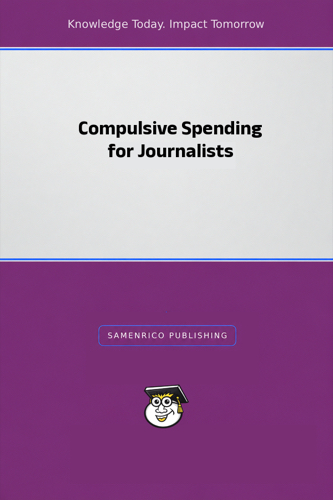
Compulsive Spending for Journalists eBook
Irregular income and stress spending.
by Keenan Meda
Irregular income and stress spending.
Formats
Free sample
Chapter 1: The Assignment Economy...--–- You know how to fact-check a CEO’s quarterly earnings report, verify a politician’s budget projections, and spot a statistical anomaly from three paragraphs away. You have interviewed sources who lied to your face and caught them in the contradiction. You have pored over documents for hours, hunting for the single number that doesn’t add up. You are a journalist. You are trained to scrutinize everyone else’s numbers.
So why do you have no idea how much money is in your checking account right now?This is not a rhetorical question. Pause for a moment and actually try to answer it. Not the balance you hope is there. Not the balance that was there last week. The exact number, as of this moment, including pending transactions and the automatic payment you forgot about.
If you are like the vast majority of journalists I have worked with over the past decade, you cannot answer with confidence. And that fact—that simple, uncomfortable fact—is the starting point of everything this book exists to address.The standard explanation for financial avoidance is laziness or irresponsibility. You have probably heard it from well-meaning friends, exasperated family members, or the nagging voice in your own head: “You’re a smart person. Why can’t you just keep track of your money?” But that explanation is wrong. It is not only wrong; it is actively harmful.
It turns a structural problem into a character flaw, and once you believe you are fundamentally broken when it comes to money, you stop trying to fix anything. What is the point? You are just bad with money. That is who you are.This entire book exists to convince you that you are not bad with money. You are responding rationally—neurobiologically, even—to an income structure that was never designed for the way journalists actually work today.
The problem is not your discipline. The problem is the gap between your paycheck and your effort, the chasm between the day you file a story and the day you get paid for it, and the complete mismatch between the budgeting advice written for salaried employees and the feast-or-famine reality of modern journalism.Let me tell you about Sarah. She is a freelance investigative journalist I mentored several years ago. She had won two state-level awards, broken a story that led to policy changes, and regularly filed 4,000-word features for respected national outlets. She was, by any professional measure, successful.
She was also, by her own admission, “terrified of her bank account.” She would go weeks without logging in. She would guess at her balance before making purchases, hoping she was right. She once drove thirty minutes to a grocery store, filled her cart, and had her card declined at checkout. She put the items back, drove home, and did not tell anyone for six months.When I finally asked her why she avoided looking at her finances, she gave me an answer I have heard in various forms from hundreds of journalists since. She said: “Because every time I look, I feel like I’m drowning.
And if I feel like I’m drowning every day, I won’t be able to write. So I just don’t look.”Sarah was not lazy. She was not irresponsible. She was protecting her creative capacity from a financial system that punished her for doing good work. And that is the first and most important truth of this book: compulsive spending among journalists is not a moral failure.
It is a coping mechanism. It is a dysfunctional but understandable response to an economy that has left you waiting sixty days for a check while the rent comes due every thirty.The Great Paradox of the Journalistic Mind There is a peculiar irony to the financial lives of journalists that deserves to be named and examined. The same skills that make you exceptional at your job—attention to detail, skepticism toward authority, comfort with complexity, the ability to hold multiple contradictory facts in your head at once—seem to evaporate the moment you open your banking app. You can trace a campaign finance violation through three shell companies, but you cannot remember whether you paid your credit card bill this month. You can spot a misleading statistic in a press release instantly, but you have no idea what interest rate you are paying on your debt.This is not because you are secretly stupid about money.
It is because your brain processes financial information differently when that information is yours. Neuroscientists have known for decades that the brain activates different neural pathways when evaluating risk for oneself versus evaluating risk for others. When you fact-check a CEO’s numbers, you are in analytical mode: calm, detached, logical. When you look at your own bank balance, you shift into threat-detection mode. The amygdala—the brain’s alarm system—lights up.
Cortisol floods your system. Your heart rate increases. You are, in a very real physiological sense, experiencing a low-grade emergency.And what does a journalist do in an emergency? You act. You move.
You do something. This is the professional instinct that serves you so well on deadline. But when the emergency is your own bank account, “doing something” often means buying something. A coffee. A drink.
A small, meaningless item that restores a fleeting sense of control. The purchase does not solve the problem. It does not even address it. But it provides a tiny hit of dopamine, a momentary respite from the cortisol, and that is enough to keep you going for another hour.This is the cycle that this book will help you break. But you cannot break something you do not understand.
So before we get to solutions, we need to spend time on diagnosis. We need to map the terrain of the journalist’s financial life, identify the traps, and name the enemy. And the enemy is not your lack of willpower. The enemy is the structure of the modern journalism economy.The Kill Fee Psychology: Learning to Expect Loss Let us start with a concept that will appear throughout this book: kill fee psychology. In journalism, a kill fee is the small amount of money a publication pays you when they assign a story and then decide not to run it.
The standard kill fee in many contracts is thirty percent of the original agreed-upon rate. You do eighty percent of the work—the reporting, the interviewing, the drafting, the fact-checking—and you get paid thirty percent of the fee. Sometimes you get nothing. Sometimes the publication simply ghosts you, and you learn the story is dead when you stop hearing back from your editor.If you have been in this industry for more than six months, you have experienced this. You have done the work.
You have delivered the goods. And you have been told, often politely and with regret, that the story is no longer running. Here is the kill fee. Sorry. Better luck next time.Here is what that experience teaches you, slowly and invisibly over time.
It teaches you that your labor is not reliably compensated. It teaches you that you can do everything right and…
This is the end of the free sample. Get the eBook to keep going. Buy now
About this book
Details
- Author
- Keenan Meda
- Publisher
- SamEnrico
- Language
- English
- Genre
- Non-Fiction, Self-Help, Journalism
- Released
- 2026-06-05
- Pages (approx.)
- 128
- Available as
- eBook, Audiobook

Read better in the ZLOADR app
Your eBooks on your phone or tablet. Sign in with your SamEnrico account and start reading.
More by Keenan Meda
 Food Freedom After Dieting GuideKeenan Meda$11.99
 IBS Yoga Poses for DigestionKeenan Meda$11.99
 Tariff Supply Chain RedesignKeenan Meda$11.99
 The Vancouver Stock Scandal: Canada's First Great Financial FraudKeenan Meda$11.99
 UX DeveloperKeenan Meda$11.99
 Skills Assessment Appeal GuideKeenan Meda$12.99
 How to Produce Apparel Design ServicesKeenan Meda$11.99
 How to Start a Fertiliser Business (Beginners Guide)Keenan Meda$11.99
You may also like
 Hong Kong Handover 1997Dunn Johnnie$11.99
 Zumba For Postnatal Recovery CourseNeal Christian$11.99
 Zumba for BeginnersLadner Nikia$11.99
 YouTube Comment Mining GuideHumes Pandora$12.99
 Worry Box MeditationCarlin Rudy$11.99
 Workplace Stress MeditationNguyen Lynn$11.99
 Workplace Stress and Sleep RepairHawley Ivory$11.99
 Workplace Perfectionism CureDelaney Jeffry$11.99
 Workplace Injustice Anger GuideWallen Isabelle$11.99
 Work Addiction and Burnout LinkGreenwood Ester$11.99
 Women in Yoga and WellnessBeattie Galina$11.99
 Women in Stand Up ComedyChun Evangeline$11.99