
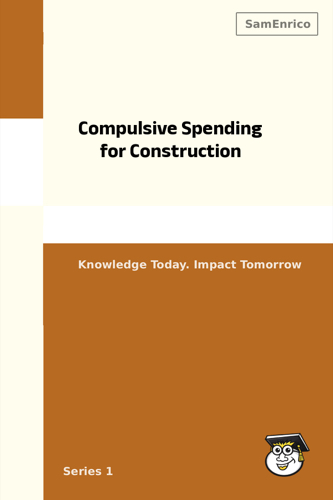
Compulsive Spending for Construction eBook
Physical labor and tool buying addiction.
Physical labor and tool buying addiction.
Formats
Free sample
Chapter 1: The Pro Rationalization--–- Every compulsive tool buyer remembers the exact moment they crossed the line. For Dave, a 34-year-old framer from Oregon, it was a Tuesday afternoon in March. The Snap-on truck had just pulled onto the site, its aluminum sides gleaming under the gray Pacific Northwest sky. Dave had gone to look. That was all.
Just to look. He walked up the three aluminum steps, ran his fingers over a limited-edition ratchet set with orange comfort grips—his favorite color—and heard the driver say six words that would cost him $4,700 over the next fourteen months: "Brother, you’ve earned this. Take it home today, pay me whenever."Dave had been working sixty-hour weeks. His lower back ached from lifting LVL beams. His wife had asked him twice that month to fix the leaking shower head.
He felt like a machine—used, tired, and invisible. But in that moment, holding that ratchet, he felt like a professional. Like someone who mattered. He signed the credit slip without reading the interest rate. He told himself the same thing he had told himself a hundred times before: This isn't shopping.
This is investing in my business.That is the lie. And this chapter is about why you believe it.The Professional Mask Compulsive Buying Disorder (CBD) affects approximately 5–8% of the adult population in industrialized nations, according to the clinical literature synthesized from Müller and Mitchell's foundational work. But those numbers tell only half the story. Among construction workers—particularly those in trades that require personal tool ownership—the prevalence is estimated to be two to three times higher. Why?
Because tool addiction wears a mask that fashion addiction cannot.When a white-collar professional buys ten pairs of designer shoes in a month, they know, on some level, that they are shopping. Guilt is present. Shame follows quickly. The behavior is socially coded as consumption, and the buyer is treated accordingly—by themselves and others—as someone who has lost control over a luxury habit.But when a construction worker buys a $1,200 cordless hammer drill they already own two versions of, the narrative is different. They tell themselves: This is the new brushless model.
It has more torque. I'll be faster on the job. This tool will pay for itself by the end of the week. The spouse who questions the purchase is met with indignation: You don't understand. This is my livelihood.
You wouldn't tell a surgeon not to buy a better scalpel.This is what I call the Pro Rationalization—a cognitive distortion that transforms discretionary spending into perceived professional necessity. It is the engine of tool addiction, and it is virtually unique to trades where tools are both personal property and income-generating assets.The Pro Rationalization has three components, each more insidious than the last.Component One: The Investment Fallacy. The buyer convinces themselves that the tool will generate more income than it costs. This is sometimes true for a first purchase of a core tool. It is almost never true for the fifth impact driver or the second set of wrenches in a different brand.
But the brain does not distinguish between the first and the fifth when the rationalization script is the same.Component Two: The Skill Substitution Myth. The buyer believes that a more expensive tool will compensate for a lack of skill or experience. A novice welder buys a $3,000 Miller machine thinking it will make his beads look like a certified pipefitter's. A weekend carpenter buys a Festool track saw believing it will eliminate the need to learn proper circular saw technique. The tool becomes a prosthetic for competence.Component Three: The Identity Preservation Defense.
This is the deepest layer. When the buyer is questioned—by a spouse, by their own conscience—they defend the purchase not as a want but as a core component of who they are. I am a professional. Professionals have good tools. Therefore, I must have this tool.
The syllogism is emotionally airtight, even when financially disastrous.Why Tools Are Different from Handbags It is worth pausing here to understand why tool addiction is clinically distinct from general retail addiction. The differences are not minor; they are the entire reason this book exists.Difference One: The Illusion of Productivity. A luxury handbag does nothing. It sits on a shelf or hangs from a shoulder. It produces no output, completes no task, generates no income.
A tool, by contrast, can be used to build something. This gives the purchase an aura of legitimacy that other compulsive purchases lack. The buyer can point to the finished deck, the repaired engine, the framed wall, and say, See? That tool built that. What they omit is that the same tool already existed in their collection—or that the job could have been done with a less expensive alternative.Difference Two: The Tax Deduction Mirage.
Many construction workers are independent contractors or sole proprietors. Tools are legitimate business expenses. This creates a dangerous psychological loophole: If I can write it off, it's not really spending. Professional tax advisors will tell you that a tax deduction reduces your taxable income by the cost of the item—it does not make the item free. A $1,000 tool deducted at a 25% tax bracket still costs you $750 in after-tax money.
But the brain does not do this math in the moment. The brain hears "tax write-off" and thinks "discount." This is an error, and it is an expensive one.Difference Three: The Durability Deception. Clothing wears out. Food spoils. Entertainment ends.
Tools, if maintained, can last decades. The compulsive buyer uses this fact to justify almost any purchase: This wrench set will outlive me. I'm buying it for my son. It's an heirloom, not an expense. But a thing can be durable and still be unnecessary.
A tool that sits unused in a gang box for ten years is not an heirloom. It is an expensive paperweight.Difference Four: The Job Site Arms Race. Fashion trends change slowly. The "must-have" handbag of one season may be embarrassing the next. Tool trends, by contrast, are driven by battery platforms, voltage upgrades, and brand loyalty ecosystems.
Once you buy into the Milwaukee M18 system, every new tool that runs on that battery feels like a natural extension. The tool companies know this. They design their battery platforms to be sticky—to lock you into an ecosystem where each new purchase feels inevitable rather than optional. This is not accidental. It is deliberate engineering of compulsive behavior.The True Scope of the Problem Let us put numbers on the table.
These numbers are drawn from clinical surveys, debt counseling data, and interviews with trade union representatives. They are not comfortable, but they are necessary.Debt Loads. The average construction worker with compulsive tool spending carries between $8,000 and $15,000 in tool-specific debt. This does not include general credit card debt, vehicle loans, or mortgages. This is debt incurred exclusively on tools—wrenches, drills, saws, welders, diagnostic scanners, battery chargers, specialty hand tools, and tool storage units.
Of this debt, approximately 60–70% is carried on high-interest financing: tool truck credit (typical APR 15–25%), store credit cards (25–30%), or payday loans (often exceeding 300%…
This is the end of the free sample. Get the eBook to keep going. Buy now
About this book
Details
- Author
- Costello Sherell
- Publisher
- SamEnrico
- Language
- English
- Genre
- Non-Fiction, Self-Help, Construction
- Released
- 2026-06-10
- Pages (approx.)
- 126
- Available as
- eBook, Audiobook

Read better in the ZLOADR app
Your eBooks on your phone or tablet. Sign in with your SamEnrico account and start reading.
More by Costello Sherell
 IBS Bathroom Map App GuideCostello Sherell$11.99
 Automotive Tariff ComplianceCostello Sherell$11.99
 Nicotine Detox Sleep Recovery GuideCostello Sherell$11.99
 Silk and Spice: The Unseen Journeys of Vasco da GamaCostello Sherell$11.99
 How to Start a Fertilizing Plough Machinery Business (Beginners Guide)Costello Sherell$11.99
 How to Produce Apartment LocatorsCostello Sherell$11.99
 Non Award Study Points GuideCostello Sherell$12.99
 Use Case WriterCostello Sherell$11.99
You may also like
 Workaholism in ConstructionGlaser Krystle$11.99
 Financial Stress for Construction WorkersHilton Cheyenne$11.99
 Construction Site Stress SafetyDraper Chasidy$11.99
 Construction Site Anger GuideWheaton Kalyn$11.99
 Construction Site Manager StressBeauregard Maragret$11.99
 Construction Safety SignalsLuke Eugene$11.99
 Financial Stress for ConstructionWyatt Maryanne$11.99
 Failure Fear in ConstructionWhitman Millie$11.99
 The Assertiveness for Construction Workers GuideCourtney Dillon$11.99
 Morning Routine for ConstructionCromwell Angeline$11.99
 Construction Project Manager StressOrtega Ramon$11.99
 Construction Innovation GuideWilke Kylie$11.99