
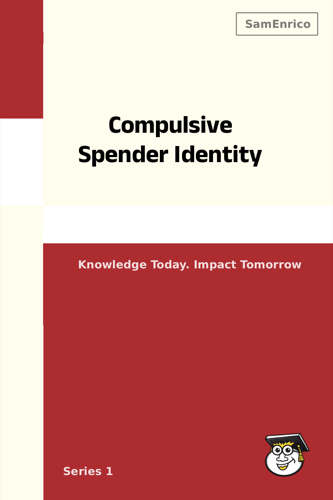
Compulsive Spender Identity eBook
Separate your self-worth from your purchases and r
by Jacoby Pia
Separate your self-worth from your purchases and rebuild a core identity.
Formats
Free sample
Chapter 1: The 103 Dresses--–- Anna had never missed a credit card payment. She had a six-figure salary, a walk-in closet the size of a Manhattan studio, and seventy-three dresses with tags still attached. When she first walked into my office for financial therapy, she sat down, crossed her legs, and said, "I don't have a money problem. I have a closet problem." I asked her how many dresses she owned. She didn't know.
We counted together. One hundred and three. She had worn exactly twelve of them in the past two years. When I asked why she kept buying, she paused for a long moment and then said something I have never forgotten: "Because every time I walk into a room, I want to be the best-dressed person there. Not because I like clothes.
Because if I'm the best-dressed, no one asks if I belong."That is not a shopping problem. That is an identity problem wrapped in a shopping habit.Anna was not broke. She was not drowning in debt. She was not stealing from her rent money to buy handbags. By all external measures, she was a responsible, high-functioning adult.
But she was also exhausted. She spent hours each week scrolling online stores, comparing silhouettes, reading reviews, checking tracking numbers, and arranging dry cleaning for garments she would wear once—if at all. Her Saturdays were consumed by returns. Her Sundays were consumed by guilt. And her Monday mornings were consumed by the same question: What if they see that I'm not enough?This book is for every Anna.
It is for the woman who buys a new dress for every wedding because she cannot bear to be seen in the same photo twice. It is for the man who owns forty watches because each one represents a version of himself he hopes to become. It is for the college student who maxes out a credit card on sneakers because, for the first time in his life, he has discovered that money can buy admiration. It is for the retiree who fills her home with QVC packages because the delivery person is the only visitor she gets all week. And it is for the person who just read that sentence and thought, At least I'm not that bad—because that thought, right there, is the first wall of denial we are about to dismantle.This chapter has one job: to convince you that you do not have a spending problem.
You have a self problem. And until you fix the self, no budget, no app, no envelope system, and no 12-step program will work for more than a few weeks. Let me prove it to you.The Biochemistry of the Buy Before we talk about psychology, we need to talk about chemistry. Because the reason you cannot "just stop" is not a failure of willpower. It is a failure of biology working against you.Every time you see something you want—a pair of shoes, a new phone, a jacket, a gadget—your brain releases a chemical called dopamine.
Dopamine is not the pleasure chemical. This is the most important misunderstanding in all of behavioral science. Dopamine is the anticipation chemical. It is released in the chase, not the capture. It is what makes your heart beat faster when you click "Add to Cart." It is what makes the tracking number feel like a lottery ticket.
It is what makes the brown box on your doorstep feel like Christmas morning, even in July.Here is the cruel trick: dopamine peaks exactly before you own the thing. The moment you open the box, dopamine levels begin to fall. Within minutes—sometimes seconds—they crash. And what rushes in to fill the void? A different chemical called cortisol, the stress hormone, often accompanied by a low-grade shame response.
Your brain, noticing the drop, does the only thing it knows how to do: it looks for another hit. Another dress. Another gadget. Another purchase. Not because you are greedy.
Because your nervous system is trying to regulate itself.This is called the dopamine–cortisol loop, and it is the engine of every compulsive spending habit on earth.Let me say this clearly: you are not weak. You are not broken. You are not morally deficient. You have accidentally trained your brain to treat shopping as a form of emotional regulation, and like any trained behavior, it can be untrained. But first, you have to stop blaming yourself for having a brain that works exactly as brains are designed to work.Utility Purchases vs.
Identity Purchases: The Great Distinction Not all spending is compulsive spending. This is crucial to understand, because one of the quickest ways to fail at behavior change is to label everything as a problem. If you feel guilty every time you spend any money on anything, you will exhaust yourself into a relapse within two weeks.Let me draw a clean line.Utility purchases are transactions that fulfill a genuine, objective need. You buy a winter coat because it is January and yours has a hole. You replace your running shoes because the tread is gone and your knees hurt.
You buy groceries. You pay your electric bill. You repair your car. These purchases have a clear functional purpose. They are not about identity.
They are about survival and function. When you make a utility purchase, you feel neutral or satisfied afterward. You do not feel a crash. You do not feel shame. You feel done.Identity purchases are transactions made to regulate an emotion, project an image, or fill a void.
They are not about the thing itself. They are about what the thing represents. A designer handbag that you buy because you are terrified of being seen as poor is an identity purchase. A watch that you buy because you want to look successful at a family reunion is an identity purchase. A dress that you buy because you need to be the best-dressed person in the room—that is Anna's purchase.
That is an identity purchase.Here is the test: imagine the item in a vacuum. Imagine no one will ever see it. Imagine you are alone on a desert island for the rest of your life. Would you still want it? If the answer is yes, it might be a utility purchase (you need sun protection) or a genuine aesthetic pleasure (you simply enjoy the look of it for your own eyes).
If the answer is no—if the value of the item collapses when no one is watching—then you are buying identity, not objects.The rest of this book is about separating your identity from your identity purchases. But first, you have to admit that you are making them.The Wallet Test: A First Look at the Void I am going to ask you to do something uncomfortable. Please actually do it. Reading about an exercise is not the same as doing it. The people who get better are the people who do the work.Take out a piece of paper or open a blank document.
Write a paragraph describing who you are. You have five minutes. There is only one rule: you cannot mention your…
This is the end of the free sample. Get the eBook to keep going. Buy now
About this book
Details
- Author
- Jacoby Pia
- Publisher
- SamEnrico
- Language
- English
- Genre
- Non-Fiction, Self-Help, Identity
- Released
- 2026-06-06
- Pages (approx.)
- 139
- Available as
- eBook, Audiobook

Read better in the ZLOADR app
Your eBooks on your phone or tablet. Sign in with your SamEnrico account and start reading.
More by Jacoby Pia
 Name Review After EventJacoby Pia$11.99
 Dating Stress Management GuideJacoby Pia$11.99
 No Phone Bedroom RuleJacoby Pia$11.99
 Volume Discounts InflationJacoby Pia$11.99
 The Citizenship Class LeaderJacoby Pia$11.99
 Performance Review TalksJacoby Pia$11.99
 OKRs for NonprofitsJacoby Pia$11.99
 The Rum Runner's Betrayal: The Prohibition-Era Cruise Ship Scandal of 1925Jacoby Pia$11.99
 The Great Gorilla Escape: A Defector’s Daring BreakoutJacoby Pia$11.99
 Service Providers Guide to Manicures & Nail ServicesJacoby Pia$11.99
 How to Produce Underwater Camera HousingsJacoby Pia$11.99
 How to Produce KaleJacoby Pia$11.99
You may also like
 Hong Kong Handover 1997Dunn Johnnie$11.99
 Zumba For Postnatal Recovery CourseNeal Christian$11.99
 Zumba for BeginnersLadner Nikia$11.99
 YouTube Comment Mining GuideHumes Pandora$12.99
 Worry Box MeditationCarlin Rudy$11.99
 Workplace Stress MeditationNguyen Lynn$11.99
 Workplace Stress and Sleep RepairHawley Ivory$11.99
 Workplace Perfectionism CureDelaney Jeffry$11.99
 Workplace Injustice Anger GuideWallen Isabelle$11.99
 Work Addiction and Burnout LinkGreenwood Ester$11.99
 Women in Yoga and WellnessBeattie Galina$11.99
 Women in Stand Up ComedyChun Evangeline$11.99