
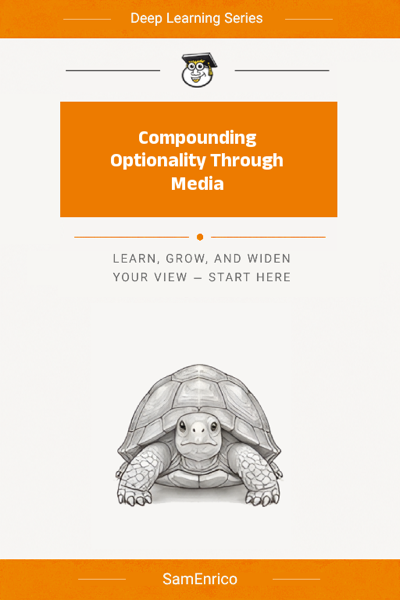
Non-FictionInformativeEducational
Compounding Optionality Through Media eBook
A Coursebook on Compounding Optionality Through Me
by Rains Millie
A Coursebook on Compounding Optionality Through Media
Formats
Free sample
Chapter 1: The Vanity Campaign...--–- The email arrived on a Tuesday, as these things usually do. The subject line read: "Q3 Campaign Results – Record Breaking!" The marketing director had cc’d the entire executive team. The body of the email boasted a 300% increase in impressions, a 150% lift in video views, and a cost-per-click that had dropped to an all-time low of $0.42. Confetti emojis punctuated every sentence.The CEO replied within minutes: "Incredible work, team. This is what velocity looks like."Three weeks later, the CEO asked a simple question in a leadership meeting: "How many of those 2.3 million impressions became customers?"Silence.A nervous voice from the back of the room: "We, uh, we’re still tracking that.
The attribution window is complex."The truth, which would take another six weeks to fully surface, was brutal: the campaign had generated exactly forty-seven new customers. Forty-seven. From 2.3 million impressions. The cost per acquisition, when finally calculated, was nearly four times the average customer lifetime value. The campaign had not created value.
It had destroyed it.But here is the most dangerous part: everyone had celebrated. The team had been rewarded. The agency had been re-signed. The metrics on the dashboard had all been green.This is not a story of incompetence. It is a story of a broken operating system.
The Vanity Campaign – the big launch, the viral spike, the Super Bowl ad, the Linked In post that gets 100,000 views and zero leads – is the single greatest wealth destroyer in modern media. And it is hiding in plain sight, celebrated by everyone, questioned by no one.Until now.The Funnel That Lied to Us For the better part of a century, marketing operated on a simple, seductive model: the linear funnel. You have probably drawn it yourself. Awareness at the top, consideration in the middle, conversion at the bottom. Pour attention in at the top, watch customers drip out at the bottom.
It feels like physics. It feels like control.The funnel was designed for a world that no longer exists. It assumed that consumers moved predictably from one stage to the next. It assumed that you could interrupt them with a message, move them down a gentle slope, and close them with a well-timed offer. It assumed that the customer journey was a highway, not a jungle.That world died sometime between the launch of the i Phone and the rise of Tik Tok.
We have been pretending it is still alive ever since.The evidence is everywhere. The average click-through rate on a display ad is 0.35 percent. The average email open rate across all industries is 21 percent. The average conversion rate from landing page to purchase is 2.6 percent. These numbers have been declining for a decade, yet the funnel remains the dominant mental model for how media creates value.Here is the core problem with the linear funnel: it is a campaign-based logic system.
You launch something. It peaks. It decays. You launch something else. Repeat.
Each campaign is a discrete event, its success measured in isolation, its lessons discarded when the next quarter begins.This is not marketing. This is a series of small fires, each burning brightly for a moment, each leaving behind nothing but ash.The opposite of this approach – the alternative to the Vanity Campaign – is what this book calls compounded optionality. Before we can build it, we need to understand its two component parts with absolute clarity.Defining Compounding: Why Most Content Gets Poorer Over Time In finance, compounding is the process by which an asset generates earnings, and those earnings generate their own earnings. A dollar invested at 10 percent annual interest becomes $1.10 after one year, $1.21 after two, and $2.59 after ten. The growth is not linear.
It is exponential. The curve bends upward because the returns themselves produce returns.Most media assets do the opposite. They are depreciating assets, not appreciating ones.Consider the typical Linked In post. It is published at 9:00 AM. It receives the majority of its engagement in the first four hours.
By the next morning, it is essentially dead. It might be shared a few more times, but the curve has flattened. The asset has delivered its value and stopped. It did not compound. It burned.The same is true for most You Tube videos, most tweets, most newsletter issues, most blog posts.
They spike and they fade. The creator moves on to the next piece of content, trapped in a treadmill of perpetual production, generating new assets to replace the decaying ones.This is exhausting. It is also financially catastrophic.A compounding media asset is different. It continues to generate value without additional input. An evergreen tutorial video about a persistent problem – "How to Set Up a Google Analytics 4 Property" – might receive 100 views in its first week, but 500 views per week a year later as search traffic accumulates.
It has not decayed. It has grown. The value has compounded.Notice what happened: the asset generated value (views, leads, trust) and those returns enabled further value (higher search rankings, more backlinks, social proof). The returns produced returns. That is compounding.But compounding alone is not enough.
A single asset that compounds predictably is valuable, but it is brittle. What happens when Google changes its algorithm? What happens when the platform you depend on shuts down? What happens when the problem you solved becomes obsolete?This is where the second concept enters.Defining Optionality: The Most Misunderstood Word in Business Optionality has become a buzzword. It is used to mean flexibility, or optionality means being agile, or optionality means having a plan B.
These are all adjacent to the truth, but none of them capture the precise, powerful meaning that this book requires.Here is the definition we will use throughout every chapter of this book, stamped and repeated:Optionality: The strategic right to take future actions without the obligation. In media, optionality is measured by how many valuable paths a single asset keeps available.Let us break this down.First, optionality is a right, not an outcome. In finance, when you buy a call option on a stock, you have the right to buy that stock at a predetermined price on a future date. You are not obligated to buy it. If the stock price falls, you let the option expire and lose only the small premium you paid.
If the stock price soars, you exercise your right and capture the upside. The option itself does not guarantee profit. It guarantees the ability to profit if conditions become favorable.Second, optionality is measured by paths. A piece of media that can only be used in one way – a single-use blog post, a one-off webinar that is never watched again – has low optionality. A piece of media that can be repurposed into a video, a podcast episode, a Twitter thread, a Linked In carousel, a lead magnet, a paid course module, and a consulting framework has high optionality.
It keeps many paths available.Third, optionality is valuable before you know which path will work. The entire point of optionality is that you do not need to predict the future. You just need to preserve the ability to act on multiple possible…
This is the end of the free sample. Get the eBook to keep going. Buy now
About this book
Details
- Author
- Rains Millie
- Publisher
- SamEnrico
- Language
- English
- Genre
- Non-Fiction, Informative, Educational
- Released
- 2026-06-02
- Pages (approx.)
- 126
- Available as
- eBook, Audiobook

Read better in the ZLOADR app
Your eBooks on your phone or tablet. Sign in with your SamEnrico account and start reading.
More by Rains Millie
 Manager Confidence GuideRains Millie$11.99Manager Confidence GuideRains Millie$11.99
 Green Beret Wounded WarriorRains Millie$11.99
 John McEnroe Fire on CourtRains Millie$11.99
 Waitlist and Deferral Stress WorkbookRains Millie$11.99
 Yahoo Marissa Mayer LeadershipRains Millie$11.99
 The Day the Sky Blew: The 1883 Krakatoa Eruption That Shook the WorldRains Millie$11.99
 Understanding Garcia–Torres–guarner SyndromeRains Millie$17.99
 Nonprofit Board Entry ManualRains Millie$12.99
 ESL Reading Comprehension GuideRains Millie$12.99
 How to Become a Cigar PackerRains Millie$11.99
You may also like
 Hong Kong Handover 1997Dunn Johnnie$11.99
 Zumba For Postnatal Recovery CourseNeal Christian$11.99
 Zumba for BeginnersLadner Nikia$11.99
 YouTube Comment Mining GuideHumes Pandora$12.99
 Worry Box MeditationCarlin Rudy$11.99
 Workplace Stress MeditationNguyen Lynn$11.99
 Workplace Stress and Sleep RepairHawley Ivory$11.99
 Workplace Perfectionism CureDelaney Jeffry$11.99
 Workplace Injustice Anger GuideWallen Isabelle$11.99
 Work Addiction and Burnout LinkGreenwood Ester$11.99
 Women in Yoga and WellnessBeattie Galina$11.99
 Women in Stand Up ComedyChun Evangeline$11.99