
Non-FictionInformativeEducational
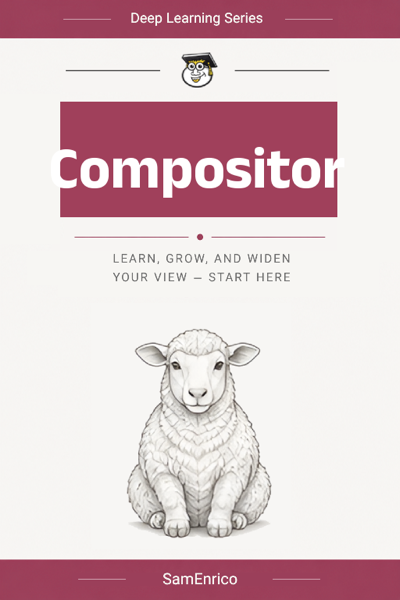
Compositor eBook
A Coursebook on Compositor
by Zook Asa
A Coursebook on Compositor
Formats
Free sample
Chapter 1: The Unwritten Note...--–- Before there is a melody, before there is a harmony, before there is a single note committed to paper or screen, there is a decision. The decision to begin. And for most people who dream of composing, that decision is followed immediately by a paralysis. The blank page stares back. The cursor blinks.
The mind, so full of music when listening to favorite pieces, becomes strangely empty when asked to create something original.This chapter exists to break that paralysis.The Compositor is built on a single conviction: musical composition is not a mystical gift reserved for prodigies. It is a craft. A set of skills involving rhythm, melody, harmony, and orchestration that can be learned, practiced, and mastered. The same way a carpenter learns to sharpen a chisel, or a cook learns to sharpen a knife, you will learn to sharpen your musical instincts through systematic practice. The only difference between someone who composes and someone who wishes they composed is that the first person learned the workflow that transforms a blank page into finished music.That workflow is what this chapter delivers.
By the time you finish reading, you will have dismantled the myth of divine inspiration, learned the difference between passive and active listening, assembled your Composer's Toolkit, created your Musical Scrapbook, and internalized the Ten-Step Plan for Composing—a method you will use for every exercise in this book and every project of your career.Let us begin with the most important truth about making music.The Dangerous Fantasy of Sudden Genius There is a story about composition that the culture tells over and over. It appears in movies about tortured artists. It appears in biographies that smooth over messy drafts to present a clean narrative of genius. It appears in the way we talk about Mozart, who supposedly heard entire symphonies in his head before writing a single note, or about Beethoven, who composed the Ninth Symphony in complete silence, as if the music simply arrived from somewhere else.This story is the Dangerous Fantasy of Sudden Genius. And it ruins more aspiring composers than any lack of talent ever could.Here is what the fantasy looks like in practice: a beginner sits at a piano, or opens notation software, expecting that if they are a "real" composer, the music will flow out effortlessly.
When it does not—when the first attempts sound clumsy, derivative, or just empty—they conclude that they are not real composers. They quit. They tell themselves they lack the gift.The truth is that Mozart filled sketchbooks with revisions. Beethoven's manuscripts are littered with crossed-out measures, rewritten passages, and marginalia that read like frustrated screams. Stravinsky said, "I have never written a single bar of music that did not come from a long process of trial and error." The effortless genius is a myth.
The reality is relentless, unglamorous work.Consider the most productive composers in history. Johann Sebastian Bach wrote a cantata every week for years while also holding a full-time job, teaching, and raising children. He did not wait for inspiration. He had a system. He showed up at the same time every morning and did the work.
John Williams, whose film scores have defined modern cinema, has described his process as "showing up and starting, whether I feel like it or not." Hans Zimmer composes fourteen hours a day, not because he is always inspired, but because he has learned that disciplined work produces results that feel, to the listener, exactly like inspiration.This book is your system. You do not need to feel inspired to compose. You need to learn the steps, follow them, and trust the process. The inspiration will either arrive along the way, or it will not matter—because craft alone can produce music that moves people.Passive Versus Active Listening Before you write music, you must learn to hear it differently.Most people listen passively. They put on a playlist while driving, exercising, or cooking, and the music functions as emotional wallpaper.
A passive listener can tell you whether they liked a piece—"That was relaxing," or "That was exciting"—but they cannot tell you why. The music washes over them and then disappears.An active listener does something different. They dissect the music while they hear it. They notice the structure, the instrumentation, the way the melody moves, the tension and release of the harmony. An active listener asks why the composer made each choice.
And by asking why, they steal the technique.Active listening is the single fastest way to improve as a composer. Every piece of music becomes a free lesson. A three-minute pop song contains as much craft as a three-hour opera—just condensed into a different form.Here is how to listen actively. Pick any piece of music you know well. It can be a symphony, a film score, a jazz standard, a hip-hop track, or a commercial jingle.
Listen to it four times, each time focusing on a different element.First pass: Form. How is the piece organized? Does it have verses and choruses? Is it in A-B-A form, where a middle section contrasts with the beginning and end? Does it tell a story with a clear beginning, middle, and end?
Map the structure in real time.Second pass: Instrumentation. Which instruments or sounds are present? Which one carries the main melody? Which ones provide accompaniment? When do new instruments enter, and when do they drop out?
How does the texture change from sparse to dense?Third pass: Dynamics and energy. Where are the loudest moments? The quietest? How does the piece build tension, and how does it release it? Pay attention to crescendos (gradually getting louder) and decrescendos (gradually getting softer).
Notice how energy can change even without changing volume.Fourth pass: The emotional arc. How does the piece make you feel, and at what specific moments do those feelings change? Does the music match the title or the lyrics, or does it create a different mood? What would you name the emotion of each section?Active listening is a skill that improves with practice. The first few times you try it, you will miss most of what is happening.
That is fine. Keep doing it. Within a few weeks, you will hear music differently—not as a blur of pleasant sounds, but as a series of deliberate choices made by another composer who once faced the same blank page you face now.What You Actually Need to Begin Beginners often believe they need expensive equipment to compose. This is not true. Some of the most influential compositions in history were written on paper with a pencil.
The desire to buy gear is often a form of procrastination—a way of feeling productive without actually doing the work.Here is your minimum viable toolkit. Nothing more is required for the first half of this book.Notation Software or Manuscript Paper Notation software allows you to place notes on a staff, hear them played back, and print professional scores. The best free option is Muse Score. It is powerful, constantly updated, and runs on Windows, Mac, and Linux. If you prefer to work…
This is the end of the free sample. Get the eBook to keep going. Buy now
About this book
Details
- Author
- Zook Asa
- Publisher
- SamEnrico
- Language
- English
- Genre
- Non-Fiction, Informative, Educational
- Released
- 2026-06-02
- Pages (approx.)
- 123
- Available as
- eBook, Audiobook

Read better in the ZLOADR app
Your eBooks on your phone or tablet. Sign in with your SamEnrico account and start reading.
More by Zook Asa
 Travel Delay Work Anger GuideZook Asa$11.99
 Environmental Engineering InnovationZook Asa$11.99
 Journaling for Addiction InsightZook Asa$11.99
 Forgiving a Work BetrayalZook Asa$11.99
 The UAE Salary Negotiation GuideZook Asa$11.99
 The House of Steel: How the Kennedys and the Bhuttos Shaped the WorldZook Asa$11.99
 How to Become a PlacerZook Asa$11.99
 VAT Return Deadlines CalendarZook Asa$12.99
 African Startup YC Rejection GuideZook Asa$12.99
 Understanding Tropical SprueZook Asa$17.99
You may also like
 Hong Kong Handover 1997Dunn Johnnie$11.99
 Zumba For Postnatal Recovery CourseNeal Christian$11.99
 Zumba for BeginnersLadner Nikia$11.99
 YouTube Comment Mining GuideHumes Pandora$12.99
 Worry Box MeditationCarlin Rudy$11.99
 Workplace Stress MeditationNguyen Lynn$11.99
 Workplace Stress and Sleep RepairHawley Ivory$11.99
 Workplace Perfectionism CureDelaney Jeffry$11.99
 Workplace Injustice Anger GuideWallen Isabelle$11.99
 Work Addiction and Burnout LinkGreenwood Ester$11.99
 Women in Yoga and WellnessBeattie Galina$11.99
 Women in Stand Up ComedyChun Evangeline$11.99