
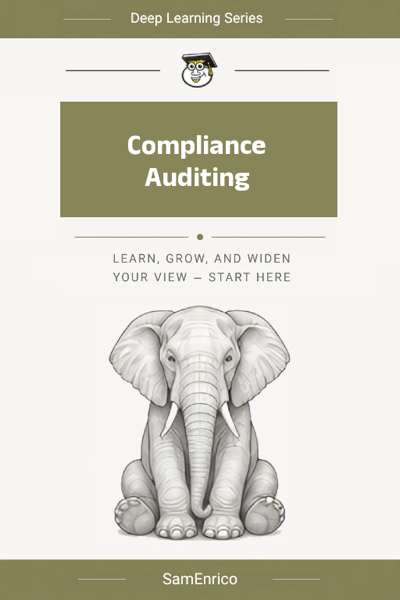
Non-FictionInformativeEducational
Compliance Auditing eBook
A Coursebook on Compliance Auditing
A Coursebook on Compliance Auditing
Formats
Free sample
Chapter 1: The Checklist Lie--–- You were hired to protect the company, but everyone treats you like the paper police. The sales team avoids your emails. The operations manager schedules "conflicts" whenever you request a meeting. The CFO, who signs your paycheck, casually asks why the audit is "taking so long" when you are only halfway through. And somewhere in the back of your mind, a quiet voice whispers: Maybe they are right.
Maybe I am just slowing things down.That voice is the enemy.Not the sales team. Not the CFO. Not even the compliance scofflaws who hide transactions and forge approvals. The real enemy is the idea that compliance auditing is fundamentally a paperwork exercise — a tedious but necessary tax on real work, a checklist to be completed so that everyone can get back to making money.This book exists because that idea is not only wrong. It is dangerously, catastrophically wrong.The checklist approach to compliance auditing has enabled some of the largest frauds, most devastating regulatory failures, and most embarrassing corporate collapses in modern history.
Enron had checklists. World Com had checklists. The banks that crashed the global economy in 2008 had checklists. Their auditors checked boxes. And then everything burned.This chapter dismantles the checklist lie and replaces it with something that actually works: a risk-based, strategic approach to compliance auditing that treats you not as a paper-pushing bureaucrat but as a hunter of hidden risk, a defender of organizational integrity, and — when necessary — a warrior in a fight that most people do not even know is happening.The Three Audits You Keep Confusing Before we can fix compliance auditing, we need to understand what it is not.
Most people — including many professionals who should know better — confuse three fundamentally distinct functions: internal audit, external audit, and compliance audit. They share tools and techniques, but their purposes, audiences, and consequences are radically different. Confusing them is like confusing a general, a police officer, and a judge. All three work within the justice system. None of them should do the other's job.Internal Audit: The Insider's Mirror Internal audit is the organization's internal check on itself.
Internal auditors report to the board or the audit committee, not to management — at least in theory. Their job is to evaluate the effectiveness of internal controls, risk management, and governance processes. They ask questions like: "Are our purchasing procedures efficient?" "Do our inventory counts match our records?" "Are we complying with our own policies?"Internal audit is valuable. A good internal audit function catches errors, identifies inefficiencies, and helps management run a tighter ship. But internal audit has an inherent limitation: it exists to make the organization better, not to enforce external rules.
If an internal auditor finds a violation of a law or regulation, they report it up the chain. But their primary loyalty is to the organization's success, not to regulatory compliance as an end in itself. This creates a subtle but critical bias. Internal auditors are incentivized to find problems that can be fixed quietly, not problems that trigger external reporting obligations or regulatory fines.External Audit: The Public's Watchdog External audit is entirely different. External auditors are independent contractors — typically from large accounting firms like Deloitte, Pw C, EY, or KPMG — who are hired to express an opinion on whether the company's financial statements are "materially accurate" and presented fairly in accordance with accounting standards.The key phrase is "materially accurate." External auditors do not certify that every transaction is correct.
They certify that the financial statements, taken as a whole, do not contain errors large enough to mislead a reasonable investor. A 50,000errorinacompanywith50,000 error in a company with 50,000errorinacompanywith10 billion in revenue is immaterial. No one goes to jail over it. The external auditor's report is addressed to shareholders and the public, not to management.External auditors are constrained by time, budget, and the inherent limitations of sampling. They typically test only a small fraction of transactions.
They rely heavily on management's representations — meaning they ask management "Is this correct?" and, absent red flags, accept the answer. The external audit is not designed to detect fraud. It is designed to detect material misstatements. Those are different things.This limitation became painfully obvious during the Enron and World Com collapses. Enron's external auditor, Arthur Andersen, signed off on financial statements that were wildly fraudulent.
World Com's external auditor missed $3.8 billion in fraudulent accounting entries. In both cases, the auditors had followed their checklists. The checklists just did not include the right questions.Compliance Audit: The Regulator's Proxy Compliance auditing is the third function — and the one most poorly understood. Compliance auditors verify adherence to specific laws, regulations, contracts, or internal policies. Their work is not about efficiency (internal audit) or financial accuracy (external audit).
It is about rule-following in a domain where violations carry legal consequences.A compliance audit asks: "Did the organization follow the Foreign Corrupt Practices Act?" "Did they comply with GDPR data privacy requirements?" "Did they meet the terms of their government contract?" These are not abstract questions. The answers determine whether the organization pays fines, faces criminal prosecution, loses licenses, or gets debarred from government contracting.Compliance audits are typically narrower, deeper, and more adversarial than internal or external audits. Narrower because they focus on a specific regulatory domain. Deeper because they cannot rely on materiality in the same way — a single violation of an anti-bribery law can destroy a company regardless of the dollar amount. More adversarial because the consequences of non-compliance are severe, and the auditee has every incentive to hide violations.Here is the crucial insight that most compliance professionals miss: the compliance auditor is not the organization's employee in the same way that the internal auditor is.
You serve a dual mandate. Yes, your paycheck comes from the organization. But your ultimate accountability is to the law and to the regulators who enforce it. If you find a violation that the organization wants to hide, your duty is to report it — internally first, but externally if necessary. The organization may not like this.
That is their problem, not yours.This dual mandate is what makes compliance auditing different from every other assurance function. It is also what makes it uncomfortable. But discomfort is not a bug. It is a feature. If compliance auditing were comfortable, it would not be doing its job.From Rule-Based to Risk-Based: The Shift That Changes Everything Traditional compliance auditing is rule-based.
You take the regulation, contract, or policy. You break it down into discrete requirements. You write a checklist. You go through the checklist, line by line, verifying compliance. At the end, you report how many checkboxes were empty.This approach has three fatal flaws.First, checklists are backward-looking.
They tell you whether the organization followed a specific rule at a specific time. They do not tell you where the next violation will occur. By the time you complete your checklist, the risks have shifted. New regulations have been enacted. New employees have been hired.
New vendors have been onboarded. Your checklist is already obsolete.Second, checklists treat all requirements equally. A rule requiring that breakroom coffee fund receipts be retained for three months…
This is the end of the free sample. Get the eBook to keep going. Buy now
About this book
Details
- Author
- Keen Marshall
- Publisher
- SamEnrico
- Language
- English
- Genre
- Non-Fiction, Informative, Educational
- Released
- 2026-05-08
- Pages (approx.)
- 145
- Available as
- eBook, Audiobook

Read better in the ZLOADR app
Your eBooks on your phone or tablet. Sign in with your SamEnrico account and start reading.
More by Keen Marshall
 Cyclothymia Spectrum GuideKeen Marshall$11.99
 Student Imposter SyndromeKeen Marshall$11.99
 Purple Team Collaboration TrendsKeen Marshall$11.99
 The Teen Cyberbullying GuideKeen Marshall$11.99
 The Artificial Sweetener Trap GuideKeen Marshall$11.99
 Raven's Shadow: The Secret War of the TricksterKeen Marshall$11.99
 How to Start a Cable Strands Made of Aluminium Business (Beginners Guide)Keen Marshall$11.99
 LEED for Export Building MaterialsKeen Marshall$12.99
 GA4 Measurement Protocol GuideKeen Marshall$12.99
You may also like
 Hong Kong Handover 1997Dunn Johnnie$11.99
 Zumba For Postnatal Recovery CourseNeal Christian$11.99
 Zumba for BeginnersLadner Nikia$11.99
 YouTube Comment Mining GuideHumes Pandora$12.99
 Worry Box MeditationCarlin Rudy$11.99
 Workplace Stress MeditationNguyen Lynn$11.99
 Workplace Stress and Sleep RepairHawley Ivory$11.99
 Workplace Perfectionism CureDelaney Jeffry$11.99
 Workplace Injustice Anger GuideWallen Isabelle$11.99
 Work Addiction and Burnout LinkGreenwood Ester$11.99
 Women in Yoga and WellnessBeattie Galina$11.99
 Women in Stand Up ComedyChun Evangeline$11.99