
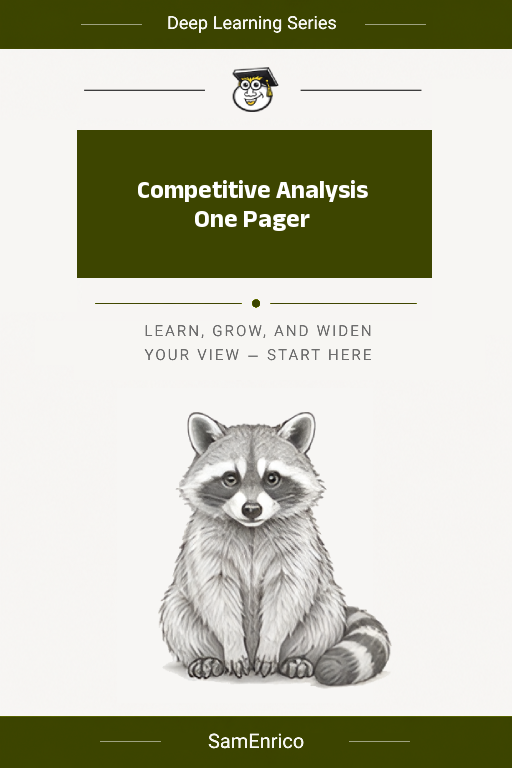
Non-FictionFirst 30 DaysCompetitive Intel
Competitive Analysis One Pager eBook
Map competitors, differentiators, and market posit
by Maes Barb
Map competitors, differentiators, and market positioning on a single sheet to spot opportunities.
Formats
Free sample
Chapter 1: The $200,000 Mistake--–- On a Tuesday morning in March, the head of strategy at a mid-sized Saa S company walked into the conference room, placed a stack of papers three inches thick on the table, and announced, "After six weeks and two hundred thousand dollars in consulting fees, we finally understand our competitive landscape." The CEO flipped to page one, scanned the executive summary, and said something that should haunt every competitive analysis ever written: "This is what I told you six weeks ago. What did we learn?"The room went silent. The strategy lead had no answer. The consultants had no answer. The forty-page report, complete with color-coded charts, competitor timelines, and a thirty-seven-page appendix, contained exactly zero insights that changed a single decision the company would make on Wednesday.
That company lost its market leadership position eighteen months later, not because they lacked data, but because they had too much data and too little intelligence. They were drowning in information while starving for wisdom.This book exists because that scene plays out every single day in boardrooms, startup offices, and product meetings around the world. Teams spend fortunes on competitive research that nobody reads. They build elaborate spreadsheets tracking every feature their rivals release. They subscribe to expensive intelligence platforms that send weekly alerts nobody clicks.
And at the end of all that effort, when someone asks, "So what do we do differently on Monday?" the answer is a shrug wrapped in a Power Point deck.The problem is not a lack of effort. The problem is not a lack of intelligence. The problem is a fundamental misunderstanding of what competitive analysis is supposed to accomplish. Most organizations treat competitive analysis as an information-gathering exercise. They believe that more data leads to better decisions.
They operate under the implicit assumption that if they just collect enough facts about their competitors, the strategy will somehow reveal itself.This assumption is catastrophically wrong.What you are about to read is not another book about competitive analysis. It is a book about strategic minimalism. It is a book about the radical discipline of throwing away ninety percent of what you think you need to know so you can focus on the ten percent that actually matters. It is a book about replacing forty-page reports with a single sheet of paper that forces clarity, action, and accountability.I call this method the Competitive Analysis One Pager, and over the next twelve chapters, you will learn exactly how to build one, how to keep it alive, and how to use it to spot market opportunities before your competitors do. But before we get to the how, we need to understand why traditional competitive analysis fails so spectacularly, and why the solution is not more analysis but less of it.The Paradox of Paralysis The human brain has a well-documented limitation: when presented with too many options or too much information, it freezes.
Psychologists call this "analysis paralysis," and it affects everything from choosing a jar of jam to deciding on a corporate strategy. In a famous study conducted at Columbia University, researchers set up a tasting booth in a gourmet food store. On some days, they offered customers a selection of six jams. On other days, they offered twenty-four jams. The booth with twenty-four jams attracted more attention, but customers who saw the larger selection were ten times less likely to actually buy anything.
More choices led to fewer decisions.Competitive analysis works exactly the same way. When you produce a forty-page report filled with every possible data point about every possible competitor, you are not helping your team make better decisions. You are handing them twenty-four jars of jam and walking away. The sheer volume of information creates an implicit message: "All of this matters, and you need to consider all of it before you act." The result is not strategic clarity. It is strategic paralysis.I have seen this play out in companies of every size, from seed-stage startups to Fortune 500 enterprises.
A product team spends three weeks building a competitor matrix with fifty features across ten competitors. They present it to leadership. Leadership nods approvingly at the thoroughness. Then someone asks, "So which three features should we build next?" And the product team cannot answer, because their matrix treats every feature as equally important, every competitor as equally threatening, and every data point as equally relevant. They have described the entire forest down to the last leaf, but they have no idea which trees to cut down.This is the paradox at the heart of traditional competitive analysis: the more complete the analysis, the less useful it becomes.
Completeness and actionability are not friends. They are trade-offs. Every additional data point you add to your analysis dilutes the signal-to-noise ratio. Every additional competitor you track spreads your attention thinner. Every additional feature you compare makes it harder to identify what actually differentiates you from the field.The organizations that win in competitive markets are not the ones with the most complete information.
They are the ones that know how to ignore most of the information available to them. They have developed the discipline to ask, "What is the smallest amount of information we need to make a good decision?" and then stop collecting data when they reach that threshold. They understand that in strategy, as in design, perfection is achieved not when there is nothing left to add, but when there is nothing left to take away.The 48-Hour Rule and Why Speed Destroys Accuracy If completeness is the enemy of actionability, speed is its unlikely ally. Conventional wisdom holds that good analysis takes time. You need to wait for quarterly earnings reports.
You need to subscribe to industry newsletters. You need to commission customer surveys. You need to hire consultants who will spend weeks conducting interviews. All of this assumes that the competitive landscape is relatively static, that your competitors are not changing while you study them, and that the insights you uncover today will still be valid next month.None of these assumptions are true.Markets move faster than any research process can keep up with. Your competitors are launching features, adjusting prices, hiring talent, and pivoting strategies in real time.
By the time you finish a four-week analysis, at least one of your competitors has done something that invalidates at least one of your findings. Your report is not a snapshot of the present. It is a historical document about the past.This is why I developed the 48-Hour Rule, which will be a recurring principle throughout this book. The rule is simple: any competitive analysis that takes longer than two weeks to complete is functionally worthless. Not slightly less valuable.
Not in need of an update. Worthless. By the time a forty-page report is bound, distributed, and read by the people who need to act on it, the intelligence inside is already historical fiction.Let me be explicit about what I am claiming here. I am not saying that you should make decisions with no information. I am not saying that research has no value.
I am saying that the marginal utility of the third week of analysis is almost always negative. You would be…
This is the end of the free sample. Get the eBook to keep going. Buy now
About this book
Details
- Author
- Maes Barb
- Publisher
- SamEnrico
- Language
- English
- Genre
- Non-Fiction, First 30 Days, Competitive Intel
- Released
- 2026-06-01
- Pages (approx.)
- 137
- Available as
- eBook, Audiobook

Read better in the ZLOADR app
Your eBooks on your phone or tablet. Sign in with your SamEnrico account and start reading.
More by Maes Barb
 Self Talk for Job LossMaes Barb$11.99
 Hayloft Rest GuideMaes Barb$11.99
 Stress Inflammation ConnectionMaes Barb$11.99
 Flow Environment AuditMaes Barb$11.99
 Bubble Float RelaxationMaes Barb$11.99
 The Mindfulness Focus LinkMaes Barb$11.99
 Ultimate Frisbee Self HypnosisMaes Barb$11.99
 ABCDE for CaregiversMaes Barb$11.99
 The Siege of Jeddah Prison: A 19th-Century Bloodbath in the Heart of the Ottoman EmpireMaes Barb$11.99
 Shadows Over Istanbul: The Vanished DiplomatMaes Barb$11.99
 How to Become a Counter-supply WorkerMaes Barb$11.99
 Woolly Mammoths: Ancient ElephantMaes Barb$11.99
You may also like
 Hong Kong Handover 1997Dunn Johnnie$11.99
 Zumba For Postnatal Recovery CourseNeal Christian$11.99
 Zumba for BeginnersLadner Nikia$11.99
 YouTube Comment Mining GuideHumes Pandora$12.99
 Worry Box MeditationCarlin Rudy$11.99
 Workplace Stress MeditationNguyen Lynn$11.99
 Workplace Stress and Sleep RepairHawley Ivory$11.99
 Workplace Perfectionism CureDelaney Jeffry$11.99
 Workplace Injustice Anger GuideWallen Isabelle$11.99
 Work Addiction and Burnout LinkGreenwood Ester$11.99
 Women in Yoga and WellnessBeattie Galina$11.99
 Women in Stand Up ComedyChun Evangeline$11.99