
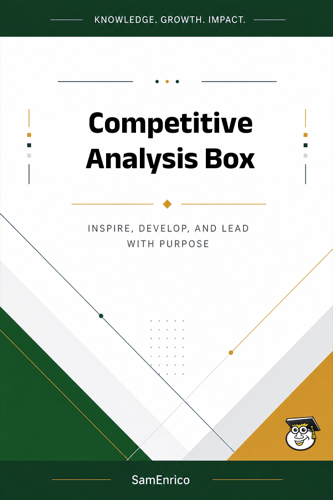
Non-FictionFirst 30 DaysCompetitive Analysis
Competitive Analysis Box eBook
Identify top competitors and your differentiation.
Identify top competitors and your differentiation.
Formats
Free sample
Chapter 1: The Headlight Effect--–- Maria Vasquez had every reason to be confident. Her Saa S company, Scribe Flow, had grown 40% year over year for three consecutive years. She knew her competitors cold: there was Docu Pros, the lumbering incumbent with outdated UX; Quick Sign, the scrappy price-cutter; and Sign Stream, the well-funded startup that kept raising rounds but couldn't close enterprise deals. Maria tracked their pricing changes, feature releases, and even their job postings. She was, by any measure, a vigilant CEO.Then she lost a $2.3 million deal to a shared Excel spreadsheet.The prospect, a mid-sized logistics company, had been in active negotiations with Scribe Flow for four months.
The sales team had done everything right: demos, security reviews, a pilot program. The prospect's procurement team had even signed off on the budget. Then, without warning, the deal died. When Maria's head of sales pressed for answers, the prospect's CEO said something that would haunt her for years: "We realized we don't actually need your software. Our team built a shared spreadsheet that does about 80% of what you offer.
It's not perfect, but it's free, and we already know how to use it."Scribe Flow had not lost to a competitor. It had lost to a substitute—and worse, to the customer's willingness to do nothing at all.This is the headlight effect. You are driving fast, focused intently on the road immediately ahead—the direct competitors who look like you, sound like you, and fight for the same customers in the same way. Your headlights illuminate these rivals brightly. Meanwhile, in the darkness to your left and right, other threats are moving: substitutes, adjacent industry players, supplier-led competitors, and the most dangerous threat of all—the customer who simply decides that your product is not worth buying from anyone.This book is about turning on the high beams.The Competitive Analysis Box is a framework designed to do exactly that: to reveal not just who is competing with you today, but who could compete with you tomorrow, next quarter, and next year.
It plots Market Attractiveness against your Relative Competitive Advantage, creating a 3×3 matrix that tells you where to invest, where to harvest, where to niche, and where to exit. But before we build the Box, we must first understand the problem it solves. We must understand why so many companies—smart companies with smart leaders—consistently miss the competitors that eventually undo them.Why the Headlight Effect Persists The headlight effect is not a failure of intelligence. It is a failure of framing. Human beings are pattern-matching machines.
We see what we expect to see. When you have spent ten years in an industry, your brain has built a sophisticated map of who matters and who does not. That map is useful for daily operations. It is deadly for strategic foresight.Consider the retail apocalypse that swept the United States in the 2010s. Toys "R" Us, Blockbuster, Borders, Radio Shack, Sears—these companies did not fail because they were poorly managed.
They failed because they defined their competitors too narrowly. Blockbuster thought its competitors were other video rental stores. Its actual competitor was a DVD-by-mail service called Netflix, which then became a streaming service, which then became a content studio. By the time Blockbuster saw Netflix clearly, it was too late.Toys "R" Us thought its competitors were other toy stores. Its actual competitors were Walmart (which used toys as a loss leader to drive foot traffic) and Amazon (which turned toy buying into a two-click transaction).
Borders thought its competitors were other bookstores. Its actual competitor was a website that sold books without stores and then built a device called the Kindle.In every case, the headlight effect created strategic blindness. The companies were watching the wrong highway.The Three Types of Competitors You Are Probably Ignoring To break the headlight effect, you must expand your definition of competition beyond the obvious. Based on our synthesis of Porter's Five Forces and Jobs to Be Done theory, there are three categories of competitors that most companies systematically overlook.First, substitutes. A substitute is a different product category that solves the same customer problem.
This is not a competitor who sells something similar. This is a competitor who sells something completely different that achieves the same outcome. For a coffee shop, substitutes include energy drinks, tea, and even sleeping longer. For a project management software company, substitutes include shared spreadsheets, whiteboards, and sticky notes on a wall. For a consulting firm, substitutes include online courses, internal training programs, and the customer deciding that the problem is not worth solving at all.Second, adjacent entrants.
These are companies from neighboring industries who decide to move into your space. They do not start as competitors. They start as suppliers, distributors, or even customers. Consider how Amazon started as a bookstore, then became a competitor to every physical retailer. Consider how Apple started as a computer company, then became a competitor to the music industry, the phone industry, the watch industry, and the financial services industry.
Adjacent entrants are dangerous because they bring different cost structures, different profit expectations, and different strategic logics. They are not playing your game, which means you cannot beat them by playing better.Third, the do-nothing competitor. This is the customer who decides that your product category is unnecessary. They do not buy from you, and they do not buy from your direct competitors. They simply exit the market.
The do-nothing competitor is the most overlooked because it does not appear in any sales report, any win-loss analysis, or any competitive intelligence dashboard. Yet it is often the largest source of lost revenue. Studies of B2B buying cycles consistently show that "do nothing" is the most common outcome of a sales process—more common than losing to any specific competitor. Customers choose to maintain the status quo, to live with the problem, to build a hacky internal solution, or to wait until something forces them to act.The Cost of Competitive Blindness When you suffer from the headlight effect, the cost is not immediate. That is what makes the effect so insidious.
You do not wake up one day to find your business destroyed. Instead, you experience a slow erosion: market share slipping by a percentage point here, a key account lost there, a new entrant gaining traction while you dismiss them as irrelevant.By the time the threat is visible in your headlights, it is usually too late to respond effectively.Let me give you a concrete framework for calculating the cost of competitive blindness. In my work with companies across technology, manufacturing, and professional services, I have observed a consistent pattern: companies that conduct systematic competitor identification beyond direct rivals grow at roughly twice the rate of companies that only track direct competitors. Why? Because they see opportunities earlier, they anticipate threats before they materialize, and they allocate resources to markets that are genuinely attractive rather than those that simply feel familiar.Conversely, companies that suffer from the headlight effect make three predictable mistakes.Mistake one: They react, never act.
Because they only see competitors when those competitors are already visible, their strategy is always reactive. They cut prices when…
This is the end of the free sample. Get the eBook to keep going. Buy now
About this book
Details
- Author
- Waldrop Mohamed
- Publisher
- SamEnrico
- Language
- English
- Genre
- Non-Fiction, First 30 Days, Competitive Analysis
- Released
- 2026-06-08
- Pages (approx.)
- 149
- Available as
- eBook, Audiobook

Read better in the ZLOADR app
Your eBooks on your phone or tablet. Sign in with your SamEnrico account and start reading.
More by Waldrop Mohamed
 Postpartum Hemorrhoid ReliefWaldrop Mohamed$11.99
 Automotive Parts AIWaldrop Mohamed$11.99
 Road Rage Prevention WorkbookWaldrop Mohamed$11.99
 Constraints for LawyersWaldrop Mohamed$11.99
 Chunking for ADHD BrainsWaldrop Mohamed$11.99
 Breast Density And Cancer RiskWaldrop Mohamed$11.99
 Assertiveness for ConstructionWaldrop Mohamed$11.99
 The Iron Kings of the Sahel: Forging Empires in the SandsWaldrop Mohamed$11.99
 The Siege of Nicaea: The Last Byzantine Bastion Falls (1461)Waldrop Mohamed$11.99
 How to Produce a Consumer Electronics ShowWaldrop Mohamed$11.99
 How to Become a Heater HelperWaldrop Mohamed$11.99
 A Collector's Handbook to the Triumph 1300Waldrop Mohamed$11.99
You may also like
 Hong Kong Handover 1997Dunn Johnnie$11.99
 Zumba For Postnatal Recovery CourseNeal Christian$11.99
 Zumba for BeginnersLadner Nikia$11.99
 YouTube Comment Mining GuideHumes Pandora$12.99
 Worry Box MeditationCarlin Rudy$11.99
 Workplace Stress MeditationNguyen Lynn$11.99
 Workplace Stress and Sleep RepairHawley Ivory$11.99
 Workplace Perfectionism CureDelaney Jeffry$11.99
 Workplace Injustice Anger GuideWallen Isabelle$11.99
 Work Addiction and Burnout LinkGreenwood Ester$11.99
 Women in Yoga and WellnessBeattie Galina$11.99
 Women in Stand Up ComedyChun Evangeline$11.99