
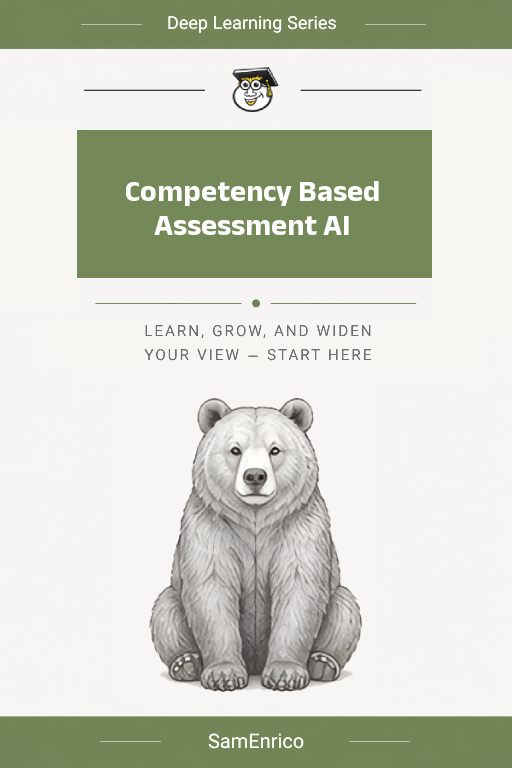
Non-FictionForecast & OutlookCompetency Ed
Competency Based Assessment AI eBook
Explore mastery-focused evaluation where students
Explore mastery-focused evaluation where students progress upon demonstrating specific skills, not seat time.
Formats
Free sample
Chapter 1: The Testing Lie...--–- Every parent remembers the moment. Your child comes home with a test score. Maybe it is an A, and you feel pride. Maybe it is a D, and you feel worry. Maybe it is somewhere in between, and you feel nothing at all except the vague sense that another week of school has passed.
You look at the number at the top of the page—87 percent, 62 percent, 94 percent—and you believe that number tells you something true about your child. You believe it tells you what they know, what they can do, and how they compare to other children their age.You are wrong.That number tells you almost nothing of value. It tells you how your child performed on a specific set of questions on a specific day, under specific time pressure, in a specific room, with a specific teacher. It does not tell you whether your child can apply that knowledge six months later. It does not tell you whether your child can solve problems that look different from the practice problems.
It does not tell you whether your child has actually mastered the skill or merely recognized the pattern. And most damning of all, that number tells you nothing about what your child could have achieved if they had been given more time, better feedback, or a different path.We have built an entire education system on a lie. The lie is that time is a reliable proxy for learning. We assume that because a student sat in a classroom for a certain number of hours, they must have learned something. We assume that because a student received a certain grade, they must possess a certain level of competence.
We assume that the calendar—not the child—should determine when learning begins and ends.These assumptions are not just wrong. They are destructive.The Invention of Seat-Time To understand why our assessment system is broken, we must first understand how it was built. And to understand that, we need to travel back to the year 1906.The Carnegie Foundation for the Advancement of Teaching faced a problem. Universities had no consistent way to measure what high school students knew. Each school used its own curriculum, its own textbooks, its own grading standards.
A diploma from one high school might represent rigorous scholarship; a diploma from another might represent little more than attendance. The foundation needed a standard unit of measurement, something that would allow colleges to compare students from different schools and make admissions decisions with confidence.Their solution was the Carnegie Unit. One unit equaled 120 hours of classroom instruction in a single subject over the course of a single year. If a student sat in a room with a teacher for 120 hours, they earned one credit. If they accumulated enough credits, they graduated.
The content of those 120 hours mattered less than the simple fact of their completion.In 1906, this was a reasonable compromise. The foundation had no way to measure learning directly. Standardized testing was in its infancy. The technology to track individual student progress across multiple skills did not exist. So they measured what they could measure: time.The problem is that we never stopped.More than a century later, we still organize schools around the Carnegie Unit.
We still believe that 120 hours of sitting in a room means something. We still sort students by age rather than ability, move them forward according to the calendar rather than their competence, and call the result education.The Carnegie Unit was never designed to measure learning. It was designed to measure compliance. And we have confused compliance with competence for so long that we no longer see the distinction.The Two Students Who Broke My Assumptions I learned the difference between seat-time and mastery the hard way. Early in my career, I taught a ninth-grade algebra class.
Two students in that class changed everything I thought I knew about teaching and assessment.The first student, let us call her Maya, was brilliant. She had an intuitive feel for mathematics that I have rarely seen in students of any age. By the third week of the semester, she had mastered everything I planned to teach for the next four months. She could solve linear equations in her head. She understood slope as rate of change without needing the formula.
She could look at a word problem, extract the relevant information, and construct an equation before most of her classmates had finished reading the question.Maya spent the next fourteen weeks sitting in my classroom, bored out of her mind. She did her homework in ten minutes. She stared out the window during lectures. She passed every test with minimal effort. She learned nothing new for almost an entire semester because the system would not let her move ahead.
Her reward for mastering the material quickly was to sit and wait for everyone else to catch up.The second student, let us call him James, struggled. He needed to see each concept multiple times, from multiple angles. He needed to practice with feedback, make mistakes, correct them, and practice again. Where Maya mastered slope in one day, James needed two weeks. Where Maya solved equations fluently, James needed step-by-step scaffolding.James failed the first test.
He failed the second test. He fell further behind with each passing week, not because he lacked ability but because the system would not slow down. The calendar demanded that we move from linear equations to inequalities whether James was ready or not. He never caught up.Here is what I learned from Maya and James. Maya was not a better student than James because she learned faster.
She was just a different student. Her brain processed mathematical relationships quickly. James's brain needed more time, more repetition, and more feedback. Neither of these facts is a moral judgment. Neither is a measure of worth or potential.
But our assessment system punished both of them—Maya with boredom and stagnation, James with failure and shame—because the system was built to measure time, not learning.What Traditional Tests Actually Measure Let us be precise about what traditional assessments actually measure. A typical end-of-unit test, final exam, or standardized test is a snapshot. It captures a student's performance on a specific set of items at a specific moment in time. That snapshot is influenced by dozens of factors that have nothing to do with the student's actual competence.Test anxiety is real. Some students freeze under pressure.
Their performance on a high-stakes exam may dramatically understate what they know and can do. Other students thrive on pressure, performing better in test conditions than they would in authentic problem-solving contexts. The same student might score very differently on Tuesday than on Thursday depending on sleep, nutrition, family stress, or a hundred other variables.Traditional tests also reward test-taking skill. Students who know how to eliminate wrong answers, manage time, guess strategically, and decode question phrasing will outperform students who do not possess those skills, even when both students have identical understanding of the content. We tell ourselves that we are measuring mathematical ability or reading comprehension or scientific reasoning.
In practice, we are measuring a composite that includes those things plus test-taking strategy plus anxiety management plus luck.Most importantly…
This is the end of the free sample. Get the eBook to keep going. Buy now
About this book
Details
- Author
- Pannell Leatrice
- Publisher
- SamEnrico
- Language
- English
- Genre
- Non-Fiction, Forecast & Outlook, Competency Ed
- Released
- 2026-06-01
- Pages (approx.)
- 148
- Available as
- eBook, Audiobook

Read better in the ZLOADR app
Your eBooks on your phone or tablet. Sign in with your SamEnrico account and start reading.
More by Pannell Leatrice
 Parasomnia Night Terror GuidePannell Leatrice$11.99
 Benzo Seizure Prevention ManualPannell Leatrice$11.99
 Irish EV Home Charger GrantPannell Leatrice$11.99
 The Sobriety Workbook for Daily StrengthPannell Leatrice$11.99
 OKRs for Relationship GoalsPannell Leatrice$11.99
 The Prince and the Prophet: Machiavelli and the Birth of Modern StatecraftPannell Leatrice$11.99
 Ultimate Handbook Guide to Torino : (Italy) Travel GuidePannell Leatrice$11.99
 Understanding Ichthyosis VulgarisPannell Leatrice$17.99
 Outside Plant TechnicianPannell Leatrice$11.99
 Retail Union Drive WorkbookPannell Leatrice$12.99
You may also like
 Hong Kong Handover 1997Dunn Johnnie$11.99
 Zumba For Postnatal Recovery CourseNeal Christian$11.99
 Zumba for BeginnersLadner Nikia$11.99
 YouTube Comment Mining GuideHumes Pandora$12.99
 Worry Box MeditationCarlin Rudy$11.99
 Workplace Stress MeditationNguyen Lynn$11.99
 Workplace Stress and Sleep RepairHawley Ivory$11.99
 Workplace Perfectionism CureDelaney Jeffry$11.99
 Workplace Injustice Anger GuideWallen Isabelle$11.99
 Work Addiction and Burnout LinkGreenwood Ester$11.99
 Women in Yoga and WellnessBeattie Galina$11.99
 Women in Stand Up ComedyChun Evangeline$11.99