
Non-FictionFirst 30 DaysCompensation
Compensation Philosophy eBook
State pay approach in one sentence.
State pay approach in one sentence.
Formats
Free sample
Chapter 1: The Public Interest Paradigm...--–- When a state government cannot point to a profit margin, a stock price, or a quarterly earnings report, how does it know if it is paying its people correctly? The answer, it turns out, is the hardest question in public administration—and the most important one to get wrong.Every private sector executive understands the basic arithmetic of compensation. You pay an employee a certain amount. That employee produces work that generates revenue or reduces costs. If the revenue exceeds the pay plus overhead, you have a profitable hire.
If not, you have a problem. The math is brutal, clear, and immediate. Quarterly earnings reports do not lie. Stock prices do not negotiate. The market renders its verdict quickly, and compensation adjusts accordingly.Now consider the public sector equivalent.
A state hires a child protective services caseworker. That caseworker investigates allegations of abuse, makes recommendations to a court, and potentially removes children from dangerous homes. What is the revenue generated by that caseworker? Zero. What is the cost reduction attributable to that caseworker?
Impossible to calculate. What is the profit margin on preventing a child’s death? The question is not merely unanswerable; it is offensive to even ask.And yet, the caseworker must be paid. The state must decide whether $45,000 is too little, $65,000 is about right, or $85,000 is too much. That decision will determine whether the state can attract qualified social workers, whether those workers stay long enough to develop expertise, and whether children fall through the cracks because caseloads are too high and turnover is too frequent.This is the public interest paradigm.
It is the foundational reality that distinguishes public sector compensation from every other form of employment. And until a compensation philosophy grapples with it directly, all discussions of market surveys, pay grades, and performance bonuses are built on sand.The Unique Employer Government is not merely another employer. It is a fundamentally different category of employer, with obligations and constraints that private firms do not face. Understanding these differences is not an academic exercise; it is the prerequisite for any coherent pay philosophy.First, government cannot go out of business. This sounds like an advantage, and in some respects it is.
Public employees enjoy a level of job security that private sector workers can only envy. A private company facing declining revenue reduces headcount. A state facing declining revenue issues bonds, raises taxes, or borrows from future budgets. Layoffs happen, but they are political catastrophes, not routine management tools. This security is a form of compensation in itself—one that Chapter 3 will quantify as part of total rewards architecture.But the inability to fail also creates perverse incentives.
Private firms that overpay for talent eventually go bankrupt. The market corrects their errors. States that overpay for talent simply raise taxes or cut services elsewhere. The correction mechanism is political, not economic, which means it is slower, messier, and less reliable. A compensation philosophy that ignores this reality will build unaffordable commitments that future legislators cannot easily unwind.Second, government cannot issue equity.
A startup can offer stock options to compensate for below-market salaries. A public company can grant restricted stock units that align employee interests with shareholder interests. A state can offer nothing analogous. There is no "State of California stock" to hand out. There are no equity grants to make the math work when salaries fall short.
This means public sector compensation must stand on its own—salary, benefits, and mission—without the lubricant of ownership stakes that private firms use to close deals with top talent.Third, government has no single profit motive. Private firms exist to maximize shareholder value. Everything else—customer satisfaction, employee morale, environmental compliance—is instrumental to that ultimate goal. Government exists to serve multiple, competing public interests simultaneously. Safety, equity, efficiency, due process, transparency, accountability, and fiscal prudence are not ranked in a consistent order.
They trade off against one another in every decision, including compensation decisions.Consider a simple example: a state Department of Transportation needs to hire civil engineers. Pay too little, and qualified engineers will work for private construction firms instead. Pay too much, and taxpayers will complain about overpaid bureaucrats while potholes go unfilled. But there is no profit formula that solves for the optimal wage. There is only judgment, politics, and philosophy.The Profit Motive Gap The absence of a profit motive transforms every aspect of compensation design.
Private firms can justify raises by pointing to increased revenue. "Last year, your division generated $2 million more than the year before. Here is your bonus." The causal chain is visible, measurable, and defensible.Public managers have no such tool. A public health epidemiologist might prevent a disease outbreak that would have cost the state $50 million in hospitalizations. But how does anyone know the outbreak was prevented?
How much credit goes to the epidemiologist versus the sanitation workers, the public awareness campaign, or simple luck? The causal chain is invisible, unmeasurable, and impossible to defend in a budget hearing.This creates the first great asymmetry of public sector compensation: accountability without attribution. Public employees are held accountable for outcomes they cannot individually control, and their pay is determined by processes that cannot reliably measure their contribution.The consequences are pervasive. Consider performance pay, which Chapter 5 will examine in depth. Private firms can tie bonuses to individual sales quotas, unit production targets, or project completion milestones.
The link between effort and reward is direct enough to motivate behavior. Public agencies trying the same approach quickly discover that most public sector work is team-based, process-oriented, and long-cycle. A teacher's impact on student test scores is confounded by家庭 environment, prior schooling, and peer effects. A social worker's success in keeping a family together may not be visible for years. A police officer's prevention of crime is, by definition, an event that did not happen.The profit motive gap also affects recruitment and retention.
Private firms can offer signing bonuses, retention bonuses, and accelerated promotion tracks to hot candidates. Public sector pay scales are typically locked into classification systems that limit flexibility. A brilliant young data scientist might command $150,000 in the private sector. A state might be able to offer $90,000 plus a pension. The data scientist takes the private offer, and the state hires someone less qualified.
Over time, this pattern systematically drains talent from government.From Entitlement to Strategic Investment For most of the twentieth century, public sector compensation rested on an implicit bargain: moderate pay, excellent job security, and a defined benefit pension at the end. Employees traded salary upside for stability. The bargain was simple, predictable, and widely understood. It was also, fundamentally, an entitlement model. You showed up, you did your job, you stayed out of trouble, and you moved up the steps.
Time served was the primary driver of pay progression.That model is dying. It is being replaced, slowly and painfully, by a strategic investment model. Instead of asking "How long has this person been here?", the strategic model asks "What skills does this person have that the organization needs?" Instead of assuming that every job deserves the same annual cost-of-living adjustment, the strategic model asks "Which jobs…
This is the end of the free sample. Get the eBook to keep going. Buy now
About this book
Details
- Author
- Barbour Annmarie
- Publisher
- SamEnrico
- Language
- English
- Genre
- Non-Fiction, First 30 Days, Compensation
- Released
- 2026-06-08
- Pages (approx.)
- 149
- Available as
- eBook, Audiobook

Read better in the ZLOADR app
Your eBooks on your phone or tablet. Sign in with your SamEnrico account and start reading.
More by Barbour Annmarie
 Postpartum for Moms Over 35Barbour Annmarie$11.99
 After Work Road Rage FixBarbour Annmarie$11.99
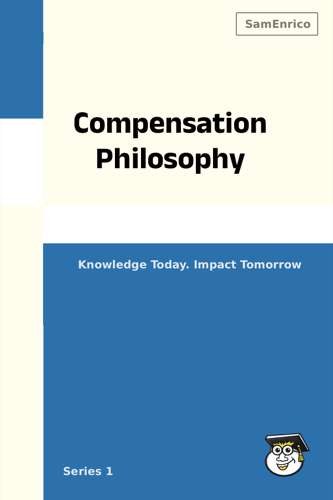 Compensation PhilosophyBarbour Annmarie$11.99
 Anticipatory Grief Pet LossBarbour Annmarie$11.99
 Days Inventory OutstandingBarbour Annmarie$11.99
 Remote Collaboration MethodsBarbour Annmarie$11.99
 Consistency Persuasion MethodBarbour Annmarie$11.99
 Breast Cancer Surgery OptionsBarbour Annmarie$11.99
 Neon Mirage: The Vanishing of the Mary CelesteBarbour Annmarie$11.99
 The Ransom of Vicksburg: Grant's Gambit and the Fall of the Confederacy's StrongholdBarbour Annmarie$11.99
 How to Produce Cookie PressesBarbour Annmarie$11.99
 How to Produce Paint MediumsBarbour Annmarie$11.99
You may also like
 Hong Kong Handover 1997Dunn Johnnie$11.99
 Zumba For Postnatal Recovery CourseNeal Christian$11.99
 Zumba for BeginnersLadner Nikia$11.99
 YouTube Comment Mining GuideHumes Pandora$12.99
 Worry Box MeditationCarlin Rudy$11.99
 Workplace Stress MeditationNguyen Lynn$11.99
 Workplace Stress and Sleep RepairHawley Ivory$11.99
 Workplace Perfectionism CureDelaney Jeffry$11.99
 Workplace Injustice Anger GuideWallen Isabelle$11.99
 Work Addiction and Burnout LinkGreenwood Ester$11.99
 Women in Yoga and WellnessBeattie Galina$11.99
 Women in Stand Up ComedyChun Evangeline$11.99