
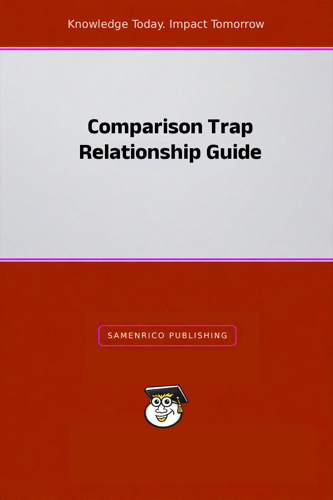
Comparison Trap Relationship Guide eBook
Stop measuring your partnership against social med
Stop measuring your partnership against social media and build confidence in your unique bond.
Formats
Free sample
Chapter 1: The Comparison Lie--–- The first time I realized I was losing a relationship to people who didn’t even know we existed, I was lying on my couch at eleven o’clock on a Tuesday night. My partner was already asleep. I was not. I was holding my phone six inches from my face, watching a video of a man I had never met surprise his wife with a puppy on their kitchen island. She cried.
He cried. The comments section wept. And I felt something cold move through my chest. It wasn’t happiness for them. It was the slow, familiar ache of wondering why my kitchen island had never hosted a puppy.
My kitchen island, in fact, had crumbs. It had an unpaid electric bill tucked under a magnet. It had the quiet hum of a refrigerator that needed replacing three years ago. And in that moment, I resented every crumb. Not because crumbs are inherently resentable, but because they were not a puppy.
They were not tears of joy. They were not proof that my relationship was one of the good ones.That is the comparison lie. And it is the most expensive lie you will ever believe about your partnership.The comparison lie whispers that your relationship should look like other people’s relationships. It insists that if you are not doing what they are doing, posting what they are posting, and feeling what they appear to be feeling, then you are falling behind. It turns love into a leaderboard.
And once you accept that frame, you will spend the rest of your relationship trying to catch up to people who do not know your name, your history, or the specific way your partner makes you laugh when you are both too tired to speak in full sentences.I wrote this book because I have sat across from too many couples in too many therapy rooms who were not fighting about money, sex, or division of labor. They were fighting about Instagram. They were fighting about why he didn’t post an anniversary tribute that looked like her coworker’s husband’s tribute. They were fighting about why they hadn’t gone on a vacation that looked like the vacation their college friend just returned from. They were fighting about a version of their relationship that existed only in pixels and envy.
And the tragedy was not that they were unhappy. The tragedy was that they had forgotten that their actual relationship—the one with crumbs and inside jokes and the way he always leaves the last bite of dessert for her—was right there, waiting to be noticed.This chapter is the diagnosis. Before we fix anything, we have to name the disease. And the disease is not social media. It is not your partner.
It is not even your own insecurity, though that plays a part. The disease is a specific kind of cognitive error that your brain makes when it is asked to compare two things that cannot be compared. You are comparing your behind-the-scenes reality to someone else’s carefully edited performance. That is not a fair fight. That is not even a fight.
That is measuring the weight of a shadow against the weight of a stone.We are going to call this error the Asymmetry of Knowledge. And once you understand it, you will never be able to unsee it.The Asymmetry of Knowledge: Why You Always Lose Let me ask you a question. How many arguments did you have with your partner last month? Not the big, theatrical ones. The small ones.
The passive-aggressive sigh when you realized they forgot to take out the trash again. The three-minute silence in the car after one of you said something dismissive. The eye roll you pretended not to see. You know roughly how many of those moments happened, because you lived through them. You were there.Now, how many arguments did the couple you follow on Instagram have last month?
How many passive-aggressive sighs? How many silent car rides? How many times did one of them feel unseen, unheard, or quietly furious while scrolling their phone instead of addressing it?You have no idea. Because they did not post those moments. They posted the proposal, the vacation, the puppy, the anniversary dinner, the sunset hike, the laughing-out-of-frame shot that suggests they are having the time of their lives.
They did not post the fight about whose turn it was to clean the bathroom. They did not post the moment one of them felt rejected and said nothing. They did not post the ordinary, exhausting, unglamorous work of staying in a relationship with another human being who sometimes annoys you.This is the Asymmetry of Knowledge. You know 100 percent of the mundane, frustrating, boring, and difficult moments in your own relationship. You know approximately 1 percent of someone else’s relationship—and that 1 percent has been filtered, edited, and staged.
You are comparing a complete dataset to a carefully curated sample. That is not comparison. That is a statistical error.The term “social referencing” comes from developmental psychology. It describes how infants look at their caregivers to figure out whether a new situation is safe. If the caregiver looks calm, the infant feels calm.
If the caregiver looks scared, the infant feels scared. It is a survival mechanism. We are wired to look at other people to know how to feel about our own circumstances.In the digital age, we have turned social referencing into a full-time job. You wake up, and before you have said good morning to your partner, you have already looked at three other couples to determine whether your own relationship is “okay.” Did they post a date night? You haven’t had a date night in two weeks.
Problem. Did they post a heartfelt caption about how grateful they are for their spouse? You haven’t said anything grateful to yours since last Tuesday. Problem. Did they post a photo from a tropical location while you are sitting in your living room in sweatpants?
Problem.Except none of those are actual problems. They are problems only if you believe that the curated 1 percent of someone else’s life is the baseline for normal. And that is the comparison lie: the belief that other people’s highlights are their reality.Why Your Brain Falls for This Every Time Your brain is not trying to hurt you. It is trying to protect you. The human brain evolved to notice threats, to compare itself to others in the tribe, and to adjust behavior accordingly.
If everyone else is gathering more berries than you, your brain sets off an alarm. You need to gather more berries. That mechanism kept your ancestors alive.But the mechanism was designed for a world where you could see the whole tribe. You could see who was sick, who was struggling, who had just lost a child, who was exhausted from a bad night’s sleep. You had access to the full picture.
Now, you see everyone’s wins and almost no one’s losses. Your brain still sounds the alarm—everyone else is gathering more berries!—but it…
This is the end of the free sample. Get the eBook to keep going. Buy now
About this book
Details
- Author
- Minton Tristan
- Publisher
- SamEnrico
- Language
- English
- Genre
- Non-Fiction, Self-Help, Social Comparison
- Released
- 2026-06-09
- Pages (approx.)
- 142
- Available as
- eBook, Audiobook

Read better in the ZLOADR app
Your eBooks on your phone or tablet. Sign in with your SamEnrico account and start reading.
More by Minton Tristan
 Public Humiliation TriggersMinton Tristan$11.99
 Barbell Basics Strength BlueprintMinton Tristan$11.99
 Acupuncture For Headache ReliefMinton Tristan$11.99
 Evening Self Talk Reset GuideMinton Tristan$11.99
 The Effortless Transcending MethodMinton Tristan$11.99
 Gamblers Anonymous StepsMinton Tristan$11.99
 Ralph Bunche NobelMinton Tristan$11.99
 Agency Burnout PreventionMinton Tristan$11.99
 The Spark of Reason: How Voltaire Lit the EnlightenmentMinton Tristan$11.99
 The Elegant Equations: Évariste Galois and the Birth of Modern AlgebraMinton Tristan$11.99
 Iron & Ice: The Untold Saga of the Titanic's Unsinkable RivalMinton Tristan$11.99
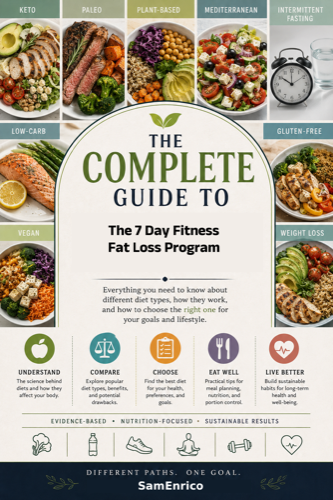 The Complete Guide to the 7 Day Fitness Fat Loss ProgramMinton Tristan$11.99
You may also like
 Teen Comparison Trap GuideDexter Kirsten$11.99
 Teen Comparison Addiction CureStackhouse Albertine$11.99
 Social Media Comparison LonelinessMancuso Fermina$11.99
 Meditation for Social Media ComparisonHudson Nora$11.99
 Facebook High School Reunion EffectGoldstein Tawana$11.99
 Facebook Envy Recovery PlanMaldonado Jorge$11.99
 Comparison Trap for ParentsPutman Jade$11.99
 Comparison Cessation GuideGage Annett$11.99
 Comparing Less Creating MoreStuckey Tiffiny$11.99
 Academic Competition PressureSinger Helga$11.99
 Social Status Self Worth GuideShook Gail$11.99
 Comparison Cessation WorkbookRansom Delmar$11.99