
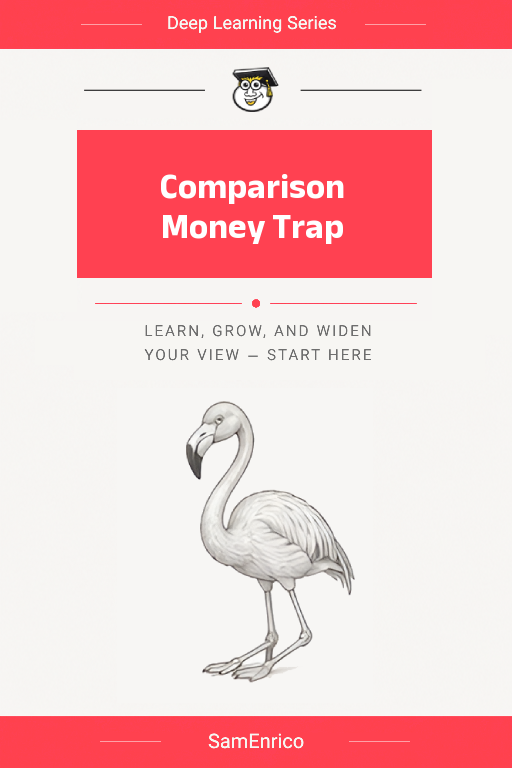
Non-FictionMental WealthSocial Comparison
Comparison Money Trap eBook
Unpack childhood competition around status, then p
by Oliver Rex
Unpack childhood competition around status, then practice values-based tracking that replaces comparison with personal enoughness.
Formats
Free sample
Chapter 1: The Status Famine--–- I was eleven years old when I learned that love is a ranking system.My brother, two years older, brought home a B-plus on his history exam. My parents didn't yell. They didn't punish. They didn't even sigh. They simply...
didn't look at him during dinner. The three of us ate in a silence so thick I could feel it pressing against my eardrums. My brother stared at his plate. My father read the newspaper propped against the salt shaker. My mother cut her chicken into smaller and smaller pieces, each one a tiny surrender.I brought home an A the next week.
My mother kissed my forehead. My father said, "That's my girl." That night, lying in bed, I understood something I didn't have words for but that my nervous system had already learned: attention is a zero-sum game. For me to be seen, someone else had to be invisible. For me to be worthy, someone else had to be insufficient.I am forty-seven years old now. I have a therapist, a mortgage, and a retirement account.
And I still feel that eleven-year-old girl sitting at the dinner table, calculating her worth in real time, measuring her safety by her rank.This book is about why you do the same thing with your money.The Dinner Table Never Ends Let me tell you a story about a man I'll call David. David is a software engineer in Seattle. He makes 210,000ayear.Hehasnocreditcarddebt,apaid−off Honda Civic,and210,000 a year. He has no credit card debt, a paid-off Honda Civic, and 210,000ayear.Hehasnocreditcarddebt,apaid−off Honda Civic,and400,000 in his 401(k). By any objective measure, David is wealthy.
By any historical measure, David is among the most financially privileged humans who have ever lived.David cannot sleep.When I met him—I am a financial therapist, though that title will make sense later—he told me about his neighbor, Mark. Mark is also a software engineer. Mark drives a Tesla. Mark just installed a backyard sauna. Mark took his family to Costa Rica over winter break.
David knows these details because David watches. He doesn't call it watching. He calls it "being aware of the market." He calls it "knowing my competition." He calls it "realistic benchmarking."But here is what David cannot see: Mark is $80,000 in credit card debt. Mark's sauna was financed at 18% interest. Mark cried in his car last Tuesday because he doesn't know how he will pay for his daughter's braces.
Mark's Instagram feed—the one David scrolls at 11:30 PM, jaw tight, thumb moving without consent—is a carefully edited museum of his regrets.David doesn't know any of this. David only knows that his neighbor's net worth appears to be rising, which means his own emotional wealth is crashing. David is trapped in what I call the Comparison Money Trap, and he is not alone.The Comparison Money Trap has a simple formula, one we will explore in depth throughout this book:Social Worth = Net Worth — (Neighbor's Net Worth)When the neighbor's net worth goes up, your social worth goes down—even if your own bank account has not changed by a single dollar. This is not logic. This is not rational self-interest.
This is a childhood survival mechanism dressed up in adult clothing, and until you see it for what it is, you will never have enough.Because here is the cruelest truth of all: the goalposts never stop moving.The Architecture of Scarcity Before we can dismantle the Comparison Money Trap, we have to understand how it was built. And the construction began long before you had a credit card, a mortgage, or even a concept of what money was.The trap was built in three specific childhood arenas, each one teaching you a different lesson about scarcity, worth, and survival. These arenas are so universal, so deeply embedded in our cultural water, that most of us don't even recognize them as training grounds. We think we just happened to become anxious about money. We think it's natural to compare our salaries, our homes, our vacations, our children's achievements.It is not natural.
It is conditioning. And conditioning can be unlearned.Arena One: Academic Ranking Think back to your elementary school classroom. Not the field trips or the art projects or the friends you played with at recess. Think about the rituals of evaluation. The spelling bee where you misspelled "necessary" in front of everyone.
The math contest where they posted the top ten scores on the bulletin board. The reading levels—colors or numbers or animal stickers—that divided the class into the fast readers and the slow readers, the gifted and the regular, the seen and the unseen.What did you learn in those moments? Not spelling. Not math. Not reading comprehension.You learned that your worth can be calculated.
You learned that there is a finite amount of approval to go around, and that you must compete for your share. You learned that to be good enough is not a stable state but a temporary position that can be taken from you at any moment.I call this conditioned belief Status Famine—the deep, pre-rational conviction that approval, love, and worth are scarce resources, and that you must hoard achievements the way a starving person hoards food.The child who wins the spelling bee does not feel secure. She feels provisionally safe—until the next spelling bee. The child who reads at a "purple level" does not feel proud. She feels relieved—until the reading levels are reassigned.
The trap is not the competition itself. The trap is the belief that competition is the only path to safety.And here is what no teacher told you, because no teacher knew: your nervous system cannot distinguish between the threat of a bad grade and the threat of a predator. The amygdala—that ancient, almond-shaped cluster of neurons deep in your brain—processes social exclusion using the same neural pathways it uses to process physical pain. A study from UCLA in 2003 showed that acetaminophen (Tylenol) actually reduces the emotional pain of social rejection. Let that land: your brain treats being left out of a birthday party the same way it treats a broken bone.Now fast-forward thirty years.
You are not facing a spelling bee. You are looking at your neighbor's new car. Your amygdala does not know the difference. It fires the same alarm: Danger. You are falling behind.
You will be excluded. You will not survive.This is not weakness. This is not greed. This is not a character flaw. This is biology.
And biology can be retrained.Arena Two: Performative Helpfulness The second arena is more subtle, and for many readers, more painful to examine. I am talking about what I call performative helpfulness—the child who learns that virtue is a performance for adult approval.Think about the language adults use with children. "You're being so helpful." "You're such a good listener." "I'm so proud of how mature you're being." These sound like compliments. And they are, in the sense that the adult genuinely intends to reinforce positive behavior. But there is a hidden curriculum embedded…
This is the end of the free sample. Get the eBook to keep going. Buy now
About this book
Details
- Author
- Oliver Rex
- Publisher
- SamEnrico
- Language
- English
- Genre
- Non-Fiction, Mental Wealth, Social Comparison
- Released
- 2026-06-01
- Pages (approx.)
- 141
- Available as
- eBook, Audiobook

Read better in the ZLOADR app
Your eBooks on your phone or tablet. Sign in with your SamEnrico account and start reading.
More by Oliver Rex
 Vitamin B1 Benfotiamine GuideOliver Rex$11.99
 Toxic Shame Origins GuideOliver Rex$11.99
 Senior Spiritual Self EsteemOliver Rex$11.99
 Annuity Buyer GuideOliver Rex$11.99
 Navigating Political TalksOliver Rex$11.99
 Anger Management AssertiveOliver Rex$11.99
 Self Hypnosis for CreativityOliver Rex$11.99
 Birth Control And Breast Cancer RiskOliver Rex$11.99
 The Battle of Kadesh Reforged: Egypt’s Lost War of the DeltaOliver Rex$11.99
 The Siege of Teruel: Blood on the Snow (1937-1938)Oliver Rex$11.99
 Javanese Cats: Siamese RelativeOliver Rex$11.99
 How to Start a College Planning Consultant BusinessOliver Rex$11.99
You may also like
 Hong Kong Handover 1997Dunn Johnnie$11.99
 Zumba For Postnatal Recovery CourseNeal Christian$11.99
 Zumba for BeginnersLadner Nikia$11.99
 YouTube Comment Mining GuideHumes Pandora$12.99
 Worry Box MeditationCarlin Rudy$11.99
 Workplace Stress MeditationNguyen Lynn$11.99
 Workplace Stress and Sleep RepairHawley Ivory$11.99
 Workplace Perfectionism CureDelaney Jeffry$11.99
 Workplace Injustice Anger GuideWallen Isabelle$11.99
 Work Addiction and Burnout LinkGreenwood Ester$11.99
 Women in Yoga and WellnessBeattie Galina$11.99
 Women in Stand Up ComedyChun Evangeline$11.99