
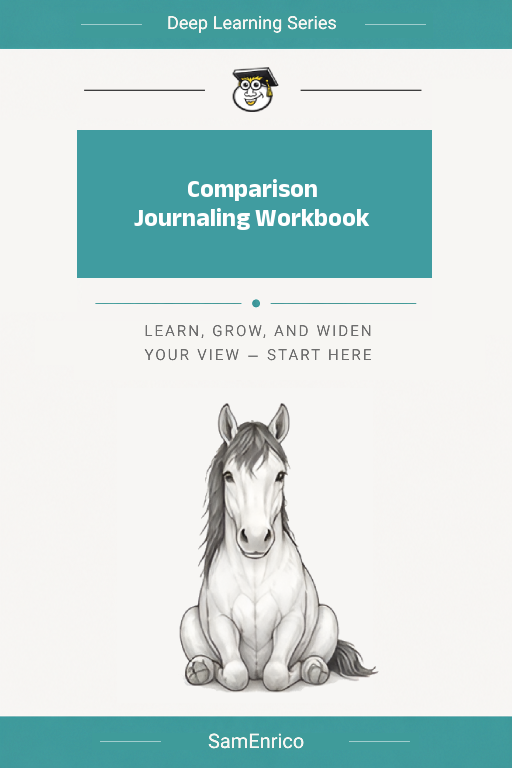
Comparison Journaling Workbook eBook
Track and reframe comparison thoughts using eviden
Track and reframe comparison thoughts using evidence based cognitive journaling techniques.
Formats
Free sample
Chapter 1: The Scroll That Stole Sunday--–- You were going to have a good day. Really. The plan was simple: coffee, a long walk, maybe finally start that book on your nightstand. Instead, you picked up your phone at 8:14 AM—just to check the weather—and somehow, at 11:47 AM, you found yourself staring at a stranger's vacation photos, feeling inexplicably worse about your own life. You've never met this person.
You don't even like the beach that much. Yet here you are, three hours gone, wondering why your bathroom tiles aren't marble and why your Saturday mornings don't look like a film still. Welcome to the comparison trap. This chapter isn't here to shame you about your screen time or lecture you about gratitude. You've already tried feeling bad about feeling bad, and it didn't work.
Instead, we're going to do something more useful: understand exactly what happened inside your brain during those three lost hours—and why none of it makes you weak, broken, or unusually vain.The Quiet Before the Scroll Before we talk about the science, let's talk about that Sunday. Not the one in the stranger's photos. Yours.Think back to the last time you felt genuinely content—not ecstatic, just quietly, unspectacularly fine. Maybe you were folding laundry while listening to a podcast. Maybe you were chopping vegetables and the light came through the window just right.
Maybe you were lying on the couch with no particular ambition other than to exist. In those moments, you weren't comparing. You were just being. And then something interrupted. A notification.
A memory. A passing glance at someone across the street. The comparison thought arrived not with a bang but with a whisper: She's further along than you. He figured it out younger. Their life looks easier.Here's what most people get wrong about comparison thoughts.
They assume these thoughts are a sign of moral failure—that if you were a better, kinder, more enlightened person, you simply wouldn't have them. That is not true. Comparison thoughts are not a character flaw. They are a neurological feature, installed by evolution long before you had a smartphone, a career, or even a concept of self. Your brain is not broken.
It is, in fact, working exactly as designed—for a world that no longer exists.The Ancient Alarm System To understand why you spent Sunday morning envying a stranger's vacation, you have to go back about 200,000 years. Picture this: a small band of humans on the savanna. No Wi-Fi. No influencer marketing. No Linked In.
But there was a problem: survival depended on knowing where you stood in the group. Who was strongest? Who had access to food? Who was likely to be protected in a conflict? The humans who paid attention to social rank—who noticed when someone else got a better piece of meat or a safer sleeping spot—were more likely to survive.
Not because envy feels good, but because it's useful. Envy is an ancient alarm system. It says: Attention. That person has something that matters. You should pay attention if you want to live.That alarm system never turned off.
It just got repurposed. Back then, "that person has something that matters" meant food, shelter, allies. Today, it means a promotion, a engagement ring, a renovated kitchen, a body that fits current beauty standards, a child who sleeps through the night, a retirement account that grows faster than yours. The alarm still screams. But the stakes are no longer life and death.
Your brain just hasn't gotten the memo.This is what psychologist Leon Festinger called Social Comparison Theory, first formalized in 1954. Festinger proposed that humans have an innate drive to evaluate themselves—and when objective measures aren't available, we compare ourselves to others. That last part is crucial: when objective measures aren't available. When can you objectively measure whether you're a good parent? Never.
When can you objectively measure whether you're successful? Not really. When can you objectively measure whether you're attractive, interesting, loved, or enough? You can't. So your brain does the next best thing: it looks around and guesses.Upward, Downward, and the Space in Between Not all comparisons are created equal.
Festinger distinguished between two directions of comparison, and understanding this distinction is the first real tool this workbook will give you.Upward comparison is when you compare yourself to someone you perceive as better off. That stranger's vacation photos? Upward comparison. Your colleague's promotion? Upward.
The friend whose children seem eerily well-regulated? Upward. Upward comparison is the one that usually hurts. It triggers feelings of inadequacy, envy, shame, and the vague sense that you're falling behind in a race you didn't sign up for.Downward comparison is the opposite: comparing yourself to someone you perceive as worse off. At least I'm not in that situation.
Well, my job isn't great, but at least I have one. My relationship has problems, but we're not like them. Downward comparison can provide temporary relief, even a hit of gratitude. But it comes with its own risks—complacency, schadenfreude (pleasure in others' misfortune), and a fragile sense of self that depends on someone else's suffering. We'll spend a full chapter on downward comparison later.
For now, just know that your brain does both, often without your permission, and each has a different emotional signature.But there's a third category that Festinger didn't name but that matters enormously for this workbook: lateral comparison. Comparing yourself to someone you perceive as equal. Same job title. Same life stage. Same fitness level.
Lateral comparisons are often the most painful because they feel the most fair. It's easier to dismiss a billionaire's lifestyle as irrelevant to your own. But your college roommate who also has two kids and also works full time? That comparison feels legitimate. And because it feels legitimate, it cuts deeper.The Highlight Reel Problem Now we have to talk about the elephant in the room: your phone.
Actually, not the phone itself. The phone is a tool. The problem is what lives inside it.Every social media platform—Instagram, Tik Tok, Linked In, Facebook, even the group chat where someone shares good news—has a structural feature that makes comparison harder to resist: the curated highlight reel. No one posts the fight they had with their spouse twenty minutes before the vacation photo. No one posts the three hours of crying in the bathroom before the "so grateful for this team" Linked In update.
No one posts the rejection letter, the failed business, the day the kids were feral, the credit card debt, the therapist's couch, the argument with their mother, the morning they couldn't get out of bed.What you see is not a lie. It's just not the whole truth. And your brain, which evolved to interpret what it sees as reality, forgets to apply the curation filter. You look at someone's feed and think: This is their life. But their life is also the unposted argument, the lonely Tuesday, the fear, the boredom, the ordinary.
The highlight reel is real—those moments happened—but they are not representative. Your brain treats them as if they are.This is not a moral failure on…
This is the end of the free sample. Get the eBook to keep going. Buy now
About this book
Details
- Author
- Nowlin Adelia
- Publisher
- SamEnrico
- Language
- English
- Genre
- Non-Fiction, Mental Wealth, Journaling
- Released
- 2026-06-02
- Pages (approx.)
- 120
- Available as
- eBook, Audiobook

Read better in the ZLOADR app
Your eBooks on your phone or tablet. Sign in with your SamEnrico account and start reading.
More by Nowlin Adelia
 The Compulsive Shopper WorkbookNowlin Adelia$11.99
 The Partner Apology Letter GuideNowlin Adelia$11.99
 Press Release Lead WritingNowlin Adelia$11.99
 Headache Prevention MeditationNowlin Adelia$11.99
 Uber Pro Status BenefitsNowlin Adelia$11.99
 Minority Shareholding FinesNowlin Adelia$11.99
 Melatonin Prescription GuideNowlin Adelia$11.99
 Warm Hands Blood FlowNowlin Adelia$11.99
 Spouse Death Life ReviewNowlin Adelia$11.99
 The Shadow of the Baobab: Africa's Forgotten Crime Writers of the 1980sNowlin Adelia$11.99
 Whispers of the Forgotten: The Last Words of the Library of AlexandriaNowlin Adelia$11.99
 The Queen’s Last Bow: A Crown of ResilienceNowlin Adelia$11.99