
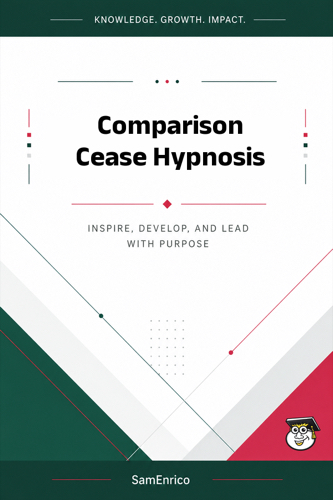
Non-FictionSelf-HelpComparison
Comparison Cease Hypnosis eBook
Builds confidence without comparing to others.
Builds confidence without comparing to others.
Formats
Free sample
Chapter 1: The Fossil in Your Phone--–- You are not broken. You are not weak-willed. You are not unusually vain or insecure. The urge to look at what someone else has and feel a pang of lack in your own chest is not a character flaw. It is a fossil.
Specifically, it is a Stone Age survival mechanism that has been dug up, dusted off, and shoved into the palm of your hand, where it now hums twenty-four hours a day. The problem is not that you compare. The problem is that your brain is running software from a time when comparing meant the difference between eating and being eaten. And the world has changed. Your operating system has not.This chapter exists to perform a single, essential surgery: the separation of the act of comparing from the shame about comparing.
Most self-help books begin by telling you that comparison is bad and you should stop. That is like telling a person drowning that water is wet. You already know it hurts. What you do not know is why your brain cannot seem to quit. By the time you finish this chapter, you will understand the evolutionary logic of the status snare, the critical difference between two very different activities that most books confuse, and why your phone is not a device but a hallucinogen.
You will also receive the first practical tool of this book: a twenty-four-hour log that will show you, in black and white, the difference between the machine that keeps you safe and the machine that keeps you trapped.The Crab Bucket and the Savanna Brain Imagine a bucket full of crabs. One crab begins to climb toward the top, seeking escape. What do the other crabs do? Do they cheer it on? Do they learn from its technique?
No. They reach up and pull it back down. If any crab gets too close to freedom, the collective drags it back into the scramble. This is called the crab bucket mentality, and it is not a metaphor for human behavior invented by a cynical philosopher. It is a literal description of how certain species behave under crowding and resource scarcity.
And human beings, under the right conditions, do the same thing. Not because we are evil. Because we are social mammals who evolved in environments where standing out too much got you killed.Let us travel back. Not three hundred years. Not three thousand.
Go back two hundred thousand years, to the African savanna. You live in a tribe of perhaps fifty to one hundred fifty people. Your entire world is these faces, these voices, these bodies. Your survival depends on three things: food, shelter, and your position within the tribe. If the tribe rejects you, you die.
Exile was a death sentence. So your brain evolved a relentless, automatic, nonstop social radar. Who is stronger? Who has more food? Who is the tribe favoring today?
Who is losing status? This radar never turned off. It could not afford to. The stakes were literally life and death.That radar is still running inside your skull. It is running right now, as you read this sentence, scanning for threats and opportunities in your social environment.
The only problem is that your social environment no longer contains fifty people. It contains billions. And your radar, which was designed to compare you to the two or three people in your immediate band, is now comparing you to movie stars, billionaires, fitness influencers, former classmates you have not spoken to in fifteen years, and a nineteen-year-old on Tik Tok who just bought a house. Your brain does not know that these people are not actually in your tribe. It does not know that their success does not threaten your access to food or shelter.
It only knows the algorithm: scan for status, feel the pang, adjust behavior.This is what we call the status snare. You are caught in a trap that your own evolution built, and the trap has been supercharged by technology that did not exist when your neural hardware was last updated. You are not weak for feeling it. You are human.The Critical Distinction: Benchmarking Versus Worth-Comparison Before we go any further, we must draw a line that most books on this topic refuse to draw. They say, "Stop comparing yourself to others." But that is impossible.
You cannot stop. Your brain will compare heights, salaries, speaking ability, parenting style, physical fitness, and a thousand other dimensions before breakfast. The goal is not to stop comparing. The goal is to understand what kind of comparing you are doing.Let us introduce two terms that will appear throughout this book. The first is benchmarking.
Benchmarking is the act of looking at another person's methods, strategies, or results to learn how to improve your own skills. It is neutral. It is information-seeking. When a young basketball player watches footage of Michael Jordan's footwork and says, "I see how he shifts his weight before the jump, I will practice that," that is benchmarking. No self-worth is attached.
No shame is generated. The second term is worth-comparison. Worth-comparison is the act of looking at another person's outcomes and using them to assign a value to your own existence. "They have more followers, so I am less important." "They make more money, so I am less successful." "Their body looks different, so I am less attractive." This is not information. This is ranking.
And ranking is where the poison lives.Here is the distinction in a single sentence: benchmarking asks, "What can I learn?" Worth-comparison asks, "What does this say about me?" The first leads to growth. The second leads to paralysis. The first is a tool. The second is a trance.The problem with most self-help advice is that it tells you to stop comparing entirely, which is like telling your heart to stop beating. Your brain will compare.
That is its job. The question is whether you can learn to recognize the difference between a benchmarking thought and a worth-comparison thought before the latter drags you into the crab bucket. This chapter is the beginning of that recognition.Why Your Phone Is a Hallucinogen Now we arrive at the most uncomfortable part of this chapter. The phone in your hand—or on the table beside you, or in your pocket—is not a neutral tool. It is a pharmacologically active substance.
Not in the chemical sense, but in the neurological sense. Every time you open Instagram, Facebook, Tik Tok, or Linked In, you are ingesting a dose of a drug called social comparison. And the people who built these platforms know exactly what they are doing.Let us look at the numbers. The average person spends over two hours per day on social media. During that time, they see hundreds of carefully curated highlights from the lives of others.
Weddings, promotions, vacations, new homes, fitness transformations, perfect children, flawless meals. What they do not see are the arguments, the debt, the failed projects, the crying in the bathroom, the marriage counseling, the anxiety medication, the nights spent staring at the ceiling. This is the highlight reel effect. Every person…
This is the end of the free sample. Get the eBook to keep going. Buy now
About this book
Details
- Author
- Cervantes Celine
- Publisher
- SamEnrico
- Language
- English
- Genre
- Non-Fiction, Self-Help, Comparison
- Released
- 2026-06-05
- Pages (approx.)
- 142
- Available as
- eBook, Audiobook

Read better in the ZLOADR app
Your eBooks on your phone or tablet. Sign in with your SamEnrico account and start reading.
More by Cervantes Celine
 Digital Calendar Review GuideCervantes Celine$11.99
 Stress Reducing ConversationCervantes Celine$11.99
 Menopause And Alcohol GuideCervantes Celine$11.99
 Learning Instruments After FiftyCervantes Celine$11.99
 The Personal Brand Voice GuideCervantes Celine$11.99
 Theme Day Scheduling StrategyCervantes Celine$11.99
 Meeting Parking Lot DigitalCervantes Celine$11.99
 The Compound: Inside the Prison That Became a CultCervantes Celine$11.99
 Pizarro's Gambit: The Fall of the Inca Empire (1532)Cervantes Celine$11.99
 Exploring Egyptian Art: Hieroglyphs, Tombs & StatuaryCervantes Celine$11.99
 Mastering Subsidy: Government Payment SystemsCervantes Celine$11.99
 How to Produce a PlowshareCervantes Celine$11.99
You may also like
 Hong Kong Handover 1997Dunn Johnnie$11.99
 Zumba For Postnatal Recovery CourseNeal Christian$11.99
 Zumba for BeginnersLadner Nikia$11.99
 YouTube Comment Mining GuideHumes Pandora$12.99
 Worry Box MeditationCarlin Rudy$11.99
 Workplace Stress MeditationNguyen Lynn$11.99
 Workplace Stress and Sleep RepairHawley Ivory$11.99
 Workplace Perfectionism CureDelaney Jeffry$11.99
 Workplace Injustice Anger GuideWallen Isabelle$11.99
 Work Addiction and Burnout LinkGreenwood Ester$11.99
 Women in Yoga and WellnessBeattie Galina$11.99
 Women in Stand Up ComedyChun Evangeline$11.99