
Non-FictionSelf-HelpCommute Productivity
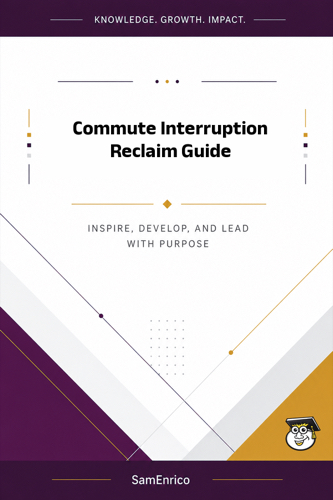
Commute Interruption Reclaim Guide eBook
Turn travel time into focused time using these pra
by Allan Quinn
Turn travel time into focused time using these practical mobile productivity strategies.
Formats
Free sample
Chapter 1: The 225-Hour Ghost--–- You are losing nine full days of your life every year, and you have probably never noticed.Not nine days of low-grade waiting, like time spent in a dentist’s reception area. Not nine days of deliberate rest, like a proper vacation. Nine full, twenty-four-hour cycles of waking life during which your brain is active, your heart is beating, your hands are scrolling, and yet you are not truly living, working, resting, or connecting. You are simply enduring. And the most unsettling part is this: you have learned to mistake that endurance for normal life.Let us run the numbers together, slowly, because this calculation is the single most important fact in this entire book.
The average full-time worker in the United States commutes fifty-four minutes per day, round trip. That figure comes from the United States Census Bureau and has been remarkably stable for two decades, fluctuating by only four minutes despite changes in remote work, fuel prices, and public transit investment. Fifty-four minutes. Not an hour, not fifty minutes. Fifty-four.
That specific number matters because it is just short enough to feel insignificant and just long enough to steal something irreplaceable.Multiply fifty-four minutes by five working days. That is four hours and thirty minutes per week. Multiply by forty-nine working weeks per year, accounting for two weeks of vacation and one week of sick leave and holidays. You get two hundred twenty hours and thirty minutes. Round down to two hundred twenty-five hours for the sake of clean math, though the truth is actually slightly worse.
Two hundred twenty-five hours divided by twenty-four hours per day equals 9.375 days. Let us call it nine days.Now let us make that number real. If you commute from age twenty-two to age sixty-seven, a standard forty-five-year career, you will spend 10,125 hours in transit. That is 421 full days. That is one year, one month, and twenty-six days of continuous, nonstop commuting.
Not spread out over weekends. Not interrupted by sleep. Four hundred twenty-one sunrises and sunsets, spent in a car, on a train, on a bus, or standing on a platform, breathing recycled air and waiting for the doors to open.Stop here for a moment. Imagine taking an entire year of your life—your thirty-fifth year, say—and removing it completely. You do not get that year.
You do not hold your children during that year. You do not advance your career, learn a language, fall in love, write a novel, or sleep well. You simply sit in transit. That is the true cost of the modern commute. And the vast majority of commuters have no idea they are paying it.But the problem is worse than the raw numbers suggest.
Because if you were actually using those 225 hours per year for something valuable—learning, thinking, resting, creating—this book would not need to exist. The tragedy is not that you commute. The tragedy is what you do during the commute. And that is where the 225-Hour Ghost makes its first appearance.The Semi-Conscious Scrolling Epidemic Let me describe a scene that will feel familiar to the point of discomfort. You board your train, or you buckle your seatbelt in traffic, or you find a plastic seat on a lurching bus.
The doors close. The vehicle begins to move. And within thirty seconds, your phone is in your hand. You do not decide to pick it up. Your hand simply goes there, the way your foot finds the brake pedal without conscious thought.
The screen lights up. You open an app. Any app. Instagram, Twitter, Reddit, Linked In, a news site, a puzzle game, work email—the specific destination does not matter. What matters is the motion: unlock, scroll, tap, scroll, tap, scroll, scroll, scroll.Forty-five minutes pass.
The vehicle stops. You look up, disoriented, as though waking from a nap that left you more tired than before. You close the app. You stand. You walk to your destination.
And later, if someone asks what you did on your commute, you say, "Nothing. Just scrolled." That answer is a lie, but not a deliberate one. You have genuinely forgotten. The scrolling produced no memory trace because it produced no meaning.This is the 225-Hour Ghost. It is the ghost of time that passed through your body without touching you.
It left no mark, no learning, no rest, no relationship, no progress, no peace. It simply evaporated, and you were left with slightly sore thumbs, slightly dry eyes, and a vague sense of having already worked a full day before you arrived at work.The behavioral scientists at the Center for Humane Technology have a name for this phenomenon: "compensatory internet use." The theory is straightforward. The commute is a liminal space—a transition zone between the home self and the work self, between private and public, between rest and labor. Human beings are deeply uncomfortable in liminal spaces. We crave anchors.
The smartphone provides an infinitely renewable anchor. Every scroll is a tiny decision to stay tethered to something, anything, rather than float untethered through the strange in-between. But here is the cruel irony: the anchor that feels like comfort is actually a weight. And that weight is actively harming you.The Cortisol Before Dawn Let me introduce you to a hormone called cortisol. You have heard of it.
It is the body's primary stress hormone, released by the adrenal glands in response to threats, real or imagined. Cortisol is not evil. It evolved to save your life. A spike of cortisol sharpens your senses, floods your muscles with glucose, and temporarily suppresses non-essential functions like digestion and immune response. In a true emergency—a car swerving toward you, a predator in the bushes—cortisol is the difference between survival and death.But the human body cannot distinguish between a sabertooth tiger and a passive-aggressive work email.
Physiologically, they are identical. Both trigger the hypothalamic-pituitary-adrenal axis. Both release cortisol. Both prepare you for fight or flight.Now consider what you do on your commute. You open work email.
You see a message from a colleague that implies (but does not state) that you missed a deadline. You read a news headline about layoffs in your industry. You scroll through Linked In and watch a former coworker announce a promotion at a company that rejected you. You check Slack and see fourteen unread messages in a channel where you are not sure if you are expected to respond.Your brain processes each of these as a micro-threat. Not a full threat—you are not running from an actual tiger—but a trickle of low-grade, persistent, anticipatory stress.
And here is the physiological fact that changes everything: the cortisol system does not have a "low-grade" setting. It turns on or it turns off. Once activated, cortisol remains elevated for ninety minutes to two hours, even if the original trigger was a single mildly annoying email.So here is what happens on a typical commute. You sit down. You open email.
You see something mildly annoying. Your cortisol rises. You scroll for forty-five minutes, accumulating a dozen more micro-threats along the way. By the time you arrive at…
This is the end of the free sample. Get the eBook to keep going. Buy now
About this book
Details
- Author
- Allan Quinn
- Publisher
- SamEnrico
- Language
- English
- Genre
- Non-Fiction, Self-Help, Commute Productivity
- Released
- 2026-06-06
- Pages (approx.)
- 116
- Available as
- eBook, Audiobook

Read better in the ZLOADR app
Your eBooks on your phone or tablet. Sign in with your SamEnrico account and start reading.
More by Allan Quinn
 Chunking for Mind MappingAllan Quinn$11.99
 Self Hypnosis Counting Method HandbookAllan Quinn$11.99
 Fitness Breathing BasicsAllan Quinn$11.99
 The Anger White Flag ProtocolAllan Quinn$11.99
 The Sky Splitter: When the Gods FellAllan Quinn$11.99
 Beyond the Stars: The Untold Story of Asia's Space PioneersAllan Quinn$11.99
 Front Office AssistantAllan Quinn$11.99
 No Estimates Kanban for BasecampAllan Quinn$12.99
 Best AI Art Midjourney StylesAllan Quinn$12.99
 Understanding Endometrial Stromal SarcomaAllan Quinn$17.99
 How to Start a Precious Stone Cutting Business (Beginners Guide)Allan Quinn$11.99
You may also like
 Hong Kong Handover 1997Dunn Johnnie$11.99
 Zumba For Postnatal Recovery CourseNeal Christian$11.99
 Zumba for BeginnersLadner Nikia$11.99
 YouTube Comment Mining GuideHumes Pandora$12.99
 Worry Box MeditationCarlin Rudy$11.99
 Workplace Stress MeditationNguyen Lynn$11.99
 Workplace Stress and Sleep RepairHawley Ivory$11.99
 Workplace Perfectionism CureDelaney Jeffry$11.99
 Workplace Injustice Anger GuideWallen Isabelle$11.99
 Work Addiction and Burnout LinkGreenwood Ester$11.99
 Women in Yoga and WellnessBeattie Galina$11.99
 Women in Stand Up ComedyChun Evangeline$11.99